

We're Not Experiencing Art Like We Used To
A new column from our editor in chief
Culture is a vague term used to describe an array of strange behaviors, interests, and interactions. Culture has a list of symptoms: events in white rooms, events in dark rooms, feelings of self-importance in otherwise unexceptional people, the average contemporary screen time, questionable outfits. There is no defining something like this. There is only what you believe it is about.
I asked a bunch of people what culture is about. One of them looked at his phone for a moment and then without looking up said “the arts and other manifestations of human intellectual achievement, regarded collectively.” Someone else said “looking cool and good.” “It’s like fashion and…that sort of thing.” “The things we think we do for fun and passion.” “Multiple things, obviously.” It’s funny that we don’t know. Maybe that’s why we’re interested.
As someone afflicted by not only cultural interest, but its matured form of cultural employment (and someone possessed, I have been made to understand, of exceptional naivete), I want to say that culture is about art. This is a good answer for several reasons. It is unlikely to make you kill yourself. It justifies the debasements of consumption, media, and bad society that comprise most of culture’s actual character. And it is structurally accurate; art (of some sort) is at the center of most cultural industries.
Culture would also like to give you the impression that it is about art. This is because art’s importance is potentially the most common conviction there is, apart from anomalies like the merits of good sleep and intercourse.
Like any consensus, our belief that art is important is an empty habit. We don’t really buy it. It’s clear in how we spend our time, our attention, and our money. Clear in the work we celebrate and the people we employ to do so. In the informational placards and the mission statements of the museums they hang in. It is abundantly clear: our collective and cultural belief in art’s importance has become a routine of thought, hollow dogma.
Consider the last handful of experiences with art (henceforth: aesthetic experiences) you’ve had, and in the privacy of your own reflection assess their quality. It’s hard to feel moved by a painting on a screen, a preview of a music video, a single scene of a movie, or anything else to which you can apply only half of your attention for half of a second.
Meanwhile, culture suffers. Diagnoses of this blight are rampant and the culprits are nasty, but look to the structural center. If culture is about our interactions with art, should we not consider the possibility that these interactions are where cultural sickness begins? That our cultural maladies are downstream of them?
Today, we have an aesthetic experience problem. I believe that it is the fundamental cultural problem of our era. So when I was recently obliged to conceptualize a thematically coherent column about ‘culture,’ my first and only thought was to investigate it.
Perhaps this sounds abstract. Aesthetic experiences are admittedly hard to talk about. They are mysterious. They can be transcendent and banal and sometimes both. They can involve thought and sensation and sometimes neither. They are transient, yet they stick with us. If a dementia patient who hasn’t recognized her husband in months being able to ace the dance choreography she learned fifty years ago when its song comes on is any indication, they may be the last thing that does.
But aesthetic experiences are not abstract. Saying what a movie or a song is ‘about’ is abstract. Aesthetic experiences are felt and immediate. Aesthetic experiences do not require you to grasp every finer technical and critical detail. They do require your attention, time, and focus. These are not demands today’s world often makes, so if you want to have meaningful aesthetic experiences you’ll have to demand them of yourself. I intend to make the argument that you should.
This is Looking Up, a column about the state of the contemporary aesthetic experience.
-
What exactly an aesthetic experience is is the subject of several centuries’ debate. It is a term laden with the burden, unique to academia, of a dozen nearly identical definitions. I will now briefly clarify the sense in which I’ll be using it, along with several other frequently appearing concepts.
An aesthetic object is similar to, but not synonymous with, the word ‘artwork.’ The most famous definition, and the one I’ll be using, comes primarily from Jerome Stolnitz:1 an aesthetic object is anything we contemplate with an ‘aesthetic attitude,’ which is just a kind of open focus that ignores the pragmatic usefulness of an object. The aesthetic attitude does not consider a painting’s possible function as a cutting board, nor a movie’s box office success. It only assesses an object’s aesthetic qualities, i.e. how it is perceived by the senses, what it might express, what this expression might mean, and so on.
Aesthetic objects are therefore defined not by intrinsic properties, but relational ones. Anything can be an aesthetic object, which will make sense to anyone who has been struck by the beauty of a produce display at the grocery store, or from whose broken pen has sputtered a glut of ink with intriguing formal qualities. These are not ‘artworks’, but they can be aesthetic objects2, if we open ourselves to considering their aesthetic properties.
When we bring an aesthetic attitude to an object, thereby making it an aesthetic object, an experience often emerges. This could be a physical sensation, an emotion, a mental image, an epiphany, a memory. These experiences are aesthetic experiences.
-
It is probably immediately obvious, based on the above definitions, where contemporary problems with aesthetic experiences start. An aesthetic attitude, the key that unlocks an aesthetic experience, requires (at least) attention, focus, and time, all of which are under significant pressure in daily life. This pressure is particularly intense when scrolling on social media, which is where the majority of our contemporary aesthetic encounters are taking place. Sometimes the obvious answer is the one to start with. This first column is about scrolling’s effect on aesthetic experiences.
-
For the last two years, with the help of my colleagues, I’ve been building an exceptional burner account on Instagram. I use this account to stay up to date on various cultural concerns, discover new artists, and generally succeed in my work. I have scheduled scroll time. To maximize my exposure, I scroll quickly.
The rapid sequential replacement of stimuli while scrolling is the definitive aesthetic consumption style of our time. Anyone attempting to distribute an artwork digitally must reckon with it. Rational artists make artworks that can deliver an experience in the single second of attention they expect to receive. Ideally, this quick hit expands viewing duration.
Works that do this successfully are sometimes called ‘thumb stoppers.’ The term came from marketing. Lately it’s been artists saying it. Even if they aren’t, they’ve internalized the logic.
The thumb-stopping imperative is the primary conditioning force of aesthetic distribution and aesthetic experiences on social media, and has several particularities that bear further consideration.
Stopping a thumb is a task often left to sound. On today’s Instagram, if you encounter a static image at all, it will be accompanied by an audio snippet. There is an art to selecting the snippet that will create a pause of maximum duration. There is also an art to aligning the content of the snippet to the content of the post. Posts with audio become multi-sensory aesthetic collages, combining two aesthetic objects to create a single aesthetic experience.
Bad audio selection feels cheap, a transparent attempt to make you feel something specific. Good audio selection can be genuinely powerful. Hardened as our hearts are today to the virtues of Aphex Twin and Radiohead, who among us has not choked up by a melancholic photo series set to ‘#3’? Audiovisual Instagram posts have made me feel swells of ego and the pangs of anger, have reminded me of higher goals and aspirations, made me want to make a drastic change in my life.
If snippets are intended to elongate and transform a viewer’s experience with visual material, music videos on Instagram are the conceptual inverse. In these cases, the visual content of the post is designed to stop people long enough to absorb the auditory content of the song.
The ways to do this are numerous and diverse. “You’re giving me at least five seconds for that” was a musician I was interviewing’s defense of his decision to commission a custom supersuit. Editing style is a more common strategy. In Fakemink’s “fml .” video, no shot exceeds 5 seconds in duration, and most are shorter than 2.
On the other end of this spectrum is Bladee’s ‘Ingen hör’ music video, which is a single shot3 that tracks him at varying proximity with a strange shudder and disorienting continuous refocus. Concrete, bare trees, cloudy day. You never quite make out his face in the shadow of his hood. For some reason, this successfully stopped my thumb. Later I showed it to my friend who actually knows how to make music videos. “See the problem with this,” he said, “is that I would have already turned it off.” Our thumbs all stop for different reasons.
-
Music videos are fundamentally ornamental, secondary to a primary aesthetic object (the song). Attention-grabbing is baked into their essence, and so they’re resistant to the debasement of thumb-stopping. Static artworks probably suffer the most.
In an as-yet unreleased interview, Lorenzo Amos (one of the art world’s brightest young stars) said “painting is about surface. Surface isn’t something you can understand through a screen.” Lucy Bull, another contemporary painter, thinks screen viewing has degraded our ability to engage with paintings at all. “People don’t really know how to look at them anymore. Looking at a photo of a painting is a completely different experience.”
The flat glass of the screen skews the artworks that succeed. Countless are the times, presumably, that I have scrolled right past a work unimpressive on my screen that in a different environment of physical confrontation might have made an impact.4 This selection isn’t only a consumer-side issue. I’ve spoken with multiple artists who say that considering whether a work will photograph well is ingrained into their ideation process.
An emergent property of works made in this context is a split personality disorder, wherein the attention-grabbing aesthetic content (color, macro composition) is sometimes literally in visible tension with the aspects of work designed for more robust focus (micro composition, style, thematics).
One way to stop a thumb with a static artwork is to show people something that offends them. Making iconoclastic art today is incredibly difficult because we’re out of undefiled icons. The church and the state are both irrevocably weakened, as is every moral precept I am personally familiar with. Woke 1 offered some candidates which have all lost their shine. There is nothing that matters to anyone that has not been disrespected by some artist somewhere.
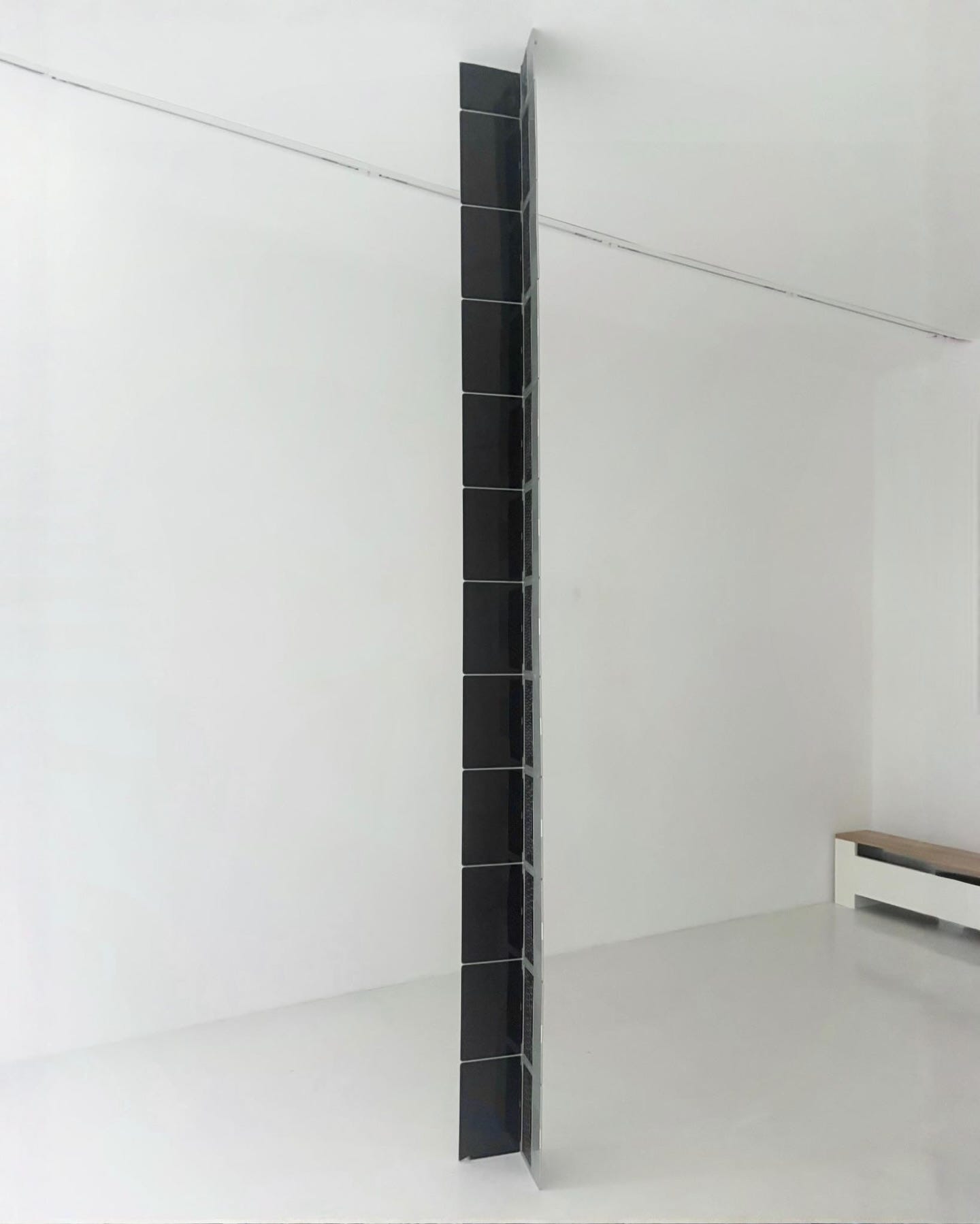
The closest thing we have to a sacred iconography is probably Apple products. The first work I saw by Mika Ben Amar was a Macbook Air skewered by a sword, and my thumb stopped immediately. My aesthetic experience with this work, as well as Amar’s subsequent work which stacked eleven and a half Airs side-on-side floor-to-ceiling, was defined by a conflicting discomfort and release characteristic of iconoclasm. A visceral reaction to seeing these devices destroyed is understandable. There are few objects whose destruction promises more personal inconvenience.
Alexander Endrullat is the quintessential Apple sculptor. In his works, the structural integrity of Macbooks, iPads, and iPhones breaks down entirely5. They hang over clotheslines and bend around corners.
But iconoclasm has always been a shallow aesthetic strategy. At its best it can create an ambivalent experience, but this generally diminishes as the thrill wears off. I expect that my thumb will soon move unhindered over bent laptops.
-
The shortcomings of aesthetic experiences in the scroll mode are many, but there are also interesting aspects. Scroll quick enough and disparate aesthetic objects begin to blur, and an accretive aesthetic experience emerges. Accretive aesthetic experiences of this sort are often tainted by the overstimulation and negative emotions social media is designed to deliver, but this is the fault of the platforms and the content, not the mode. An accretive aesthetic experience is a fascinating thing, and one productive horizon presented by our current method of consumption.
Accretive aesthetic experiences are not only possible digitally. This fall, while in Prague, a city whose public art collection is thematically and physically segmented between several historic buildings, I visited the Convent of St. Agnes of Bohemia which houses the permanent exhibit ‘Medieval Art in Bohemia and Central Europe 1200 - 1550.’
When I arrived, the Convent was entirely empty other than a group of American highschoolers being forced to give short presentations on various significant artworks by a Czech chaperone. After they invariably fumbled the Czech’s follow-up questions he would step to the front of the group to deliver a heavily accented and superior analysis.
This is one way to approach a museum. My preference, which was easier done once I overtook the gauntlet of body spray characteristic of teenage Americans in foreign countries, is to move from painting to painting at roughly equal intervals, standing square to it and adjusting my distance based on its size and composition, attempting to clear my mind and ignore informational placards.
Under normal curatorial conditions, the diversity of aesthetic objects keeps these aesthetic experiences separated. But large collections of religious paintings have comparatively little diversity, especially when they are focused on a particular period of time in a particular part of the world. This homogeneity can be further intensified by curatorial decisions, such as, in the Monastery, the choice to set up about twenty ‘Madonna with Child’ paintings in close proximity.
This remarkable series began in one room with several distinguished and well-lit pieces, continued down a dim hallway lined with Madonnas of lesser quality, and ended in a second gallery room with several more, broken up by a Crucifixion here and there.
The paintings varied minimally, and created a formal mold in my short-term memory, so that each new work textured an ongoing mental image. The result was a single stacking aesthetic experience stitched together of subsequent paintings. A feeling of satisfaction accompanied the stacking, like puzzle pieces fitting.
Different artists emphasized different characteristics of the paintings’ subjects. Mary was at turns stolid, motherly, forlorn, or fearful. Artists have always had a hilarious time trying to paint baby Jesus, and his facial structure varies from an entirely adult skeletal distinction to a prefetal ambiguity. Sometimes he regards the viewer, others Mary. Often, he is raising his hand in benediction.
Madonna with Child is a simple format of great depth. The relationship between Mary and Christ specifically contains the mystery of immaculate conception and God in human flesh. This is something large. The succession of paintings at the convent embodied the attempts of numerous individuals over hundreds of years attempting to articulate this single big thing.6 It is a telling done by diverse aesthetic and spiritual perspectives working under a variety of societal conditions. Each version is a unique perspective. Consumed in sequence, these perspectives were collected into a single aesthetic experience with immense texture.
The scale of what this sequence of paintings was able to convey to me is something that only a rare few paintings can capture on their own. But it does sometimes happen. Raphael’s Madonna del prato, which I encountered several days later in Vienna, is one example.
Raphael’s Madonna places its subjects in an idyllic green rolling field set off from the human world by fine blue mist. Mary is supporting Jesus with both hands, but her downward gaze is trained on St. John, whose cross Jesus is reaching for. From the hem of Mary’s deep blue robe, a single slender white foot extends.
Mary’s downgaze is difficult to parse, perhaps one of subtle approval or even amusement. The supportive hands, the stolidity of her garb, the tenderness of her gaze all create a sense of peace, stability, and safety. Christ, at her feet, off balance and reaching, is already embodying the commitment of his passion, and facing the limitations of his human form.
The tragedy is there in Christ’s imbalance, in the buildings behind. So too is divine love and the natural beauty of God’s creation. A sense of peace and safety permeates the field. A magnetism, that becomes yearning, that becomes desperation. I wanted it, the field and the peace. First it was an upwelling of tenderness and desire. It broke into something like heartbreak.
But it was partial, and fast. The museum was hot, and people kept coming to my shoulder to read the placard. I promptly left, and on my way out encountered the phenomenon, common to every central European museum, of dressed up young women having their photograph taken on the grandest stairwell available.
-
“Culture is about what is meaningful to people in a given moment.” Perhaps aesthetic experiences just aren’t. Hard to blame anyone without getting sanctimonious. And if there is one thing that culture won’t put up with for long, it’s sanctimony.
But also: “Culture is an attempt to make human life a meaningful experience on a collective scale through the search for a common understanding of what life is, what makes it worth living, and how it should be shaped as a result.” For generations, aesthetic experiences have been an integral part of that attempt.
I know a guy who felt despair in front of an Edvard Munch it took him days to get out of. I saw the end of It’s A Wonderful Life make my whole family cry. Someone I spoke to recently said that for the first time in their lives they understood what a human being is while reading a Dostoyevsky novel. These are not trivial things. Everything written here is just the start.
Who is developing Kant's if you care.
And to ward off any later confusion, an aesthetic object does not need to be material. A song, for instance, can very much be an aesthetic object.
The two poles represented by these videos embody a more general dichotomy in content made today, namely that which doggedly purses attention in its ever greater breakdown, and that which goes the opposite way. In the former category, consider a film broken into 30 second clips, and in the latter a marathon stream. In some ways they represent two different sides of the same atrophy.
A salutary question whenever we begin to complain about the lack of quality in contemporary art: are we confident we would recognize it?
We’ve written previously about how the Bauhaus adage of form following function has broken down in our technological reality where immense function requires no form at all. Invisible function is archetypically embodied by Apple products, those attractive sheets of metals and glass, of zero formal suggestion and infinite contents.
Just one fraction of the even larger project of religious painting in general, which has conscripted innumerable individuals over a far greater diversity of conditions and is humanity’s greatest collective storytelling project.


