

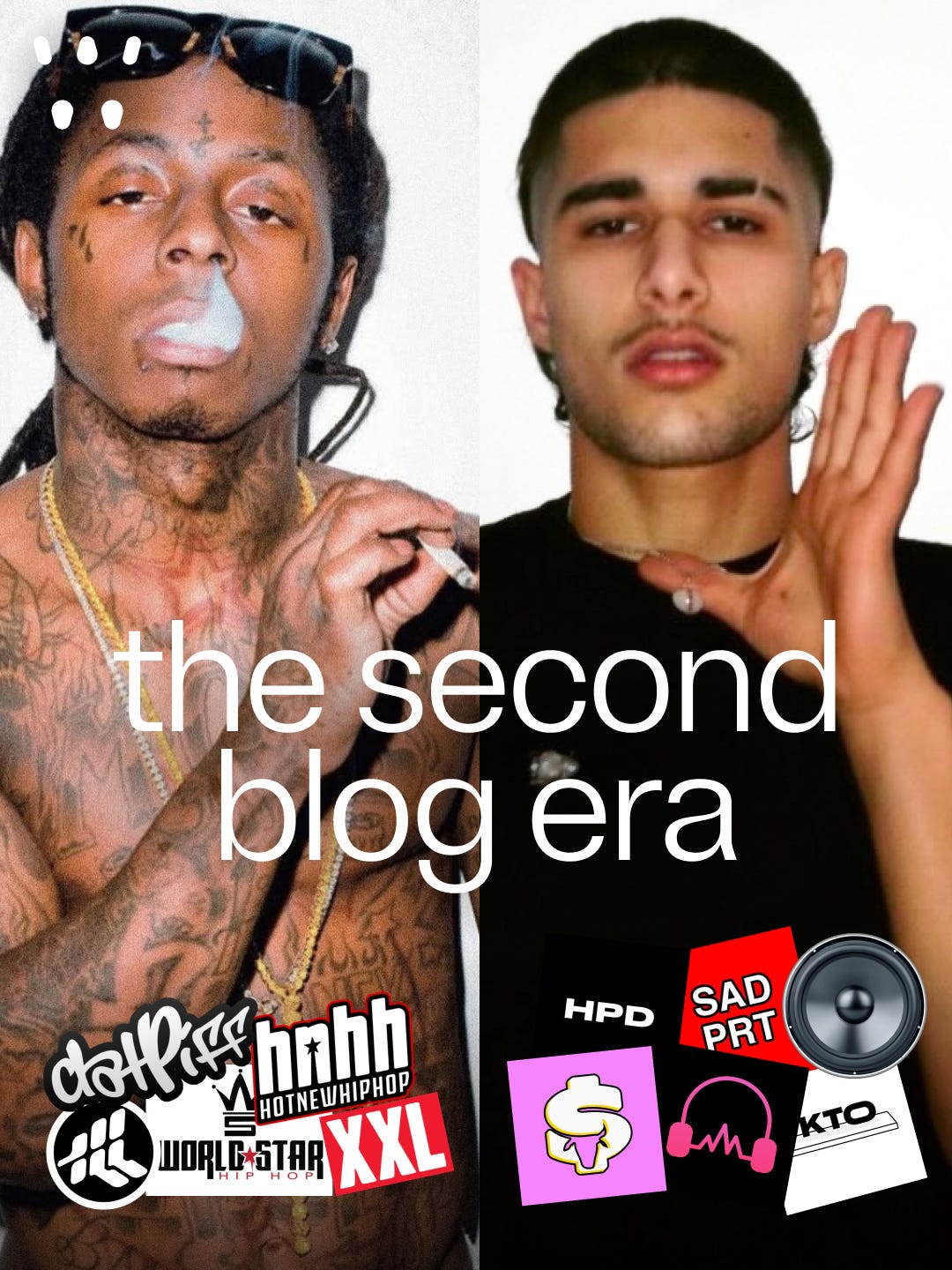
Welcome To The Second Blog Era
A deep dive on the roots and voices of our new cultural age
Something exciting is happening in cultural media, if you know where to look. From the culturally flattened desert of major media platforms is springing new life: Instagram pages showcasing emerging artists and eclectic fashion; independent Substacks blogging to devoted followings; a new generation of scene photographers mythologizing subcultures in real time. We are living in the Second Blog Era. Just not everybody knows it yet.
You’ve heard of the ‘blog era’ (henceforth referred to as the First Blog Era). Probably, you have a romanticized idea of this period, one filled with grungy early underground live shows, vibrant Tumblr forums, and a sense of early 2000s cultural optimism.
During the First Blog Era, roughly 2004 - 2014, the internet’s adoption by creatives created a fertile environment for new scenes and aesthetics like Twee, (what is now referred to as) Indie Sleaze, Midwest Emo, Scenecore, and early Swag. Early internet style blogs like Tumblr, KanyeToThe, and Flickr defined these new movements, and established communities around them.
But over the past two decades, both the internet and the culture moving through it changed. Curation, once decentralized across hundreds of independent blogs and guided by human taste, became increasingly commodified as algorithms prioritized corporate efficiency and user convenience. Feeds became centralized, making it easier for corporations to push out polished paid partnerships and covert industry plants. A few massive pop culture pages like Complex, Worldstar, and Genius dominated coverage.
Today, things are changing again. While it is true that a few major clearnet platforms continue to host cultural material, there has been a shift away from centralized, commercial, mass-market distribution towards decentralized, human-to-human, taste-driven curation. Blog-era aesthetics and taste-sharing modes have resurged. TikTok-driven discovery, algorithm fatigue, and AI slop content have reignited desire for thoughtful, human-led coverage. Legacy cultural platforms like Vice and Pigeons and Planes have been revived.
This isn’t just nostalgia—it’s the return of decentralized discovery systems and the prioritization of individual taste that defined the First Blog Era. It is a renaissance in taste-sharing. This is the Second Blog Era, and it has implications for every cultural industry.
What the First Blog Era looked like, why we lost it, and what replaced it are all questions that will help us understand why our media landscape looks the way it does today, where it might be going, and what that means for culture. What follows is a comprehensive timeline of the first blog era, its demise, and its contemporary revival.
Early Internet
On the early Internet, discovery tools were open and decentralized; anyone could publish and distribute culture. Taste was shared human-to-human through early file-sharing platforms and social media, most notably Napster and MySpace.
Napster foreshadowed how music discovery and consumption would function online through peer-to-peer exchange. Discovery was driven by users, rather than editorial curation. It also gave independent artists a cheap, effective promotional tool outside traditional label systems, while offering unprecedented access to vast digital music libraries.
Napster and similar MP3-sharing sites posed a major threat to the music industry, leading to the decline of physical CD sales and the shift toward digital consumption. In response, Apple launched the iTunes Store in 2003, offering a simple and centralized way to digitally purchase music. This laid the groundwork for the streaming infrastructure that would ultimately bring about the end of the First Blog Era.
New Platforms: MySpace and Tumblr
Small blogs paved the way for decentralized music discovery, but MySpace and Tumblr brought this consumption style to the masses. These platforms linked personal identity to media consumption, giving rise to the digital persona, where taste was visible at a glance. They also introduced peer curation, allowing users to instantly share discoveries and create a constant feedback loop between discovery and conversation.
While MySpace mirrored real-life social networks, Tumblr introduced something more radical: sprawling, niche digital communities built around shared aesthetics and interests. Fans debated music, shared obscure references, and built new cultural languages.
DIY Blogs
Around this time, DIY music blogs began to emerge. These blogs were largely independent, small, and hosted on their own sites. Written by passionate music lovers, they focused on discussing and sharing emerging, internet-native artists. Between 2004 and 2007, sites like Nah Right, 2DopeBoyz, and Hype Machine became highly influential in rap, helping launch artists such as Kid Cudi, Lupe Fiasco, and Wale.
At the same time, mixtapes from DJs like DJ Drama and DJ Clue circulated widely across peer-to-peer platforms like Limewire and Kazaa. Indie blogs like Music for Robots and Fluxblog introduced emerging artists such as Animal Collective and Sufjan Stevens, while electronic-focused blogs such as Fluokids, Discobelle, and Missing Toof played a central role in popularizing acts like Justice, Digitalism, and M.I.A., helping define the aesthetics most associated with the bloghouse era.
In the broader cultural landscape, blogs disrupted the hierarchy of music journalism, challenging legacy publications like Rolling Stone, The Atlantic, Creem, and NME, which had previously served as the primary arbiters of taste. Tastemaking shifted from magazines and radio to decentralized online communities, where listeners could bypass traditional gatekeeping and establish taste-based authority. This allowed local music scenes, such as Montreal’s indie rock scene, Houston’s chopped and screwed scene, Atlanta’s trap scene, and Brooklyn’s hipster scene, to integrate into the broader online cultural landscape.
In this way, for a generation of music fans, blogs became the most exciting place to discover new sounds, driven entirely by passionate human curators and largely free from corporate or algorithmic influence.
Early SoundCloud and Peak Tumblr
In 2007, SoundCloud launched on the same ethos of free access that defined the MP3 blogosphere era. It allowed artists to bypass traditional rollouts and label support by uploading and distributing music directly, which Tumblr and other emerging platforms quickly adopted. Electronic acts like Flume, Skrillex, and RL Grime emerged through the platform, while rappers such as Drake, J. Cole, and Big Sean built momentum via online mixtapes.
Tumblr reached its cultural peak between 2011 and 2014. Artists like A$AP Rocky, Danny Brown, The Weeknd, Odd Future, SpaceGhostPurrp, Lil B, Black Kray, Bones, Xavier Wulf, Chris Travis, and Yung Lean began to heavily incorporate internet aesthetics directly into their artistic identities. Music discovery became deeply intertwined with visual culture. Fans and artists built evolving aesthetic worlds around imagery and references such as Windows 95 interfaces, galaxy prints, vaporwave graphics, and cult brands like Been Trill, PYREX, and HBA. Cloud rap emerged as the defining sound of the era, with producers like Clams Casino shaping its atmospheric, washed-out production style that still echoes in internet rap today.
Already during this period, we see the early inklings of the death of the First Blog Era. Discourse moved from smaller hip-hop blogs to larger, more centralized hubs like Kanye-To-The, and Reddit forums like r/hiphopheads and r/hiphop101. But these spaces were still distanced from corporate interests.
The End of the First Blog Era
The ascension of streaming to the primary metric of an artist’s success played a key role in ending the First Blog Era. In 2013, streaming data was incorporated into Billboard’s charts, catapulting the careers of some Tumblr artists like A$AP Rocky, The Weeknd, and Odd Future, while confining others to the underground. As platforms like Spotify, Apple Music, YouTube, and Vimeo grew, the blogosphere declined, and music discovery was centralized into streaming libraries. This reduced the need for link-sharing sites. By 2014, streaming revenue had surpassed digital downloads across the music industry.
For a time, SoundCloud remained in a liminal space as both a centralized streaming platform and one of the last accessible frontiers of free file sharing. During its 2014 - 2017 peak, its accessibility for non-label-backed artists defined a new generation of “SoundCloud rap”. Think Kodak Black, Lil Uzi Vert, XXXTENTACION, Playboi Carti, Lil Peep, Famous Dex, Denzel Curry, Ski Mask the Slump God, Yung Lean, Bladee, Lil Pump, Smokepurpp, Trippie Redd, 6ix9ine, Wifisfuneral, and others. Many of these artists emerged from loosely connected online collectives like Raider Klan, Goth Money, Members Only, GothBoiClique, and Drain Gang.
But by 2017, the centralizing forces in culture were winning out. Corporations were adapting, and swallowing blogs, forums, and small communities. Platforms, algorithms, and centralized playlists replaced them. As scale increased, taste began to flatten, with corporate editorials and algorithms overtaking human curators as the main engines of discovery. Instagram pages like Complex, Our Generation Music, DJ Akademiks, Worldstar, and Rap came to dominate cultural discovery, compressing the once sprawling ecosystem of small blogs that defined the era.
A major turning point was the rollout of new algorithms across Instagram, Twitter, Spotify, and Apple Music, shifting feeds away from chronology and toward opaque recommendations. This marked a growing influence of corporate systems in creative discovery, further amplified by thinly veiled ads and sponsored content.
In 2015, Spotify launched Rap Caviar, which quickly became one of the most influential editorial playlists in streaming and a major tastemaker within rap, helping pull the once-underground SoundCloud scene into the mainstream. Its success cemented these editorial playlists as a central force in shaping taste, with a 2022 study reporting that 31% of all listening on the platform comes from editorial and algorithmic playlists.
-
Many people think that this is still the media environment we live in: centralized, corporate curators, homogenizing algorithms, flattened taste. In reality, in recent years these trends have reversed, giving rise to the Second Blog Era. It just hasn’t always been recognized.
The Second Blog Era
One of the major catalysts for the Second Blog Era nobody saw coming. In 2020, COVID created a cultural shift that transformed social and artistic life. As physical spaces temporarily disappeared, culture and tastemaking entirely retreated back online. Scenes that once relied on parties, concerts, and in-person communities were forced to reorganize and double down digitally. This moment quietly set the stage for a new era of blogging.
An unlikely driver of the Second Blog Era is TikTok. On the surface, due to its enormous scale, TikTok looks like one of the commercial platforms that buried the First Blog Era. Yet its algorithm produces dense, overlapping niche communities that often collide, occasionally breaking into wider virality. In this way, the platform recreates one of the blog era’s core dynamics.
Just as in the First Blog Era, when obscure tracks circulated by a few small blogs exploded into wider popularity, today on TikTok a clip using seconds of an unknown song can become a breakout moment. Many of the most popular artists of the past few years have emerged through this process, without relying on label marketing. Songs circulate through decentralized participation. Users remix, reinterpret, and attach songs to entirely new cultural contexts.
Random B-sides and previously little-streamed tracks have been catapulted into virality this way, at times overtaking an artist’s more established work. For example, ambient artists like Duster and Grouper have accumulated hundreds of millions of streams. Aphex Twin’s “QKThr,” a relatively obscure track from Drukqs, has become his most popular song.
Combined with the lack of in-person spaces, these algorithms that rewarded niche interests created an environment where subcultures were revived, new scenes emerged, and independent voices documented culture outside traditional media institutions. It pushed younger users towards riskier self-expression in fashion, and more experimental genres like hyperpop, shoegaze, and ambient music. Discovery was once again driven by communities rather than institutions. Only now, the communities were operating on algorithmic feeds instead of independent websites.
Another way the Second Blog Era asserted itself was through a collective exhaustion with centralized editorial ‘tastemaking,’ such as public playlists on major streaming platforms. For nearly a decade, platforms like Spotify, TikTok, and YouTube have dominated music discovery through opaque early algorithms and editorial curation, prioritizing engagement over personalized taste.
The tradeoff of this curatorial scale is a cultural flattening. New York Magazine examined one way this happens through the “Discover Weekly music” phenomenon, where Spotify’s algorithm pushes a uniform layer of slightly obscure tracks to millions under the guise of personalization. As AI increasingly shapes these systems, concerns around the “slopification” of culture continue to grow. In response, audiences are turning back toward human curators, with Instagram archive pages, niche Substacks, and independent newsletters occupying the role that MP3 blogs once held.
Instagram pages dedicated to hyper-specific aesthetics, micro-genres, and archives now function like decentralized media outlets. Pages and platforms like ours, HIDDEN NY, Perfectly Imperfect, Nina, Sadprt, and Silk, as well as blog-meme hybrids like Hyperpop Daily and Dick Owens Online, curate culture that feels closer to early Tumblr blogs than traditional feeds. Curation itself has once again become a form of cultural authorship.
Another defining feature of the Second Blog Era is the documentation of IRL scenes. In the First Blog Era, photographers like Mark Hunter, better known as Cobrasnake, along with the Vice team and Ciesay and Soulz, the duo behind Places+Faces, and many others, became as significant as the musicians themselves, visually defining entire subcultures.
That IRL ecosystem is reappearing today, accelerated by the deterioration of authenticity on the internet. Today authenticity is validated in physical spaces, and these are documented by party photographers, small magazines, and Instagram pages, which now function as real-time archives of scenes.
Contemporary photographers like Simran Kaur, Stolen Besos, and Matt Weinberger are capturing some of the most compelling snapshots of contemporary culture, documenting everything from Paris Fashion Week events for Enfants Riches Déprimés and Anne Demeulemeester, to alt-literature magazine openings like Heavy Traffic, to niche curated shows like those run by The 1989 and John Richmond.
Underlying these shifts is a new blogging infrastructure that is much more accessible than it was in the 2000s. Running a blog no longer requires technical knowledge and costly infrastructure. Platforms like Substack, Instagram, and Discord allow anyone to build a media outlet instantly for free. Substack in particular has revived long-form independent publishing, enabling writers who once relied on magazines to build their own readerships and income directly. This has effectively recreated the conditions of the blog era, but with more accessible tools and larger potential audiences.
There is also a generational dimension to the blog revival. The people now shaping culture in their twenties and early thirties grew up during Tumblr and the blog era. Many are now writers, DJs, photographers, designers, and editors whose cultural instincts were shaped in a period of decentralized discovery and niche online communities. As they gain influence, they naturally recreate the media environments that shaped them.
-
People often say the First Blog Era ‘died.’ But really, it was buried, temporarily overshadowed by the scale and efficiency of streaming platforms and algorithmic feeds. Now, those same human desires that gave us MP3 sharing blogs are driving a new media ecosystem defined by Instagram archive pages, niche newsletters, independent magazines, and scene photographers. Discovery is becoming decentralized again, and taste and individuality have been reprioritized. In many ways, today’s internet resembles an earlier form, just with larger infrastructure.
Big tech is convinced that taste will be the defining skill of the future, and they’re attempting to convince audiences that it’s one that AI can possess. In reality, tastemaking remains an inherently human instinct. Audiences can still distinguish what genuinely resonates from what feels manufactured. The rise of the Second Blog Era confirms this.
AI and algorithms will undoubtedly shape the future of culture. But for creatives, the patterns outlined here should be reassuring. Platforms come and go, and commercial interests will always have their say, but taste is not replaceable.
Written by Mikail Haroon (@mvkail)


