

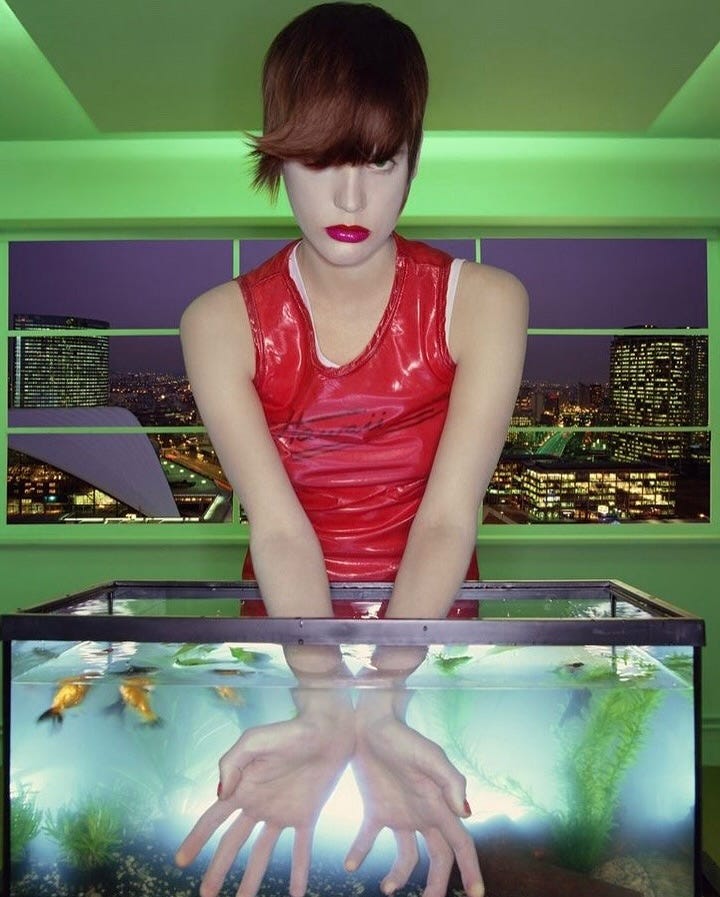
The Prophetic 90s Photography of Andrea Giacobbe
A Welcome Archive Report
W.A.Rs (Welcome Archive Reports) are a new effort by Welcome Magazine, where we’ll be studying select instances of impactful creativity from the past. It could be the work of an artist, a series of works, an era, or anything else that we can learn from and appreciate today.
There is work that perfectly captures the moment in which it was made, and there is work that is ahead of its time. Some work, such as Andrea Giacobbe’s 1990s photography, is both.
Without certain context clues, like Björk’s youthfulness or the slightly clumsy digital editing, it would be hard to tell which decade Giacobbe’s 90s photography comes from. Once we have a time stamp, however, it clearly embodies the spirit of its age. Turn-of-millennium technological anxieties, burgeoning digital editing tools, and a posthumanist approach to the photographic subject are all apparent in his work from this period.
Taken as a body of work, Giacobbe’s 90s photography tells a story of a world in flux culturally, technologically, and photographically. It also predicted our contemporary visual landscape. In fact, we’re currently seeing an aesthetic trend in editorial photography which echoes the shift Giacobbe was a part of. For these and other reasons, it’s worth taking a closer look at one of photography’s unsung heroes.
-
Giacobbe was born in Florence in 1968, and studied photography in the UK. By the 90s, he was working primarily between three major metropolitan areas: Paris, London, and New York.
When Giacobbe was studying, the dominant regime of photography was siloed, prescriptive, and highly controlled. Photographers primarily focused on one medium: fashion photography looked very different from music photography, and lifestyle or journalistic photographers rarely ventured into commercial and editorial jobs. The editorial style of the time was rigid, defined by glamor and a clinical technicality. Clean compositions in a white studio, symmetrical and beautiful bodies displaying conventional physical ideals.
This photographic style embodied a more general sensibility of the pop culture of the 80s. In the commercial sphere at least, it was a time of glossy brightness and optimism. Material ambition and excess were celebrated, and technological advancements were regarded positively.
Giacobbe’s generation rejected this rosy cultural outlook. As the world complexified, technological advancements took on a more menacing tinge. Changing economic conditions also contributed to a growing skepticism about the direction of society. The future, as well as the technology that would define it, started to scare people. The worldviews, aesthetics, and subcultures of the 90s all expressed this changing orientation, something we can see in the gritty aesthetics of grunge and the existentialism of posthumanism.
It is in this context that we can best understand Giacobbe’s work. Beyond questioning the photographic status quo, his photography questioned the fundamental idea of humanness, critiqued a commercialized present, and depicted a future that was strange and inhospitable.
A strength of Giacobbe’s work is that a thematic understanding begins exactly where the eye is drawn to first: the subject itself. Giacobbe’s subjects have a strange artificiality to them. Some look like mannequins. A combination of makeup, posture, and editing creates humans that look like dolls, in stark contrast to the dynamic and athletic affect dominant in the 80s.
Portraying his subjects this way was an intentional choice aimed at critiquing the commodification of the individual so rampant in that era’s pop culture. It also contained a posthuman notion: by artificializing the humans of his compositions, Giacobbe put them on the same level as the consumer products and technological devices of their environment. The human ceases to be a superior form of being, and is subsumed as an object alongside other objects. This challenge of the categorical differentiation of humans is a core posthumanist position.
A perhaps more explicit nod to the posthumanist tradition was Giacobbe’s habit of making his subjects look nonhuman altogether. His iconic 1997 shoot with Björk is archetypical of this strategy. Björk’s wardrobe for this shoot includes horns, a witchy cloak, and artificially enhanced eyebrows. Mythic symbols balance a sci-fi futurism, creating the surreal effect Giacobbe was known for.
The environments of Giacobbe’s photography were central to his aesthetic. While we may recognize the settings (say, a bathtub) and consumer products (say, dish soap bottles) in Giacobbe’s photos, we don’t recognize their vibe. There is a menacing tinge to these products. Normal settings become defamiliarized, even frightening.
The world of Giacobbe’s subjects is slightly futuristic (science fiction was a major inspiration for his work) but also liminal. Much of this liminality is intentional, but some of it is an aesthetic byproduct of his technical process, which involved heavy digital editing and image construction. The outlandish compositions of his photographs are often stitched together in the post-edit. On a technical level, Giacobbe’s work is some of the most forward-looking of his time.
Beyond this technical proficiency, Giacobbe’s approach to environment and composition completely challenged the film regime of editorial photography. When Giacobbe began his career, film photography was the dominant mode. Post-editing was done, but stealthily. Visible editing was associated with lowbrow culture, and rarely used in major editorial shoots.
Giacobbe’s work helped change this. He normalized a more experimental and surreal style by photographing some of the most outstanding acts of the 90s. He shot Bjork, Beck, Trent Reznor, The Smashing Pumpkins, and more for outlets like Flaunt, Dazed & Confused, and The Face. Advertising and art collapsed into a new editorial style.
-
By the time the 90s ended, at which point Giacobbe shifted towards video formats, photography writ large had shifted in his direction. The cultural outlets he shot for were creating a new class of editorial taste, and it looked very different: a blurring of mediums, space for experimentation, a colorful and surreal style that embraced the new generation of digital editing tools.
In some ways, the transitional cycle that Giacobbe helped trailblaze in the 90s is coming around again. In past years there has been growing frustration with the staleness of contemporary editorial photography, and recently a colorful trend towards more outlandish wardrobes, makeup, and postures has emerged, although these shoots are often still staged in studios and fairly stale.
It’s difficult to identify work that best captures its moment. It’s even more difficult to say what work will predict the future. But we can all appreciate creativity. Giacobbe’s work ultimately succeeds not because of its position in the history of photography, but because it is creative. After all, an artist is not a prophet, and the best work succeeds on its own terms.


