

The Most Expensive Fashion Show of All Time
How Karl Lagerfeld put a runway on the Great Wall of China
Part theater, part construction project, part marketing campaign, the runway show is a keystone production for any fashion house, and one of the best ways to understand the latest intricacies of a brand’s vision. Generally, shows are delicate atmospheres that succeed in subtle ways through cohesion of set, setting, casting, music, and collection. Sometimes, though, they are not subtle at all.
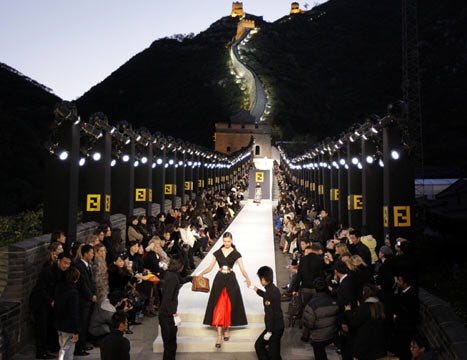
Karl Lagerfeld’s 2007 Fendi show on the Great Wall of China was not only the least subtle runway show ever, it was also one of the most expensive. 500 guests were transported to the top of the Great Wall’s Mutianyu section, a stretch originally built in 1368, and lined the exceptionally long runway on which the Spring-Summer 2008 collection made its first appearance.
The show was motivated, as so many are, by commercial strategy. In 2007, the entire fashion world was reckoning with the rising power of the Chinese consumer. Fendi was attempting to break into the market.
Apart from the setting, other aspects of the show nodded to the target demographic: the runway was 88 meters (the longest ever, by the way) and there were 88 models walking it because 88 is considered a lucky number in Chinese culture; they put Ziyi Zhang (a Chinese actress) and Kate Bosworth (an American one) side-by-side in the front row; circular patterns appeared throughout the garments and staging, referencing traditional Chinese symbols associated with happiness and harmony.
Getting 500 cultural elites, equipment, lighting systems, staging materials, and production crews to the top of the Great Wall turned the event into a massive logistical operation. The total cost was estimated at around $10 million, an enormous number for a runway show in 2007, and adjusting for inflation making it one of the most expensive ever thrown.
Unbeknownst to Karl Lagerfeld and Silvia Venturini Fendi, but widelty known among the show’s producers, was that but Fendi did not have official permission to stage the show there.
“There is no procedure to do a show on the Great Wall,” Michael Burke, who was the chief executive officer at Fendi, said later in an interview. “There is no single entity that controls the wall. We had to deal with 47 different entities and not a single one of them could approve anyone else’s. And you’d never get approvals. All you’d ever get is non-rejections.”
A key figure behind the project was graphic-designer-turned-entrepreneur Terence Chu, who helped connect the Fendi to the Chinese market and assisted with the event’s local coordination. He made a lot of money since the 00s doing this for other brands as well, including Hermes and Dolce & Gabbana.
Today, massive destination runway shows are common. Dior staged its 2022 menswear show at the Pyramids of Giza; Balenciaga held a show inside the New York Stock Exchange. Fendi’s Great Wall show ran the focus group on this strategy, and remains unusually excessive even by modern standards. As luxury mogul Bernard Arnault said, this was the first, and probably still the only, fashion show whose runway you could see from the surface of the moon.


