

The Early Websites of Fashion Brands
Looking back at an era of exceptional web design

Fashion tends to translates well to new forms of media; when glossy print or the television arrived, the industry immediately knew how to use them to distribute its products and brands. The arrival of the internet was different. An entirely new medium arrived before rules were set, and brands were left to decide what to do with it. The result was a renaissance in digital creativity that defined the early websites of fashion brands.
In the early days of the internet, fashion houses approached websites as a creative medium, where digital architecture afforded new modes of expression through design. Sites were largely seen as storytelling devices whose ultimate goal was to cultivate a meaningful branded experience, rather than sell a product.
Today, the websites of those same houses have homogenized and dulled. Open the online store of any major brand, and you will be met with sleek drop-down menus and video banners lifted from store displays.
Driving the creative disparity between present and past website design has been a growing obsession with conversion. Today’s sites are not geared toward creating branded experiences, but toward selling the consumer a product with as little friction as possible. Customers are reduced to an array of data points, and websites are streamlined vehicles for online transactions. The goal is volume. When, rarely, we do see e-comm creativity today, it comes in the form of temporary initiatives that function as marketing devices to be distributed on social media.
As a result, brand and sales have become functionally synonymous. The early e-comm era of fashion retail reminds us that it wasn’t always this way. In addition to being cool to look at, these archival websites show us how far brand has fallen, and suggest how it might be restored.
-
In 1998, Helmut Lang was among the first designers to recognize what digital capabilities meant for brands. “We’re in the midst of a technological revolution,” he said, “we all know it, we talk about it, but we have to live it.”

Lang proceeded to scrap his New York runway show, instead sending buyers and critics a metallic gold CD-ROM of the season’s material. The disc contained some eighty-one looks from his Fall/Winter collection, and copies of the same material were distributed on the brand’s simple website. This was the first seasonal presentation to leverage the internet as a vehicle for mass distribution. Critical response was immediate and negative.
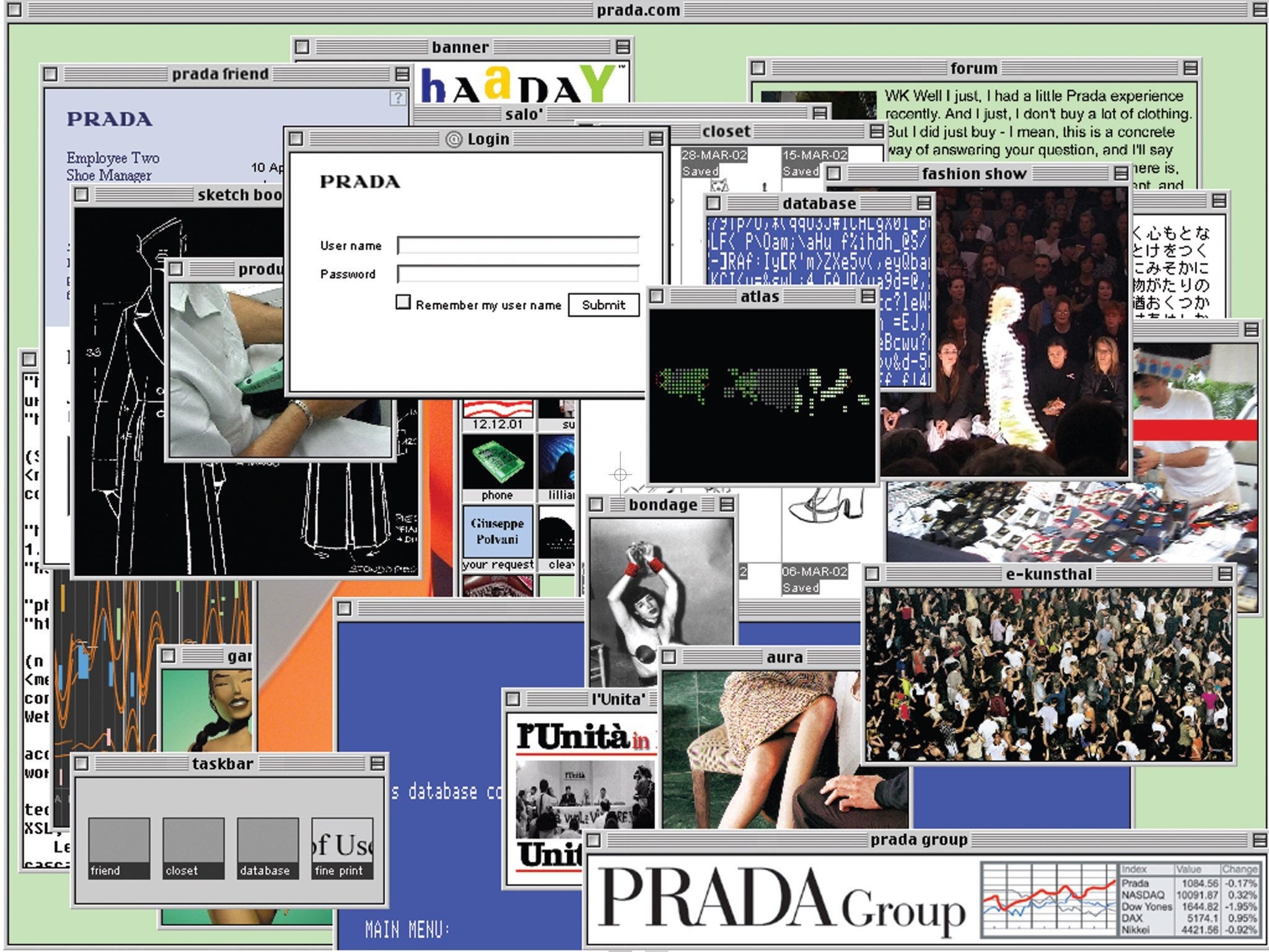
Shortly after Lang’s stunt, other luxury powerhouses followed his turn to the internet. By the early 2000s, global brands such as Prada and Issey Miyake had established online presences. Aesthetic inspiration was drawn from Information Age optimism, using the novel affordances of browsers to employ music, layered overlay, and Flash-integrated video. An archetypal motif across early sites was the intentional use of pop-ups, repurposing them as a formal storytelling device. Designs like these celebrated the new medium of the internet as much as they attempted to communicate a message.
In 2000, Dutch architecture firm OMA partnered with long-time collaborator Prada to prototype Prada Vomit, an iconoclastic barrage of pop-ups featuring everything from Prada runway content to vintage bondage imagery. The site was designed to celebrate the superfluidity of the internet while maintaining the curatorial codes of the house. It satirized the new and chaotic access to images and data. This was an early installment of their ongoing collaboration campaign Real Fantasies, employing collage and vintage imagery to reimagine the traditional lookbook digitally.

Issey Miyake’s early websites also drew on self-referential browser imagery such as the pop-up. Reading as a directory, the site archived presentations of runway shows from Spring/Summer 2002 onwards. Each presentation redirects to a pop-up window featuring video representations of the runway through using avatars and both still and moving imagery, demonstrating an advanced use of motion effects and green-screen. While seemingly minimal, altering the runway show’s representation in this way destabilized previous distribution patterns. Instead of passively receiving a highly polished and static narrative, Issey Miyake’s website put the audience in a position of narrative agency, making them active digital decoders of the brand’s story.

Maison Margiela’s website during this time has similarities to Miyake’s. Its file directory design was intuitive for the early internet user, borrowing from Windows XP and other operating systems from the era. Collections, store information, and archives are neatly enclosed in folders for the user to explore. Earlier this year, Margiela recalled the era with the “Folders” campaign, which displayed archives and working documents in a similar file-based fashion.

Often, brands skipped elaborate website architecture in favor of the still image. For Number Nine, a simple logo and contact page said plenty. If Six Was Nine employed the still image to sequence a skeletal figure emerging from the homepage, paired with a textural darkwave track from Dead Can Dance.


On the other hand, some brands leveraged the internet’s new tools to the fullest in pursuit of immersive storytelling. The early Bathing Ape website is a distinct showcase of everything that could be explored by the digital. Before finally launching a browser site in 2008, the BAPE website solicited users to download an EXE file to run the webpage. Accompanied by a loop of the punchy Neek Rusher track “Year 3798,” the site overwhelms the user’s screen with colorful BAPE artifacts. Forcing a user to download something to unlock a digital experience is almost beyond belief in the contemporary digital climate, but Bapeheads at the time loved it. It was a beautiful microcosm of the brand’s culture in both form and function.

The growing interactive nature of the internet unlocked new modes of communication too. Livestreaming was one. Diesel was a first adopter for livestream technology within campaigns. “15 MB of Fame” was an impromptu hijacking stunt of the Diesel website by the two Myspace personalities “The Heidies”.
Having stolen the unreleased Diesel “Intimates” collection, the girls kidnapped Diesel employee Juan and staged a five-day hotel room lock-in, streamed in real time. The girls used MySpace to share the stream. Embedded polls allowed viewers to vote on a series of absurd ventures, such as waxing Juan’s legs or putting ice cubes in his pants. It was a huge, prophetic success.

At a high level, the internet’s greatest impact on the fashion industry was democratization. Where access had long been gatekept by industry insiders and guarded by the spatial exclusivity of the front row, websites and blogs gave the masses a window. Cultural power resting on controlled visibility weakened. Those critics who were less than impressed with Helmut Lang’s 1998 presentation (including Anna Wintour who called it a “huge mistake”) were immediately proven wrong. Condé Nast launched Style.com in 2000 to publish seasonal presentations in real time. Other platforms engineered by highly legitimized media organisations followed. Access to the front-row became available to anyone for the first time, laying the groundwork for early blogs on sites such as LiveJournal.

These new platforms were innovative in their own right. Founded by fashion photographer Nick Knight in 2000, SHOWstudio turned the internet into a live and participatory medium for fashion by streaming shoots, interviews and fashion shows. This ethos culminated in Alexander McQueen’s Spring/Summer 2010 presentation Plato’s Atlantis, widely understood as the first livestreamed fashion show.
SHOWStudio went further than optics, taking advantage of the internet to share practical and exclusive resources. The Design Download series invited users to participate as collaborators. Free sewing patterns were published by the likes of McQueen and Yohji Yamamoto (and are still being offered today). The distributive creative network folded users into the site of production for the first time.

On the early internet, the fashion industry was divided into two spheres: brand and retail. Retail sites like Net-a-Porter facilitated points-of-sale (which was trickier in these early internet days), and this allowed companies to experiment with design on brand websites that didn’t bear the burden of having to actually sell things.
But this binary distinction between brand and retail no longer exists online. In the later 2000s, it became easier for brands to host their own point-of-sale infrastructures due to the increasing sophistication of web development and online payment systems. Simultaneously, sites were optimized for search engine discovery. Storytelling, in turn, was ironed out. Today, this brings us to the website as an e-commerce vehicle, with creative ambition hosted elsewhere.

Now, creative brand-oriented storytelling is primarily distributed on social media, where it is just one blip in a scrollable field of content. The inherent issue with content is that its success is determined by the algorithm. The algorithm sees users as metrics, rather than as individuals. As a result, fashion brands see us that way too.
When brands do still experiment creatively online, it is engineered for redistribution across social media channels. Take the Hermes website campaign Venture Beyond, featuring hand-drawn illustrations by Kit Klein. While beautiful, and even construed by many as ideologically anti-AI, the site design was taken down after less than two weeks, just long enough to gain algorithmic traction on social media channels and generate discourse. Venture Beyond is one of many Trojan-style marketing vehicles sold as experiences. As campaigns become more disposable, they continue to lose any native wit and meaning. This is because the terminal objective is not to mean anything, but to convert sales.

Early websites, because they could neither achieve virality nor sell product, were intended to distribute brand messages and experiences to the loyal visitor. These experiences could be messy, experimental, and unwieldy. Today, conversion optimization dictates that the site should be a clean, digital storefront. Frictionless design generates revenue, but it is characterless. Any tendency to pursue design that speaks to brand is sanded down in favor of accelerating the purchase funnel.
It isn’t to say that there haven’t been any positive developments. KidSuper and Basement Studio’s kidsuper.world won several awards in 2024 for engineering a dazzling, creativity-first design. Analog-style models like these don’t subscribe to contemporary e-commerce logic, and the site is difficult to intuitively navigate when it comes to actually purchasing an item, harkening back to earlier sites. These creative websites are small insurgencies, but point to an increasing consumer dissatisfaction with conversion-based web design.

Looking back, early websites of brands in the industry are representative of a better era of retail. The magic that suffuses early websites is the intention; websites were somewhere you went. Storytelling and community connection were first principles for these designs.
These archival website offers a way forward for brands seeking to cure consumer fatigue in an age when commercial strategy encroaches on every aspect of human life. Early websites were not a golden age so much as a proof of concept. People respond to immersive brand experiences, and today they yearn for them more than ever. Hopefully, it isn’t too late for brands to learn this lesson.
Written by Hannah Morgan


