


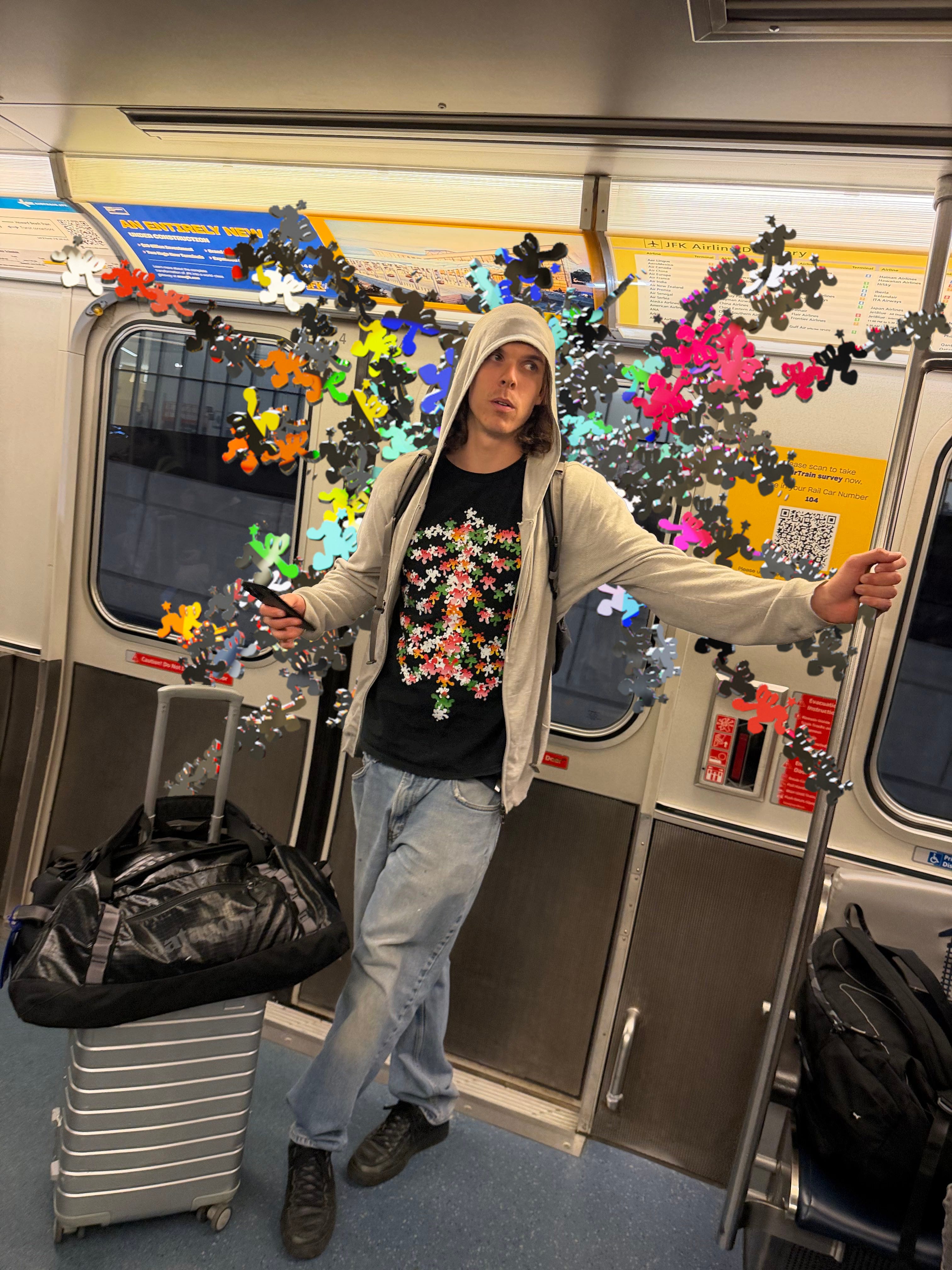
There is so much electronic music out there, and so much of it sounds the same. But every once in a while an artist comes along who makes it sound new again. These acts are not soon forgotten: Aphex Twin, Crystal Castles, Burial. Loukeman, the innovative electronic musician and producer who is at the sonic center of a burgeoning Canadian underground scene, is our age’s entry in this cultural pantheon.
Loukeman accidentally became a cult sensation when he uploaded a playlist of his beats to streaming platforms in 2021 under the title Sd-1. At the time, he was a hobbyist with a wealth of raw talent and no listeners. Now he’s worked with some of the biggest names in music, and has an avid enough fanbase to generate a multi-block line outside the NY venue where he hosted the listening party for his latest album, Sd-3, the third and final installment of the Star Dog (Sd) trilogy, ending the chapter which can be officially considered his come-up.
Sd-3 finds Loukeman’s signature style in full bloom. It’s a style defined by several motifs: creative and transformative sampling; melody; soft bass; mid-tempo; and unique synths. Loukeman’s songs are open and winding, often anchored by highly distorted and very pretty vocals. His sample sources range widely, but he has a particular penchant for emotional folk.
The three projects of the Star Dog trilogy (which came out in 2021, 2024, and 2026) are time capsules of Loukeman’s ascension. He has become a better producer at the technical level. His stylistic motifs have matured. His reach has increased as well. He’s collaborated with Vegyn and PinkPantheress. He was very involved with A$AP Rocky’s last album.
The growing star of Loukeman’s musical talent has changed the shape of his life. He now lives somewhat nomadically, flying from the studios of one metropole to another. But when it’s time to lock in, he goes back to Toronto. His Canadian home is core to his identity. He says he still makes his best work there.
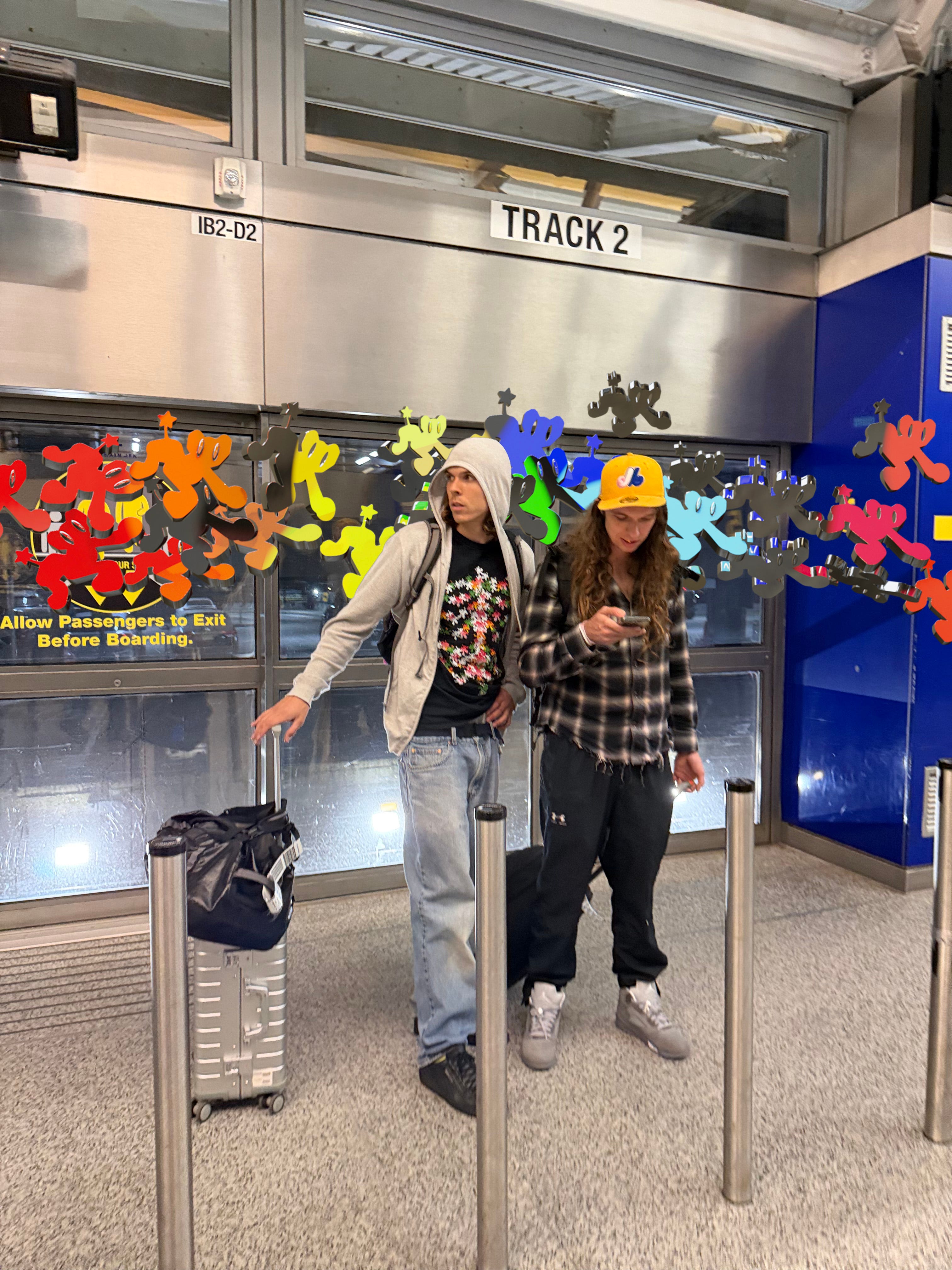
It is a home that is increasingly visible to the rest of the world. Loukeman is long-term friends with a crop of Canadian talent that is on the cusp of international popularity. He went to college with a lot of them, and they remain close. So when we decided we wanted to interview Loukeman about the new album, we also reached out to some of these peers for their thoughts about Loukeman.
You can read those takes below, embedded into our conversation with the man himself. We spoke about the new album, how this all started, the importance of a good remix, the albums he listens to when he wants to make music sound new again, and much more.
Read on for a portrait of Loukeman, in his own words and those of his friends.
Welcome: What’s your story? Where are you from, and how did you get into music?
Loukeman: I grew up in Toronto and had dabbled in music, but when I went to University and met all my good homies like Dylan (Dyltwosix), Ian Mills, and ML Bratstar, that’s where everything came together, and we all started making music together when I was about 19.
Welcome: It’s crazy that you all went to the same university.
Loukeman: I knew Dyltwosix actually from when I was probably 14 or 15. There’s a sick photo of us at the skate park, probably from 2013 or something. We had skated together growing up, and then we ended up randomly going to the same school. When we linked up together, it was like four of us that really enjoyed making beats and music, and that turned into making beats every day.
W: Tell me about that period. Did it feel like you were deliberately working towards something?
L: The best thing for me was that I never had the idea of making music a job. The first four years of making music, I never was like, I’m going to do this for a living. It was purely just for fun, trying to make the music that I had been inspired by when I was 19. I think that was a strength; not thinking too much about anything, you know.
How did your first project, Sd-1, come together? Was it a deliberate decision to create a body of work, or did it just sort of just happen?
I made a playlist one day for some songs I had made that month, and I put that [dog] logo on it, and Dyl was like, That’s cool, you should just use that as the art, and then I just put it out. It wasn’t conceptualized as a trilogy or anything.
When it came to Sd-2, did you set out with the intention to make something that felt like a second chapter? or did it come together the same way the first one did?
It had been a couple of years, and I had been making music steadily. Some people hit me up saying, when’s the next one? I was like, I guess I should make that. So then I deliberately put my mind towards making Sd-2. With all of them, I try to maintain a flowing mindset that’s not overthinking or trying to make it better than the last. It’s more about maintaining its essence. If I made a beat and it feels good, I’ll put it on a playlist and then look at them together one day and say, these are the 14 songs.
What about this third one, Sd-3? Same mindset?
I think for each one it got a little harder to be so chill. Before Sd-1 came out I had no listeners. Then it came out and I had a few, so I was thinking for Sd-2, I hope they enjoy it, and kind of tripping on that a bit. For Sd-3, I have a few more listeners. So it’s the same thing of trying to maintain the essence of a loose mixtape-y beat approach to making music.
So is that what you would say unites the three as a trilogy? That essence, that same approach?
There are certain parameters that make it feel like this is a me song. That’s usually sampling. I love sampling from the same world, like folk stuff and guitars. It’s sort of an intuitive feeling. This is the music I make when I’m chilling alone. I know that feeling now and assemble the project through that lens.
Do you feel like the music you make for yourself has developed over the course of these three projects? Is it different now than it was when you started Sd-1?
Naturally you shift through interests, through what you listen to, and I think that informs what you end up making. Production-wise, you shift through playing with different instruments, you get bored with this thing and pick up that thing. I’m sort of always interested in trying to mix things better or trying to make stuff sound better on sound systems. That’s the consistent thing I’m trying to improve: mixing and trying to make it hit harder. At the same time, I don’t mind a really bad mix that sounds cool. But it’s less about making things better and more just trusting that things will change without me trying to change them.
Dyltwosix on Loukeman
Dyltwosix is a Toronto-based rapper, and longtime friend and collaborator of Loukeman’s.
How did you meet Luke?
When we were about 14-15 through skating. [We] reconnected in school and subsequently ended up living together for 6ish years in our 20s.
What do you admire about him?
Bro is true to himself—a real artist and a determined individual. Bro is a true friend and doesn’t forget the day 1s. A real Canadian legend who carries the sd flag. He lives like the music sounds.
What is a unique aspect of his music-making process that you’ve witnessed first-hand?
The speed. It’s out of pocket to see bro cook ideas so fast. It’s like watching someone breathe air. The amount of music and tech knowledge that gets packed into each move is something only he can tell you about. It’s krazy work.
Welcome: I’ve been hearing people talk about this emerging scene in Canada. Do you feel there’s an exciting energy in Canada right now?
Loukeman: I honestly haven’t heard much about new Canadian talent as a generalization, but I love to hear that it’s a thing. There’s some Toronto underground rap that’s popping. Montreal has dance music legends and really good producers. But I definitely think about it less as a Canadian movement. Maybe I’m just too in it to see that outside perspective. It feels less distinct than the UK underground. I think the thing with Canada that’s cool—or Toronto—is you’re sort of attached to everything, but you’re also kind of in your own world. In my experience in Toronto, I don’t work with that many other artists besides my core friends. Usually, I’m just sort of alone working. It kind of feels like we’re all coming from Canada, but on our own paths.
Are you living in Toronto these days? Is that where you’re based usually?
I’m like 40% in Toronto, 60% everywhere else. Bit of LA, a bit of London, a bit of anywhere else that I might end up. I kind of bounce around right now.
What’s that nomadic lifestyle like?
I’ve been on it for some years now, and it’s nice. I definitely talk about getting an apartment, but I cherish both sides; routine, being healthy, working out, and then also traveling a lot and spawning into new cities, which is equally fun in a different way.
It seems like you’ve had some really exciting experiences on the road the past couple of years. Have there been any pinch-me moments you can think of?
Maybe not all the way pinch-me, but I’m always trying to see it that way. I think it’s a skill to be able to be proud of yourself. The goalpost always moves. You work towards something, and when you get there it doesn’t feel that different because it’s been a slow progression. I’m definitely stoked on how music’s been going for me and all my friends. I always try to think back to when I first wanted to make some music, and put where I’m at now into perspective. This was the initial goal, being able to play sets and produce for other people and produce my own music. So yeah, it’s less of a pinch me moment, but more just trying to always remember that you’re doing the thing that you wanted to do, and to try to be grateful for that. The Fred Again show was sick though.
Tell me about that show.
I think Toronto doesn’t have a huge scene for massive raves. The show was so wholesome. It was all my friends like FROSSYOUTH, ML Bratstar and Dyl; my hometown homies; my sister. Everyone in one room turning up. Those types of shows are very easy for my family or friends to understand how sick they are, because it’s just such a big room. Whereas you know, it’s harder to understand the niche things that I’m stoked on, like when this artist puts a verse on something. They don’t care, you know. But a big show, cool lights, that’s fun for everyone.
That’s an interesting thing about being a producer, the wins aren’t always obvious to the people outside of it.
I always think about there being certain things you accomplish in music that different people can look to and understand what you’re doing. My uncles and cousins can understand what I do through a big show with Fred Again, and my homies can understand it through the beats I send them.
Speaking of the more production stuff, I’m curious what the experience working with A$AP Rocky on that record was like?
He’s honestly such a nice dude and very open to beats and trying to make weird, interesting shit, which was amazing to work with. It spawned from my homie Ging. I had been working with him a couple of years ago, and he was like, Rocky’s going to pull up, you want to come by? And I was like, hell yeah. So I came by, and I was kind of nervous, but ended up playing five or six beats for him, and he took the majority of them. He cut “Don’t Be Dumb” like that night. I was stoked.
I ended up working on the album for the next couple of years, here and there, weeks in LA or in New York. It was sick that everything actually came out. Usually, you go into a session, especially with a big artist, and they might not pick the beats that you want them to pick. They might go for the more basic ones that you threw in just in case. But he picked the two beats that I was like, trust me, if you take this beat, it’ll be sick. That rarely happens.
Brat Star on Loukeman:
Brat Star is a Canadian singer-songwriter and DJ, and a longtime friend and collaborator of Loukeman’s.
How did you meet Luke?
I met Luke and Dyl for the first time in Montreal in 2020. I was a fan of their music and had been playing it on my radio shows. We went for a hike on the mountain and talked about life things.
When I came across their music, I was deep in my European era. I was mostly DJing but had started making my own music. I was visiting Montreal from Berlin, where I was based then. Luke and Dyl’s infectious, distinctly Canadian swag inspired me to reconnect with my roots. Gave me the idea that we could make it exciting to be Canadian. Looking back, I can see meeting them was the beginning of my journey exploring and embracing Canada in my work, as my culture and the place I’m from.
What impact has Luke had on you as a musician?
There’s so much that I get from Luke. Above all I’m inspired by his super locked in vibe—he has a crazy work ethic and is always trying new things. He has this intuitive and exploratory yet uncomplicated approach to music that feels mad liberating. I remember one time he said “I don’t grind music” and it really stuck with me—he kind of just throws things at the wall until something magical happens. He works really fast, which keeps things playful, and I think you hear that in the music. It’s emotional. At the same time, he has a strong sense of the big picture and achieving balance in a track. He’s great at making decisions and finishing songs, which is the hardest thing to do as an artist imo.
What impact has Luke had on the broader Canadian music scene you’re both a part of?
He’s an extremely grounding presence in our scene. There’s always this sense with him that he’s building something bigger than the sum of its parts. There’s a cohesive vision holding all the music and visuals together. There’s something to the way he’ll never archive an IG post or delete an old track on SoundCloud. It all feels so inclusive and encouraging. I think his steady creative output has formed a kind of Canadian springboard from which we can all jump off.
Welcome: You’ve put out a number of remixes as well. Some people out there don’t listen to remixes on principle. From your perspective as a producer and a musical scientist, what is the point of a remix? What is the importance of a good remix?
Loukeman: I see it as pre-clearing samples. So I look at it as an opportunity to make something with pre-existing material. I love sampling, and if I know I can sample and then put it out, I’m inclined to try and use that piece of audio. I just see it as making a track, and I don’t really think of it as trying to make a remix. I’ve probably made like 10 different remixes just by having the folder of stems on my computer and waking up making something, doing it again the next day, and then whichever one feels coolest, I’ll finish. It’s just another song really.
I’m curious, you mentioned waking up and then working. What does a day in the life look like for you? What times of day do you work best? What kind of environments do you work best in?
If I’m in Toronto and in a routine, I usually wake up, get on my computer as soon as possible, have a coffee, and make something. Go work out, spend some time outside, and then come back and maybe make more music or do some boring work-related tasks. After dinner, I come back and check things out again, listen, and maybe make another beat. Lately, I’m not on that schedule, and I’m just trying to be open to making music wherever, whenever.
Is it hard to be open to that?
Yeah, it’s really easy to get into the mindset of, I need this studio and this synth and this routine to be able to do this. I definitely fall into that a lot, like thinking for Sd-3 that I need to make most of it in Canada. I was like, I need to go home to these songs. Most of the songs of Sd-1, 2, and 3 began in Toronto or north of Toronto on the lake. I definitely still have that sort of stubbornness like, this is stuff I work on in Toronto. It just happens when I’m in Canada.
Why is that do you think?
When I’m in Toronto, I’m a little more even-keel. Maybe a little sadder, a little less stoked on everything, but I’m also working all the time, and good things come from it. It’s so hard to get that in LA. There’s the ocean, hiking and all that stuff. You know, Toronto winter, you just sort of wake up, it’s snowing, make some beats, see the homies, and do it again. Time flies by.
I liked the video with your friends at the ice rink. It seems like those individuals have been very formative and central in this period of your life. What was the thinking behind getting them all together on the ice rink?
I think generally my approach to videos comes from somewhere close to my heart. That’s my safety net, pulling from my real life, because if I do that, then I won’t feel weird about it, cuz it is what it is, you know? That’s sort of been my process of making music and videos specifically, to just try and find something that feels close to the heart and regular.
I honestly had an idea of making a hockey video for five years. Initially, I wanted to make something like the hockey movie Goon. Sort of violent, hockey fights, super HD body checks and shit. But we pivoted. My friends Marco and Carlo shot it. It was more of a game of pick-up hockey. That’s what we do in the winter. We really just link up and play hockey outside. I grew up playing hockey at that arena as a kid. It was pretty easy to cast people; I just hit the group chat like, Hey guy, you want to play hockey? I’ll give you free coffee and pizza. They were all just stoked to have open ice for 4 hours. Genuinely just a fun day. Everyone on set is pretty much a homie.
Ian Mills on Loukeman:
Ian Mills is a Canadian musician, and a longtime friend and collaborator of Loukeman’s.
How did you meet Luke?
We had the same guitar teacher growing up. We would pass each other in the hallway but didn’t really know each other yet.
What’s something not enough people know about him?
He can dunk.
What makes him a special producer in your eyes?
He treats every little sample like a member of the band.
Welcome: What’s an album that’s important to you?
Loukeman: Burial albums. I always end up listening to them because they’re so inspiring in a production sense. They’re so open, and whenever I’m bored of music, I just peep that. And Arthur Russell’s Love Is Overtaking Me. I love that album; it feels so emotional. It’s such a distinct, interesting combination of different instruments and drums, and it hits exactly the stuff that inspires me. Kind of folky, kind of experimental, kind of disco, and a bit of dance. After I listen to that I feel like making music.
Where else do you find creative juice?
I can’t really put my finger on where I draw inspiration from. There are some core motivations in life that make you want to create things. I’m inspired by certain music, but a lot of the time, the listening and the making are separate things, and I try to let the influences of listening come into my music less directly. I sit down, I make music feeling inspired, feeling not inspired, it’s always different. I just know when I make something I like, it feels good. So I just try to show up and see if that can happen.
For someone thinking about listening to Sd-3, how does it fit into your larger discography?
I probably couldn’t tell you. I’m 28, and I’ve been making music for so long, things have changed in my life in many ways, and I think that probably changes the music. But the process and the feeling of it is kind of the same; sit down and make beats. Maybe I’m just not the guy to answer this question.
What’s next? Anything else you want to plug to our readers coming up?
I’m stoked for Sd-3, I’ve made a bunch of music, and I look forward to getting that stuff out. And Dyltwosix, we’re working on his album, and then we’re working on a dance project with him, which is really fun. Bratstar’s got an album coming, Ian Mills got an album coming. So my core music homies are all just working together and have a lot of music to put out. I think it’ll be a nice next few months.
Interview by Noah Jordan
very excited to see what these guys accomplish this year
🥇🥇