


Reporting and photos by Bryan Munguia
Embedded in our collective idea of cool, is the image (or, perhaps, idea) of Berlin. Smoking artists, all black outfits, Berghain. Its gritty reputation grew out of the fall of the Wall in 1989, when an abundance of space and cheap rent combined with a newfound freedom to create fertile ground for art and culture.
Today, to the outsider, that culture seems to remain exceptionally tolerant of the strange and unconventional. Some Berlin-based artists disagree, though. I have heard more than once that “Berlin is over” from artists bemoaning an increasingly exclusionary art scene and social hierarchies that undermine the free, collective spirit the city became known for.
To better understand the art of Berlin today, rather than the myth of its past, I traveled to this year’s edition of Berlin Art Week, where local galleries and institutions came together for a citywide program of more than 100 exhibitions and events.
Unlike most of the fairs that anchor the international art calendar, Berlin Art Week has no central exhibition hall. The city is the venue. It is the largest coordinated gathering of Berlin’s contemporary art ecosystem, and marks the beginning of the busy autumn art season after the industry’s annual summer lull.
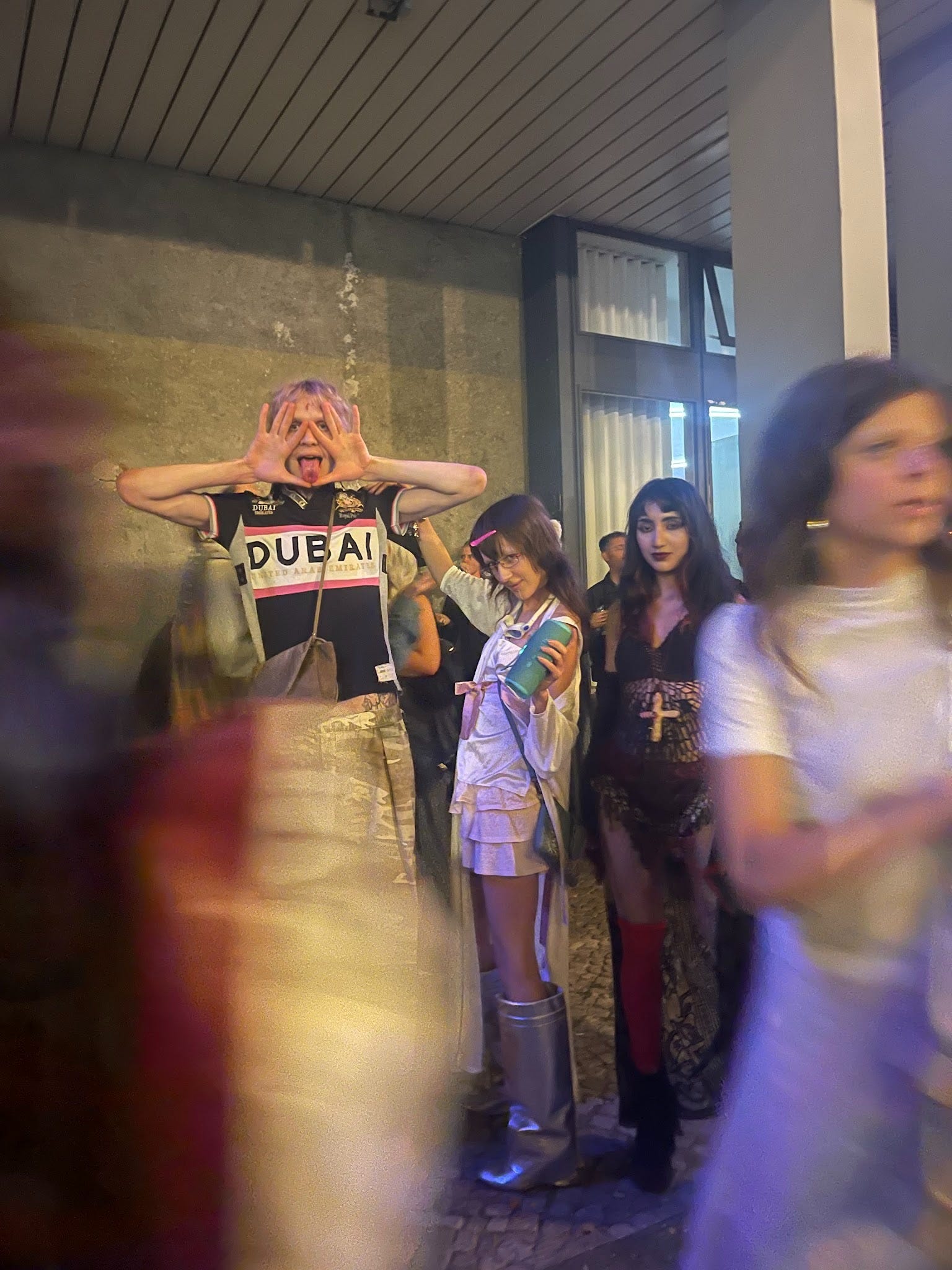
When I arrived in Berlin, I found an urban landscape bursting at its seams. The city is cluttered with images. Advertising and graffiti compete for every available concrete surface. Over the course of the week, this overload takes on a social form. The city crawls with a broad spectrum of art-bound Berlin archetypes, from elites in black silhouettes to art school kids dressed as if they were heading to a techno set. Here, the smoking area tends to be more popular than the exhibition.
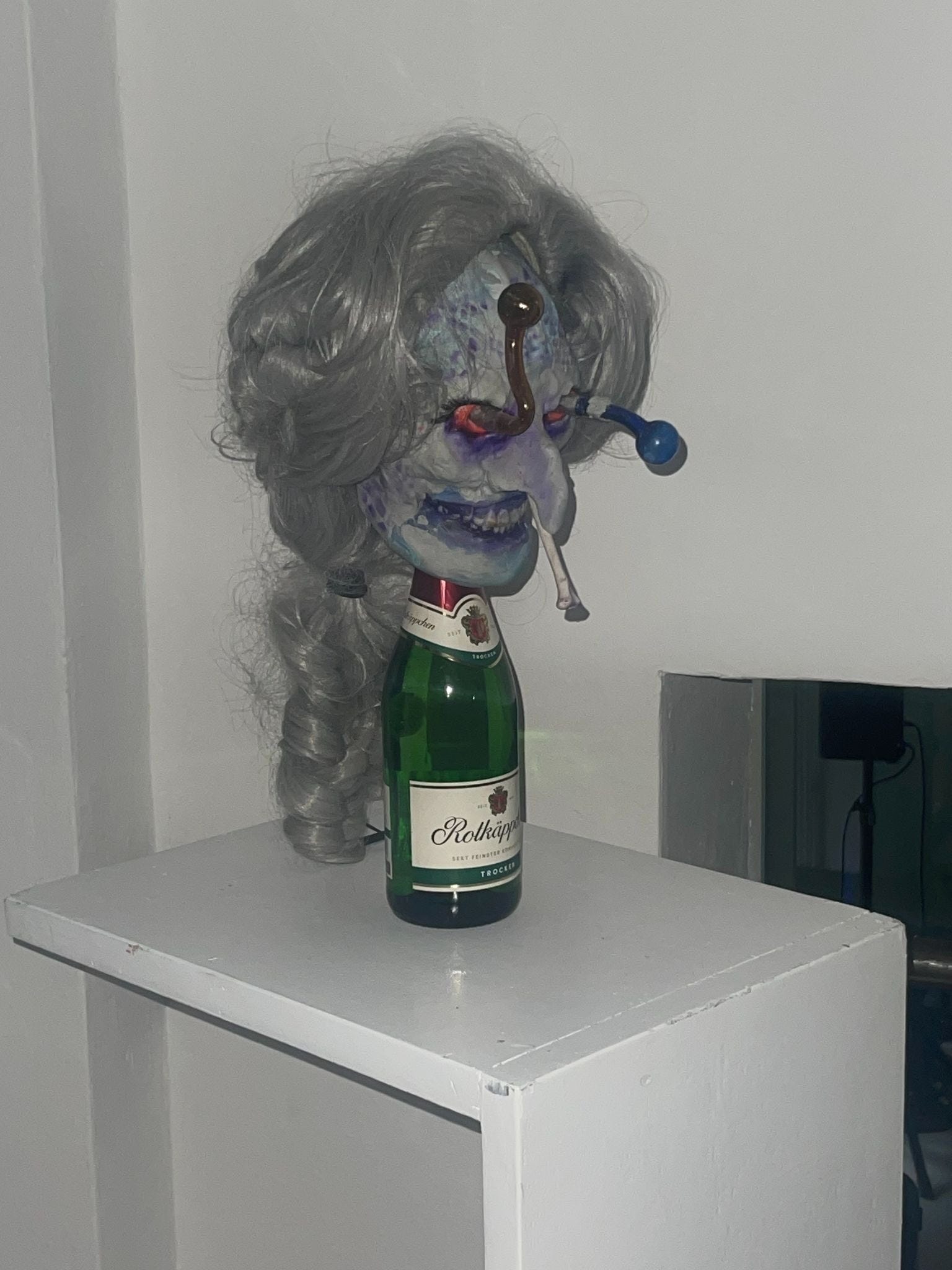
One of the main lessons I took from this art week is that in Berlin, absurd is hardly derogatory. From the artworks to the clothing, absurdity seems to capture something much larger in contemporary culture, where constant circulation brings conflicting information into proximity. Images collide, histories overlap, and things that shouldn’t necessarily belong together somehow do. Berlin’s dense arts ecosystem thrives in these eccentric combinations.
So, amid all the excess, here are the exhibitions and artworks that stood out from the overload.
JULIA WACHTEL, Return to Content a/b, KLEMM’S BERLIN
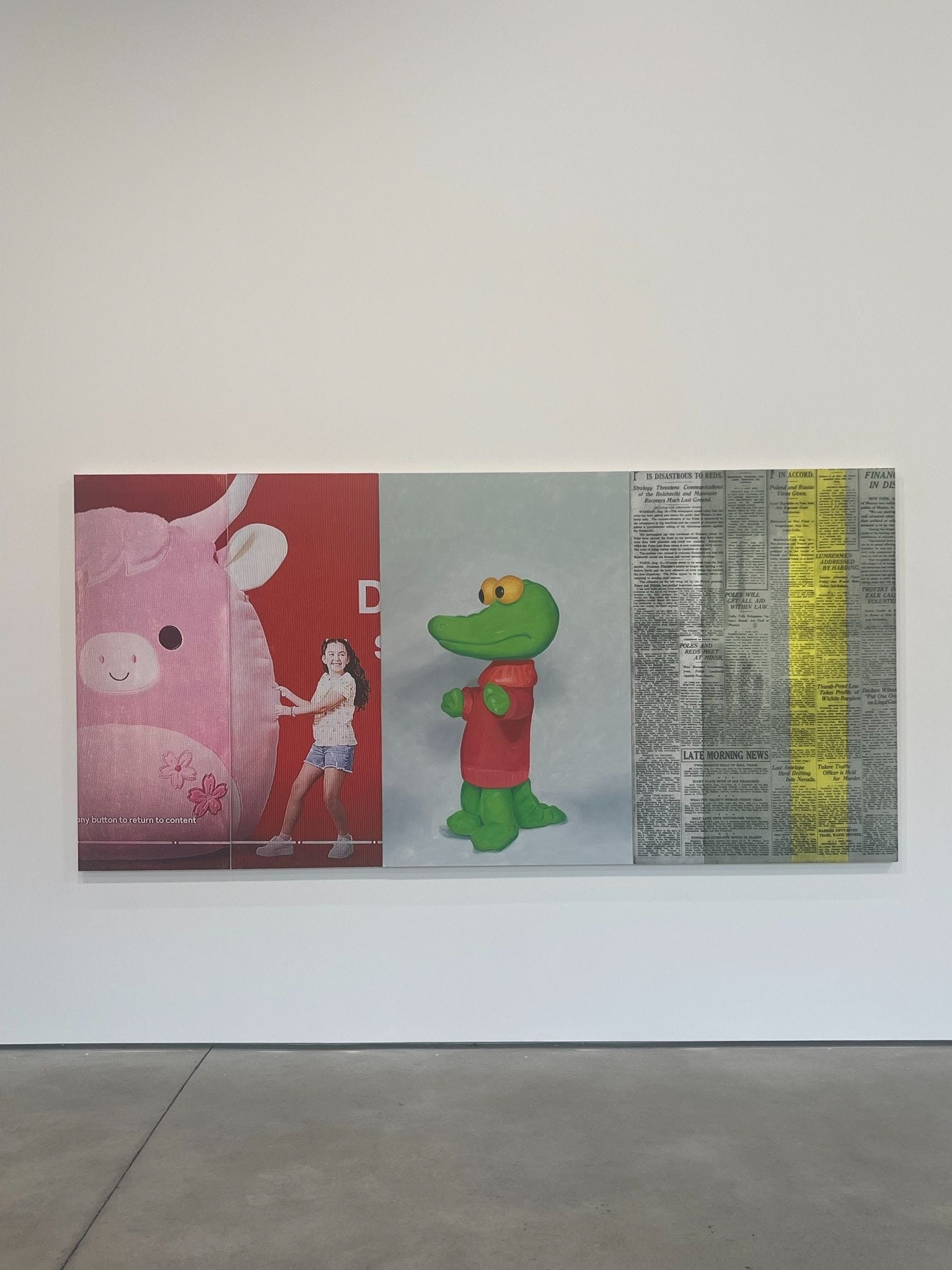
On the second floor of a Berlin business park, panoramic paintings stretch across the gallery walls to form a horizon of memes. It’s American artist Julia Wachtel’s social image landscape, where cartoons, celebrities, political figures, ads, and internet debris rest side by side like a horizontal doomscroll.
Long before social media, Wachtel was mining the terrain of memetic images. She emerged alongside New York’s Pictures Generation in the early ’80s, a group of artists that appropriated images of mass media to make sense of an increasingly digital and commercial culture. Back then, their images came from television and advertising; today, the internet is Wachtel’s primary source.
In her solo exhibition, Return to Content a/b, Wachtel intentionally interrupts her image’s circulation, plucking them from the stream and freezing them onto canvas through a combination of painting and screen printing.
Removed from their feeds, these remixed images begin to form strange new associations with whatever they share the canvas with.
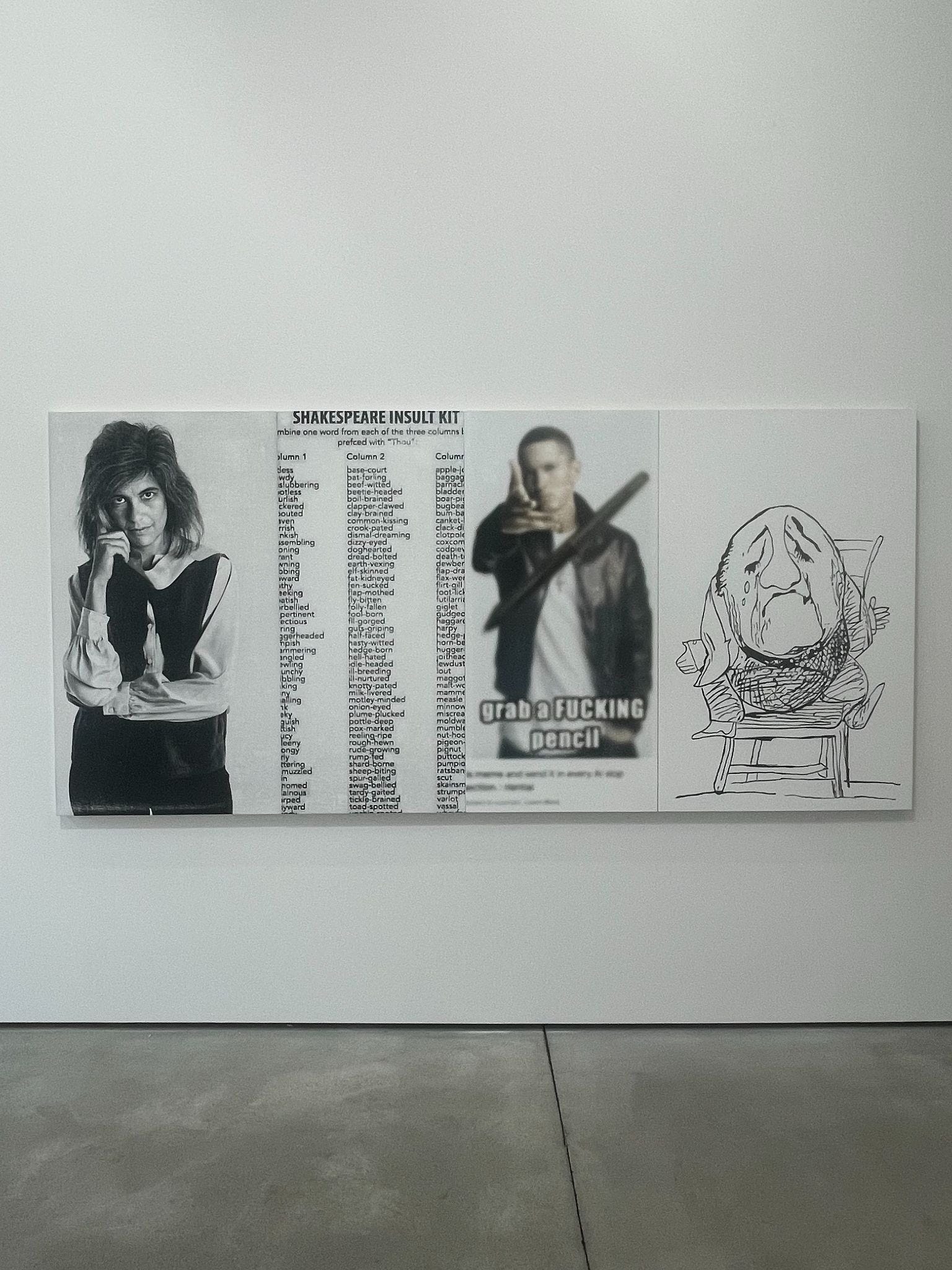
In more recent works like grab A Fucking pencil (2026), the associations become absurd. Susan Sontag, the formidable American writer and culture critic, appears alongside a Shakespearean insult generator, a blurry Eminem meme, and an illustration of Edward Leer’s A Book of Nonsense. High intellectual culture occupies the same plane as internet sludge. Wachtel illustrates a collapsed cultural hierarchy, where Eminem and Susan Sontag are only ever a scroll apart.
ROBERT RAUSCHENBERG, CROSSTOWN, BASTIAN
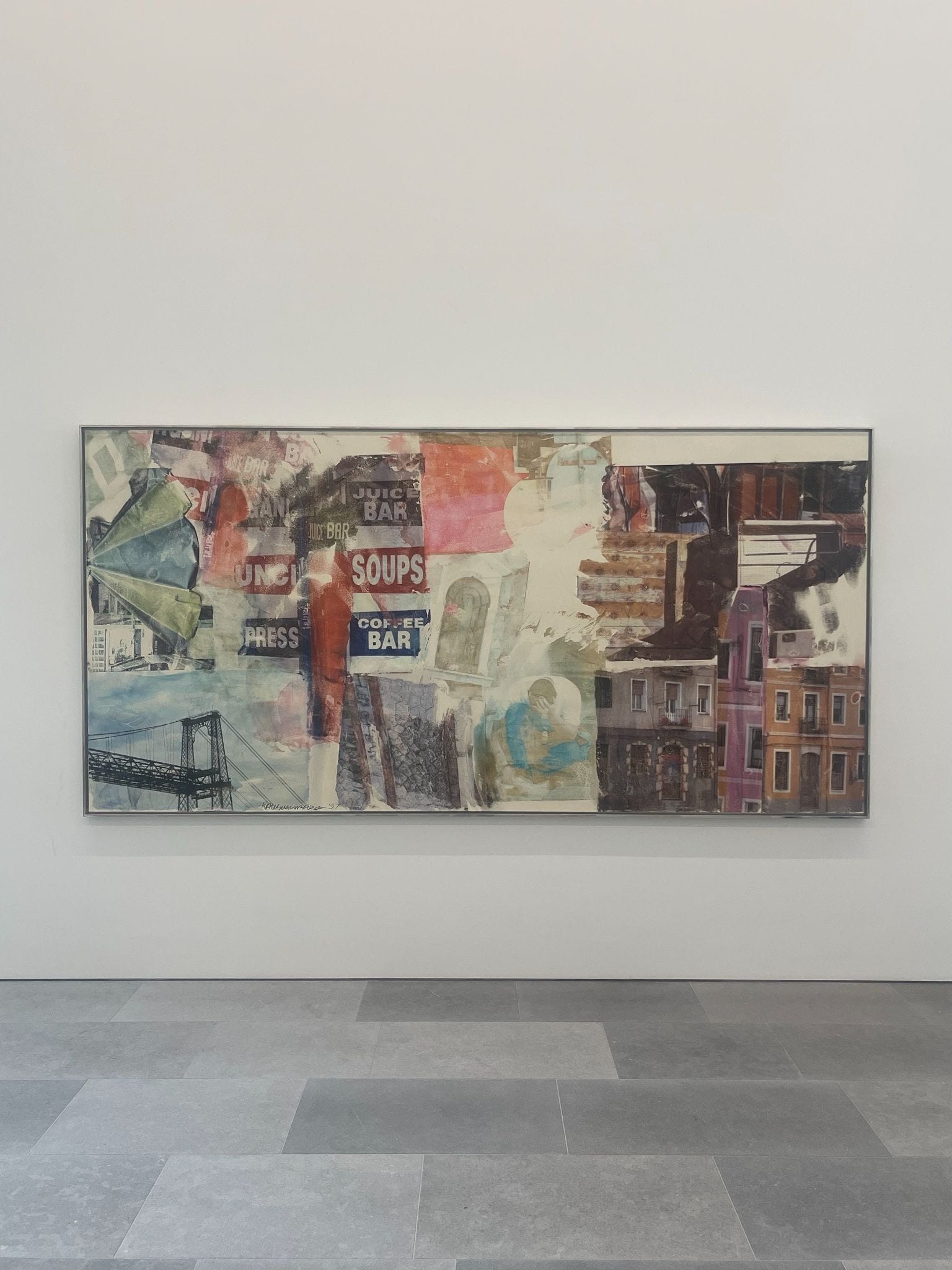
This suite of Robert Rauschenberg’s work (which is fittingly named because I had to spend almost an hour on the U-Bahn to get to it), feels distinctly Berlin.
Anchoring this pristine, white cube gallery is Crosstown (1997), a sprawling panorama where photographs of faces, buildings, signs, and everyday fragments drift across a hazy surface of transferred images and paint.
Outside the gallery, Berlin seems to adopt a similar rhythm. Perhaps that’s why the work feels so at home here in this city. Like Rauschenberg’s paintings, Berlin seems built through accumulation. Layers of posters peel into one another, advertisements fade beneath graffiti, and stickers conceal street signs. Surfaces collect images without ever fully erasing what came before, allowing unlikely fragments to coexist.
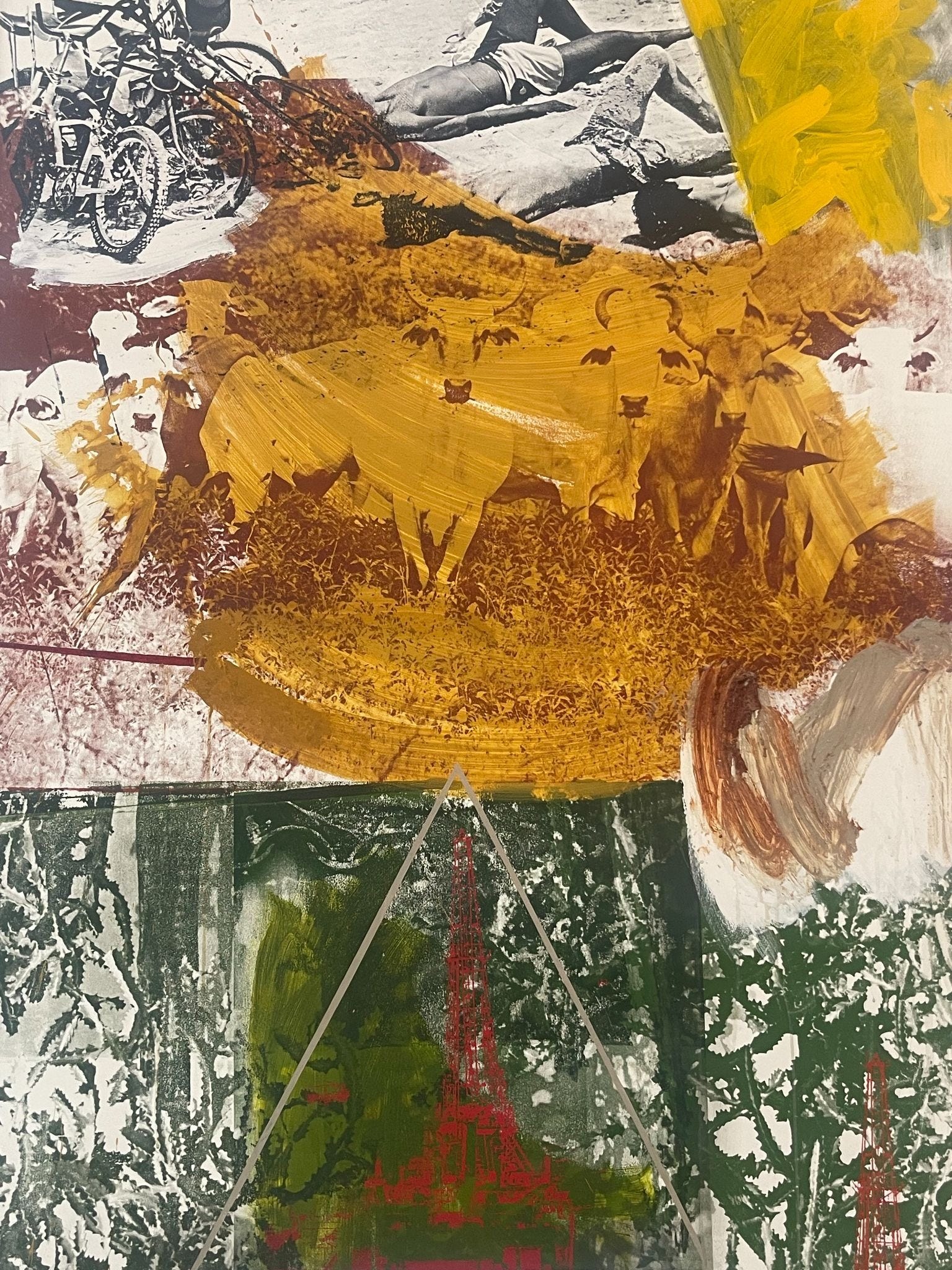
This sort of collision of materials and symbols is fundamental to Rauschenberg’s practice. Beginning with his “Combines” in the’ 50s—a series of works that combined painting and sculpture—he allowed the outside world to leak into his practice, pulling photographs, newspapers, clothes, and ordinary objects directly into his pieces. Nothing was too mundane or out of place to enter the picture. In doing so, Rauschenberg disrupted the boundaries of painting, allowing the mess of everyday life to become part of the image itself.
Today, the use of everyday materials in art is so common that it’s easy to overlook how groundbreaking Rauschenberg’s contributions were at the time.
TAÍNA H. CRUZ, Pixie Theatre, KRAUPA-TUSKANY ZEIDLER
Located in Berlin’s Kreuzberg neighborhood is the Pixie Theatre of rising art star Taína H. Cruz. Cruz is a hot new name in the art market. Recent showings in major exhibitions such as The Whitney Biennial and MoMA PS1’S Greater New York have only stoked the excitement. Beyond the commercial hype, though, it’s her ability to locate something strangely ancient and uncanny within the contemporary that sets her apart.
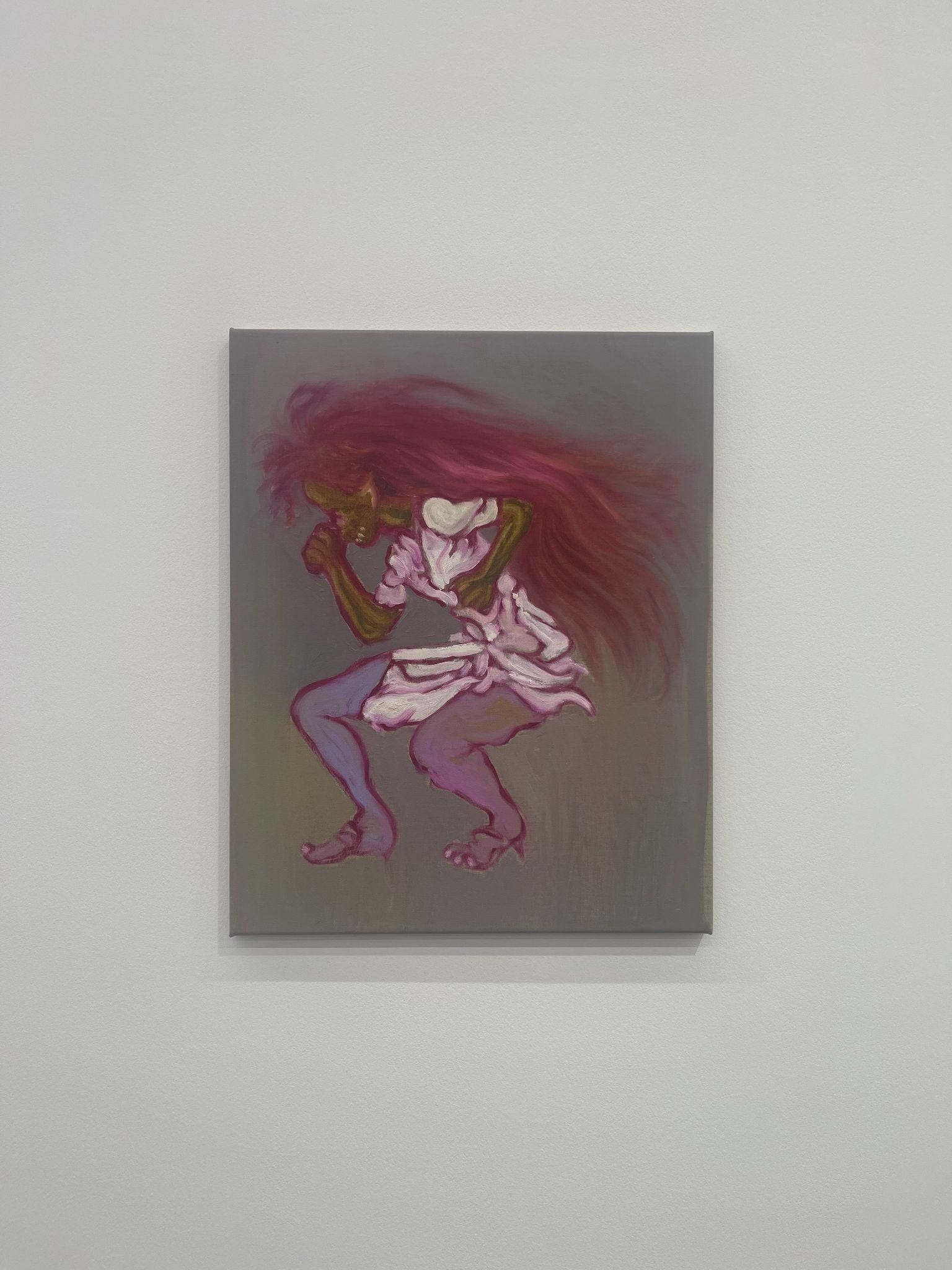
Cruz’s paintings live inside their own fairy tales, on the threshold between our contemporary digital ecosystem and something much older, almost folkloric. Her references shapeshift from one painting to the next. In the first gallery, one painting shows a woman mid-Pilates workout, while another captures a cartoonish troll figure that seems to be caught mid-dance. Elsewhere, the canvas is entirely replaced by a screen, where a video work shows two 3-D animated characters gyrating through a pollen-infested New York somewhere between The Sims and Grand Theft Auto.
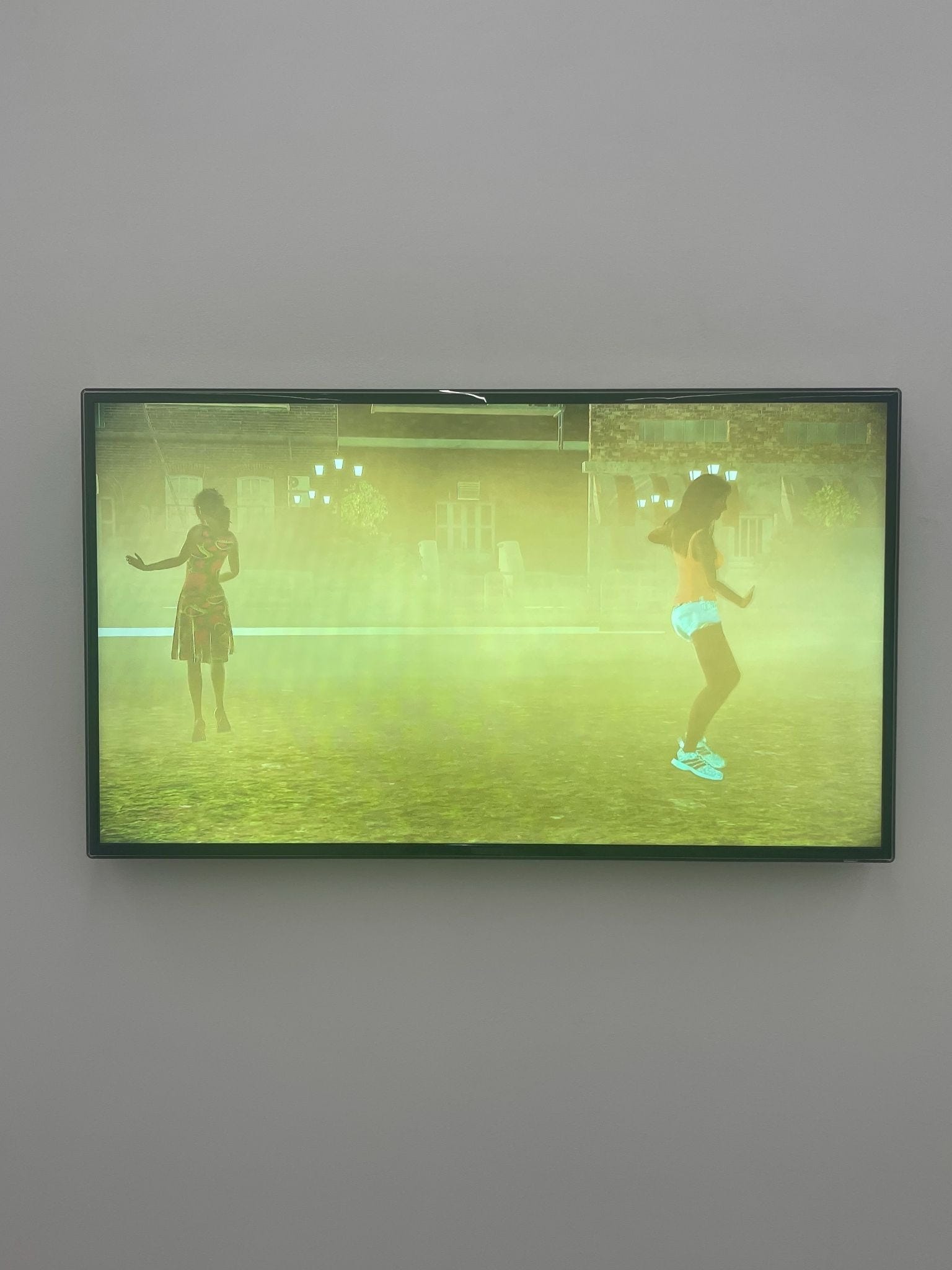
Energy seems to hold this strange universe together. Up close, Cruz’s brushwork creates a vibrating aura around her figures. Edges blur on bodies that seem caught between forming and coming undone, as if time itself were tugging at their edges.
In the second gallery, Cruz’s figures mutate further. On one canvas is a monstrous ballerina; on another a black-and-white face peers out. Opposite them, two paintings dissolve into an ambiguous blur. One shows a cavernous scene emerging from an amber glow, where figures appear to be engaged in some hallucinatory ritual.
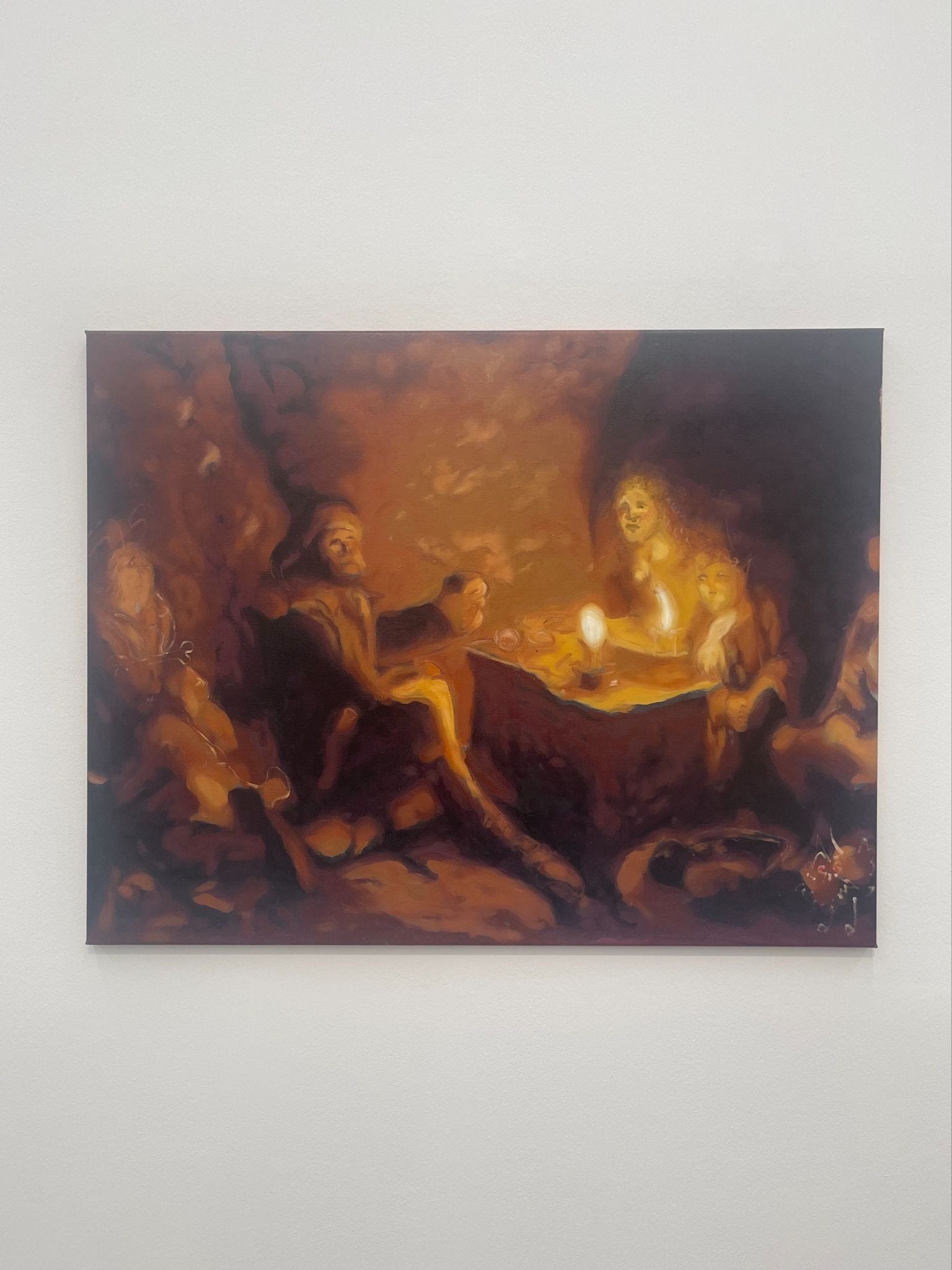
Their obscure faces have the slippery quality of an AI-generated image, as if an image engine had been asked to remix art history with folklore and fiction. Cruz finds something ancient and uncanny lurking in the contemporary. Everything is available at once, from ancestral symbols to cartoons, old paintings to video games, and nothing stays where it came from. In Pixie Theatre, the past doesn’t fade, but mutates.
NIKA KUTATELADEZ, Acacia Bloom, Galerie Molitor
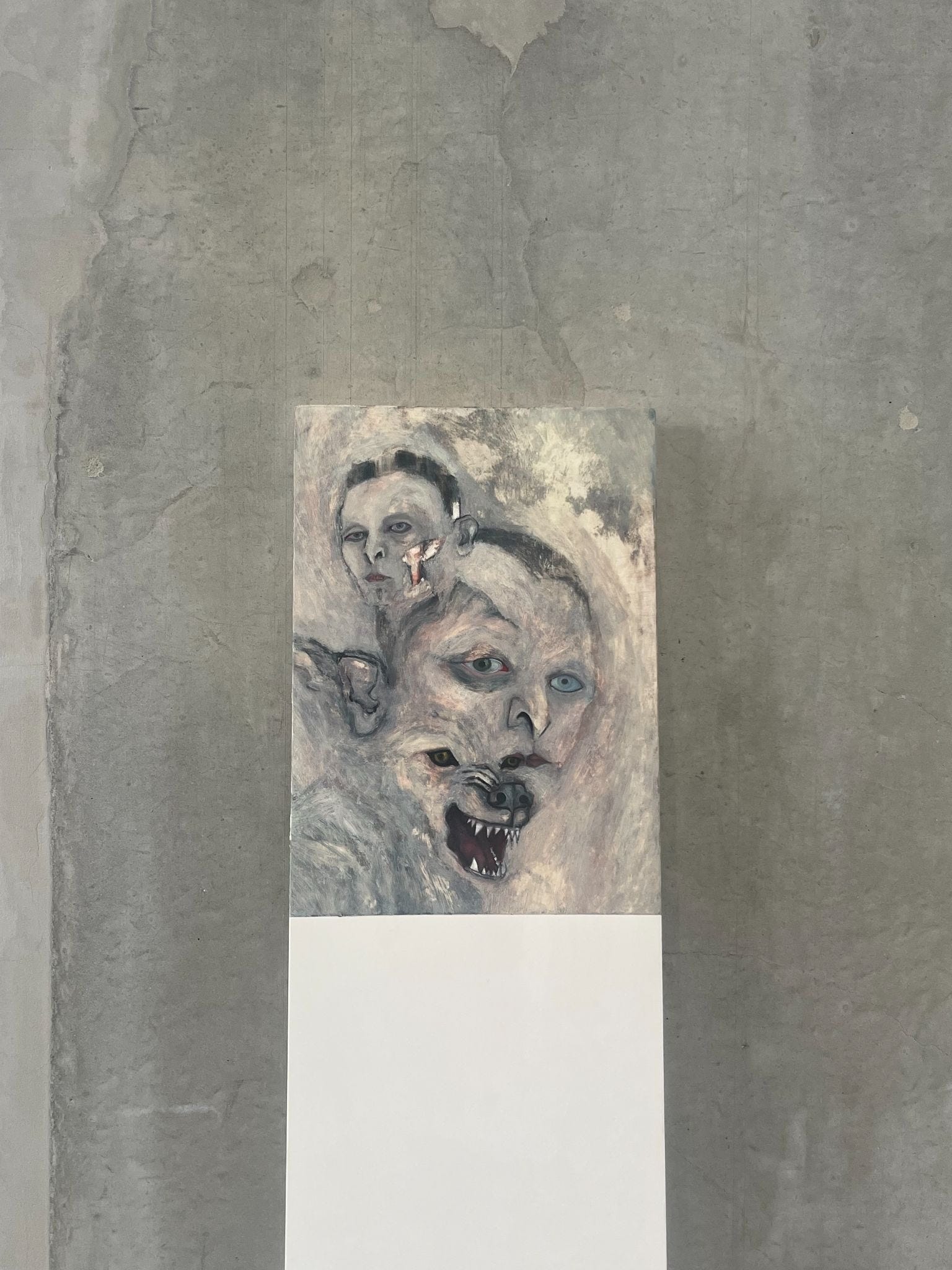
Mutant bodies were also a focus in Georgian artist Nika Kutateladze’s solo exhibition, Acacia Bloom. Inside an industrial gallery, concrete walls host small paintings of a man’s face caught in a kind of transmutation. His eyes seem to drift as flesh muddles into earthy color, leaving his face suspended somewhere between portrait and apparition.
In another work, the man now seems to morph into a chimerical jackal. As you descend into the basement, wooden pikes join the paintings.
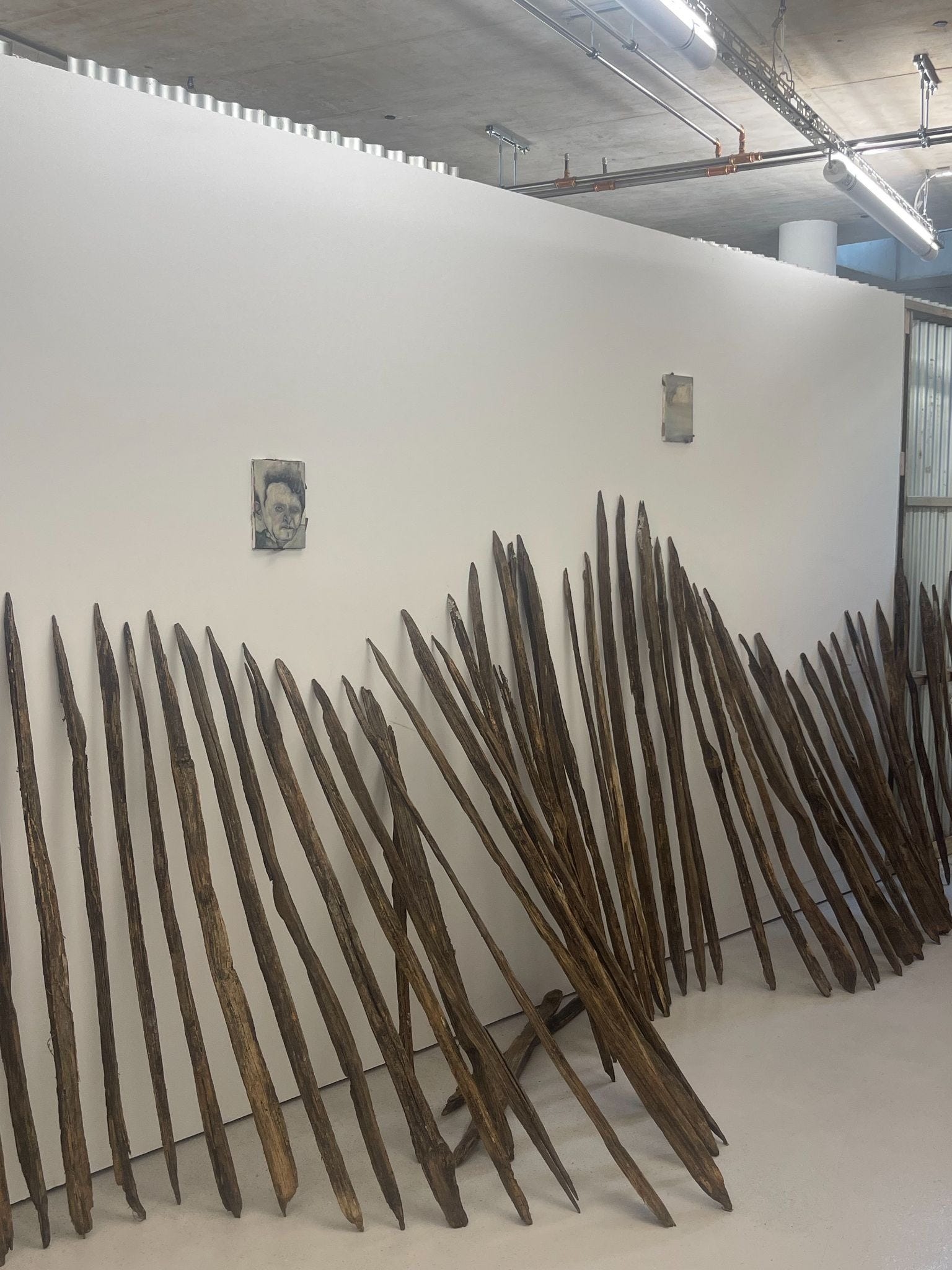
Kutateladze leans into his architecture background to build an environment that models the disappearing Georgian village that inspired this exhibition. There, locally grown acacia trees are used as fences, creating a peculiar loop of cultivation and enclosure as its mountainside slips away. The artist spent five years alongside the few men who remain in this eroding terrain, often painting their portraits.
In the remodeled basement, makeshift fences of acacia wood divide the space like remnants of a rural dwelling. Portraits of its inhabitants hang on temporary walls, where the painted men become increasingly inseparable from the landscape around them.
MAURIZIO CATTELAN, Night, NEUE NATIONALGALERIE
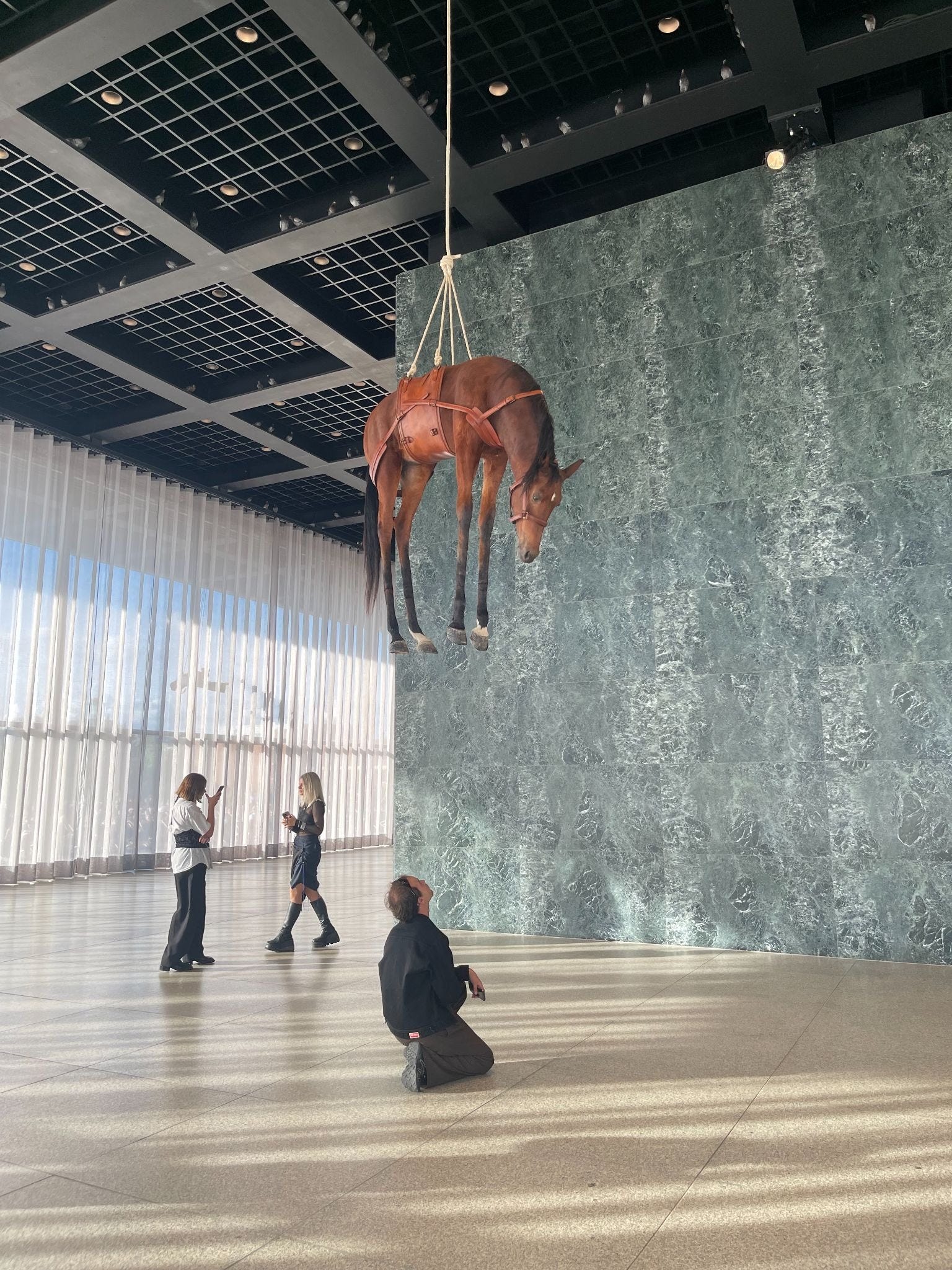
Serving as an anchor for Art Week is Maurizio Cattelan’s first major exhibition in Germany, NIGHT, at the Neue Nationalgalerie.
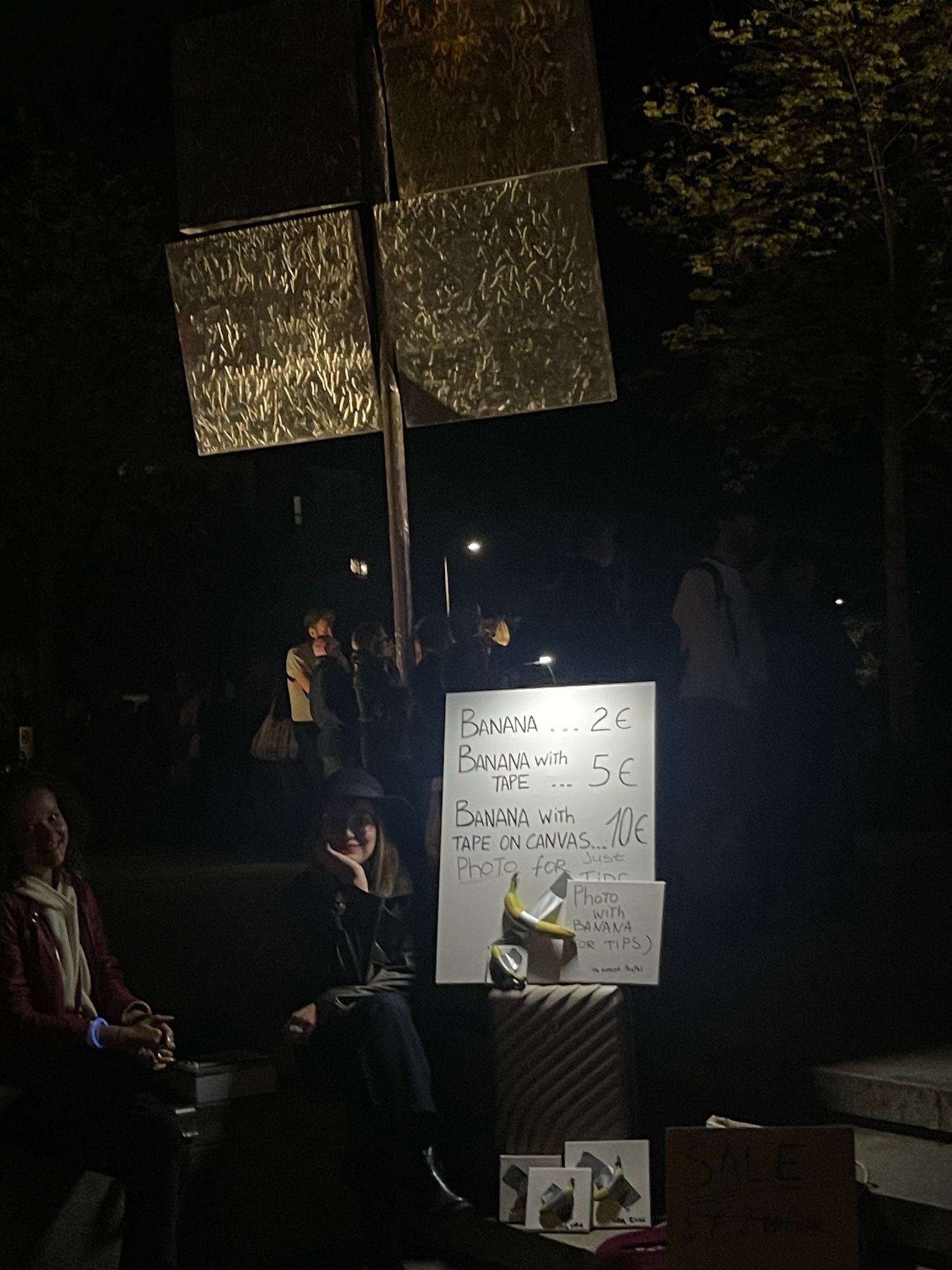
If you don’t know the name of this Italian artist, you most likely know one of his most famous works, Comedian (2019), the banana duct-taped to a wall that became an instant cultural phenomenon. Ridiculed, memed, and eventually sold at auction for $6.2 million, it became one of those rare contemporary artworks recognizable beyond the art world’s insular bubble.
Despite the lack of bananas here at Neue Nationalgalerie, Cattelan’s popularity remains evident. On opening night, I was greeted with a three-hour queue to enter the museum. Nearby, a local vendor capitalized on the hype.
Once inside, hyperreal sculptures flood the first floor of Mies van der Rohe’s glass building. Kneeling in the center of the gallery is a small, childlike figure with his back to the entrance, seemingly in prayer before another body suspended face-down over a bed. Walking around to the front of the innocent figure, I was surprised to discover Adolf Hitler. The trick is almost stupidly simple, yet somehow effective. Innocence from one angle is monstrous from the next.
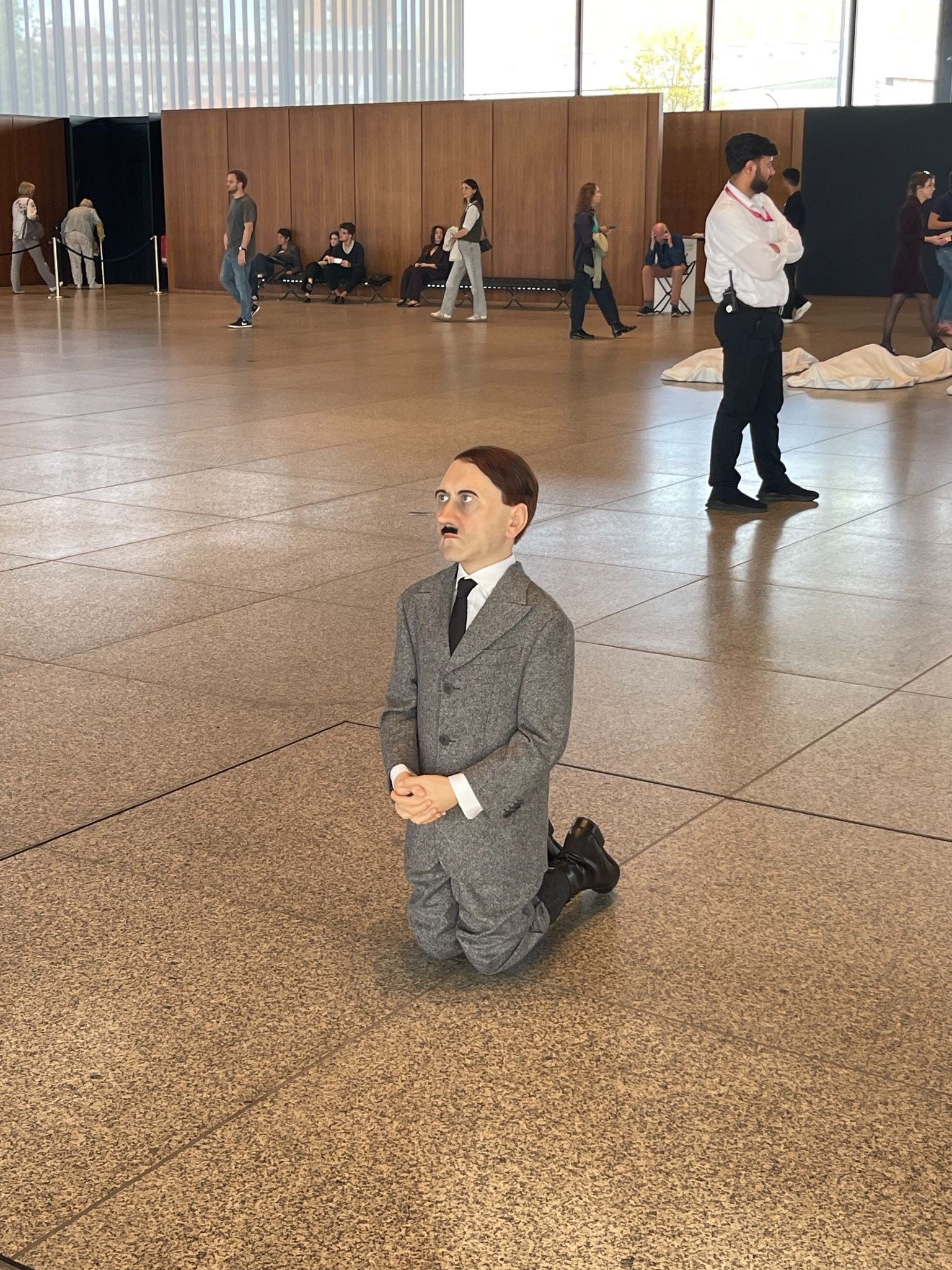
Encountering Hitler in Berlin gives the gag a weight. Cattelan seems most at home in this uneasy space, drawing you in through humor before leaving you to negotiate its darker implications.
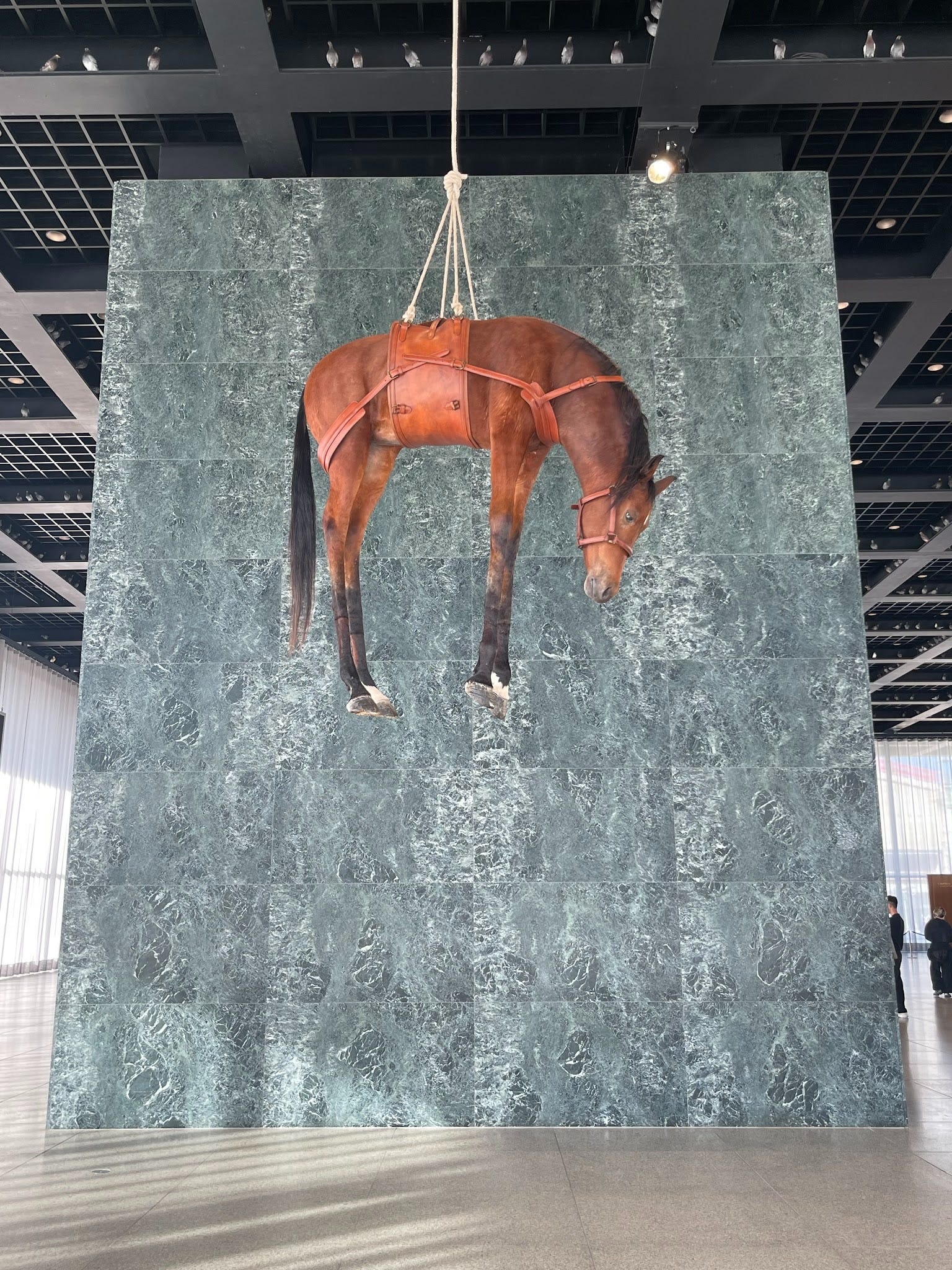
Elsewhere, a dead horse hangs from the ceiling, made strangely devotional against the backdrop of the museum’s cool marble. In the rafters, uncanny pigeons have invaded the building. The images register immediately, before you learn anything about the artist or the intellectual critiques associated with them.
This immediacy may be Cattelan’s true skill. He understands culture through its spectacular nature, where an image lands before its meaning. His sculptures exploit that instinct, using visual provocation as an entry point into something more difficult. Cattelan’s images are simple enough to circulate widely, yet strange enough to linger in your mind.
RYUICHI SAKAMOTO, seeing sound, hearing time, HAMBURGER BAHNHOF
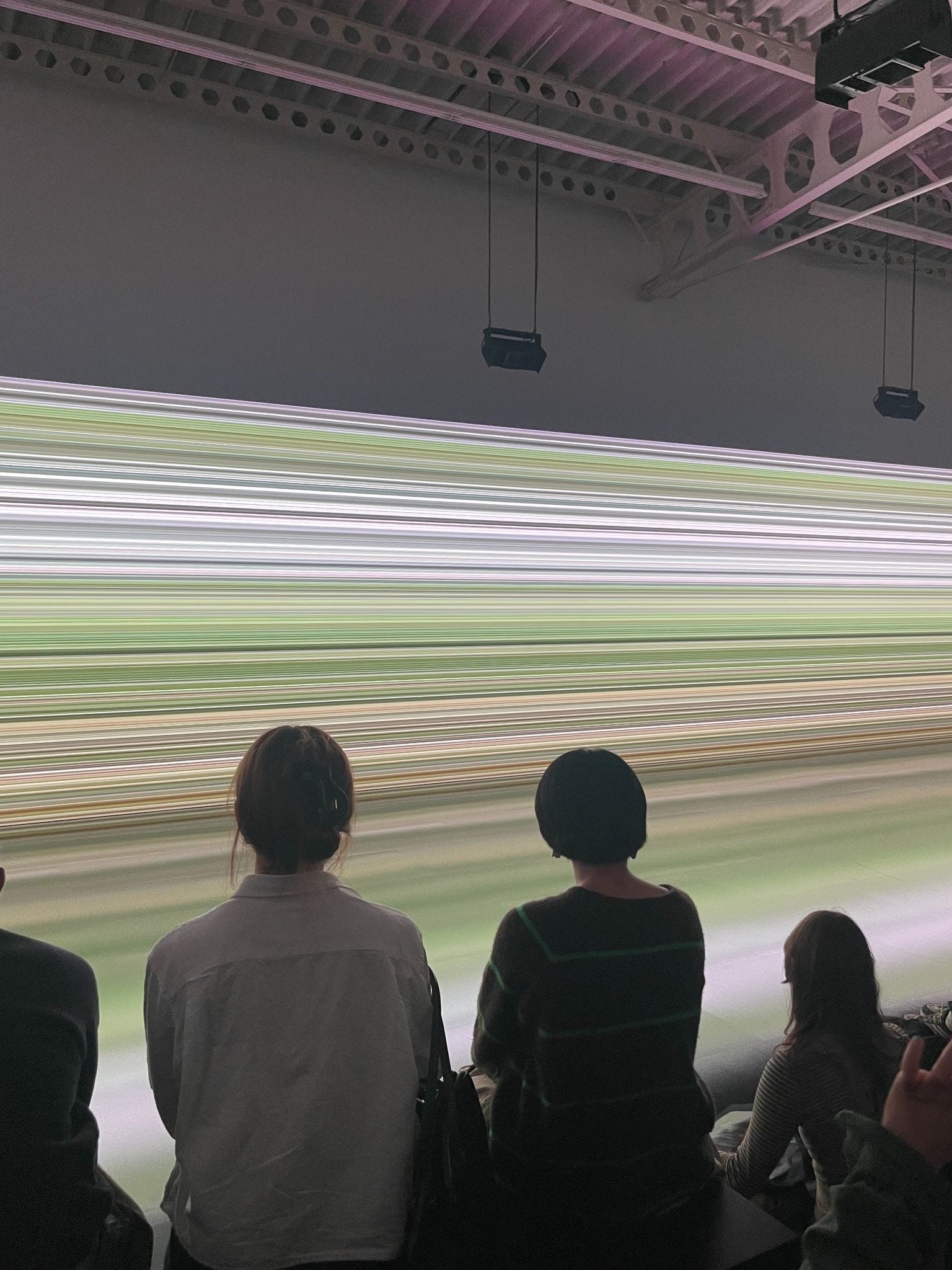
Inside Hamburger Bahnhof, and past another terrifyingly long queue, Berlin’s noise finally seems to dissolve. Japanese composer and electronic music pioneer Ryuichi Sakamoto’s seeing sound, hearing time unfolds across the museum’s cavernous suite of exhibition halls, which he transformed into a series of sound-and-image environments.
In one room, a piano affected by the 2011 Japanese earthquake mechanically plays a haunting score generated from seismological data. Next door, an expansive screen shows landscapes sliding in and out of existence. Scenes of nature emerge through spectral bands of light before being pulled apart again, as if the world were caught somewhere between rendering and disappearing.
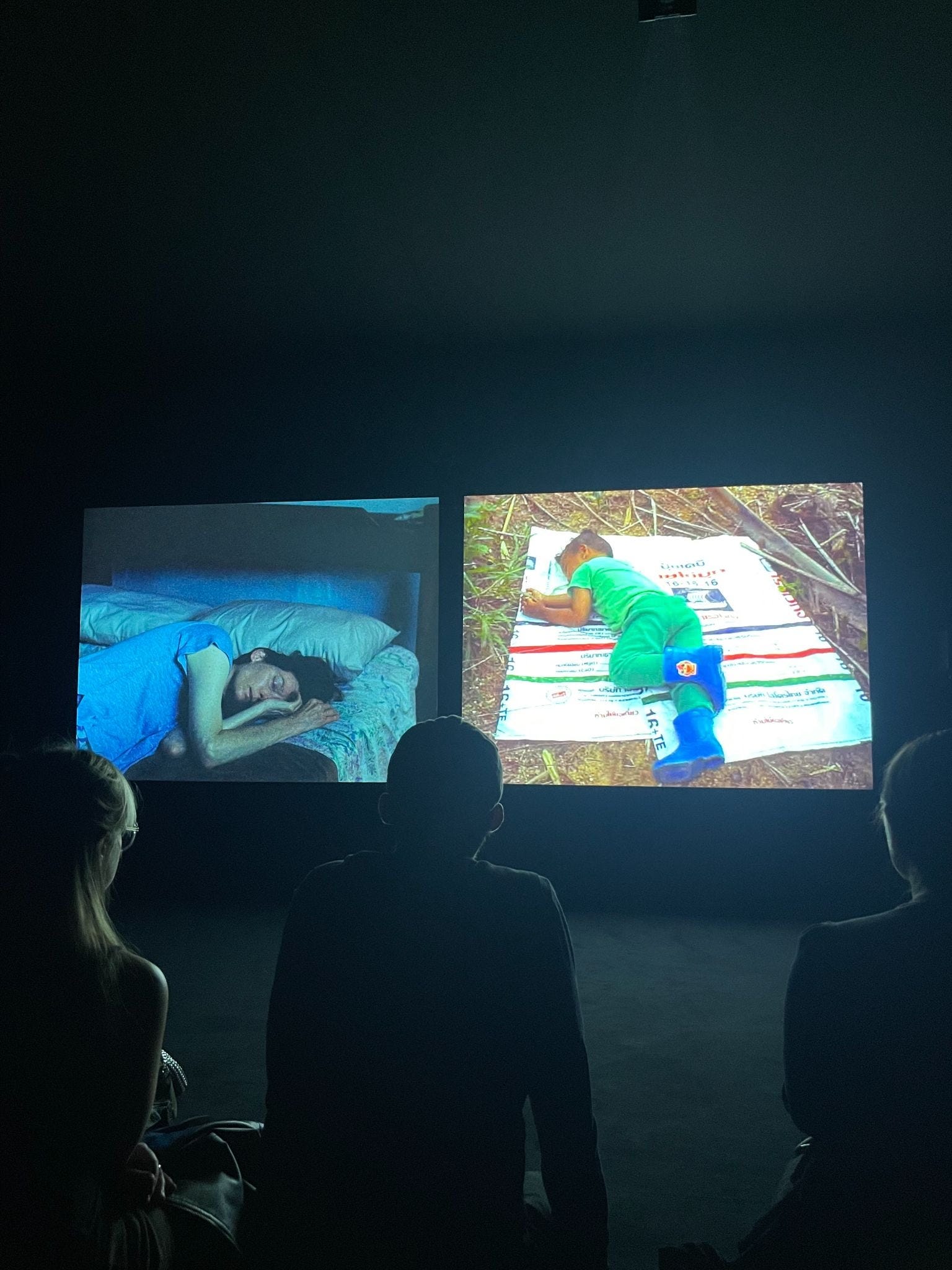
Sakamoto’s melodic environments feel like a fitting closure to Art Week. Rather than offering an overloaded image, Sakamoto leaves you in the dark, simply listening. For a moment, Berlin is made quiet.