


Written by Bryan Munguia
Whether you know his name or not, chances are you have seen the work of Damien Jalet. With a career spanning over three decades, the Franco-Belgian choreographer is responsible for some of the most recognisable movement and dance pieces in recent memory. He’s the mind behind that Yung Lean music video and VMA performance, Madonna’s Confessions II comeback, and the unforgettable choreography of Luca Guadagnino’s Suspiria. Just last week, his talents were recognised with an Instagram Rings award, which celebrates the people behind groundbreaking creativity on and off of the platform.
His roster of collaborators reads like a who’s who of the cultural vanguard, from filmmaker Paul Thomas Anderson to performance artist Marina Abramović to Daft Punk’s Thomas Bangalter.
Despite his seemingly mainstream visibility, Jalet remains a radical experimentalist. Drawing from his interests in mythology, ancient rituals, and the natural world, his practice continues to test the limits of the human body in motion.
We spoke to Jalet to hear more about his career-defining moments, his unexpected rise to viral fame, and his rather unfiltered thoughts on AI and the future of bodies.
Bryan Munguia: Just to start, what is a typical week working as one of the most sought-out choreographers today?
Damien Jalet: Oh, there’s no typical week. The most characteristic [trait] of my life is that there’s no routine whatsoever. I have spent the last 20 years trying to bridge contemporary dance and basically all the other artistic mediums. I’ve been working with filmmakers, visual artists, musicians, and even fashion designers sometimes. All my pieces are fruits of conversations. I’m also frequently traveling to opposite sides of the world, from north to south, east to west.
BM: I want to talk about some of your major works. Let’s start with one of your first pieces, D’avant (2002).
DJ: D’avant is a piece I co-created a long time ago, in 2002, at the beginning of my career. I used to sing and study ethnomusicology and was always fascinated by polyphonic singing and oral traditional music. Usually these were religious songs, but also funeral songs and Gregorian chants. [While studying] ethnomusicology, I met three other dancers and created D’avant. It became so successful that we toured it for about 13 years.
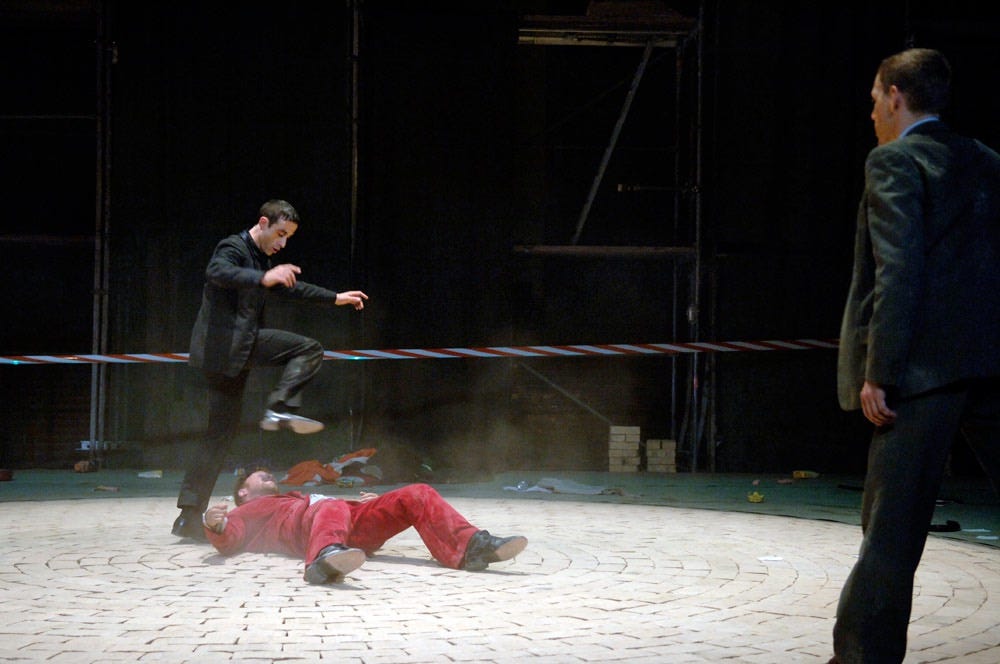
The piece was an ironic commentary on manhood, religion, and the fragility of [human] harmony throughout history. It was also quite a funny show. It was probably the most intense piece I’ve done. It was a repertoire of roughly 14 polyphonic songs, and extremely difficult to sing while dancing. It was also quite violent. It’s a piece that has taught me how to stand in your shoes as a performer, because it was demanding on every level.
Starting from this early work to now, are there any consistent themes or ideas you find yourself referencing?
I have quite a clear backbone in my research. My work has often been inspired by mythology, science, and rituals. For me, rituals and mythology are closely connected because they offer a way into the human subconscious through our ancestral knowledge.
I also love working with anatomy. I like to question the body and how we got our shape through millions of years of evolution. I re-question very elementary things that we’re so used to not seeing, like gravity, breathing, or the fact that we walk on two legs. We are the only species that does that, and also the only one that dances.
Tell me about the piece Skid (2016).
Skid is a piece I created 10 years ago for the Gothenburg Dance Company. I have always tried to find a way to make gravity more perceptible to an audience. The company only allowed me to use one-third of the stage, so, in collaboration with the American visual artist Jim Hodges, I decided to tilt it on a 34-degree platform so the stage would fall directly into the orchestra pit.
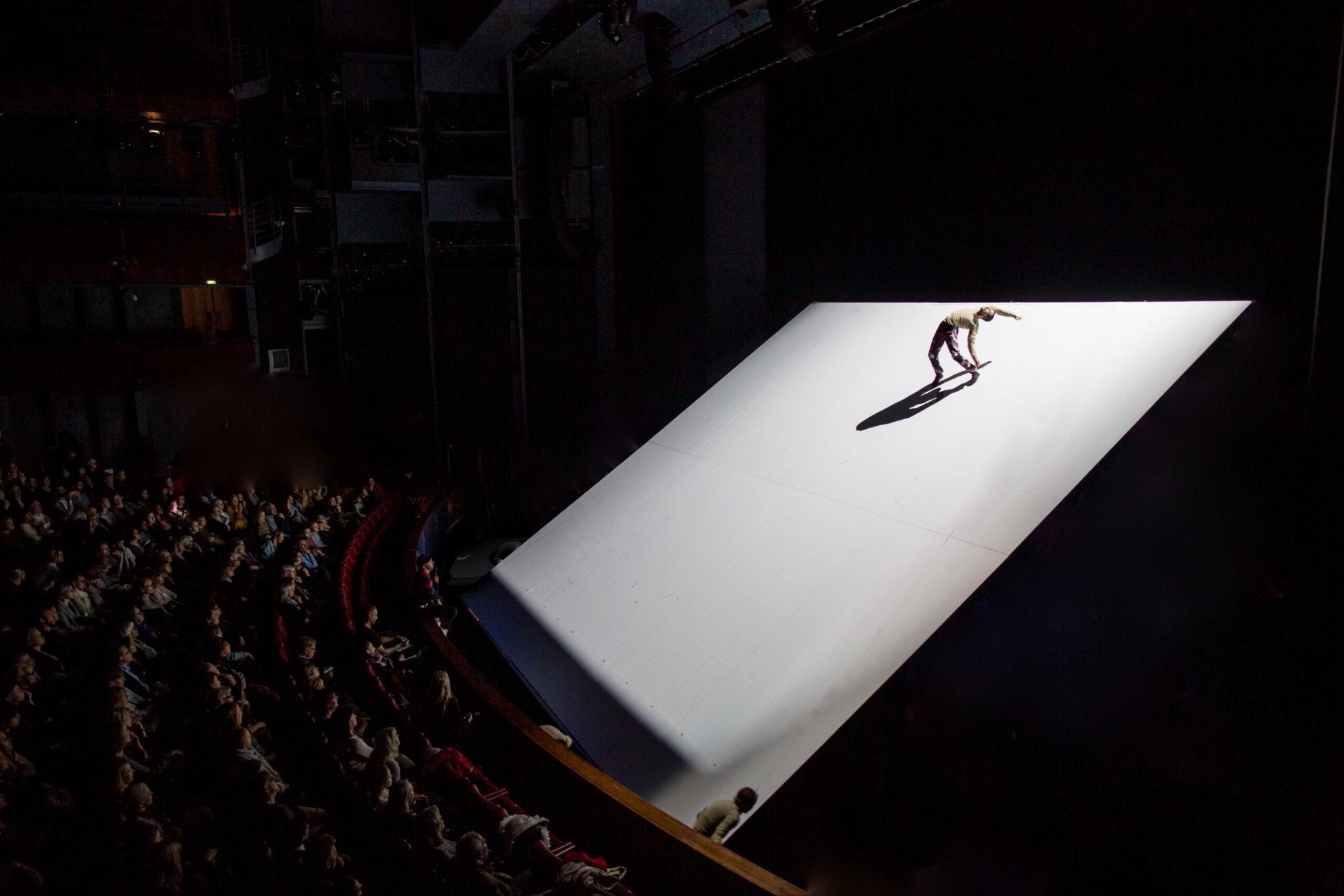
The idea is that, when dancing on this tilted platform, [the performers] have to completely deconstruct everything they know and rebuild the language of what is possible. Sometimes you can move without moving because gravity is doing the job, or you move so quickly, like 10 meters in two seconds, just because of the gravitational pull. Everything is drawn into the movement, sliding across what looks like a big canvas or screen. You watch the piece almost vertically in front of you.
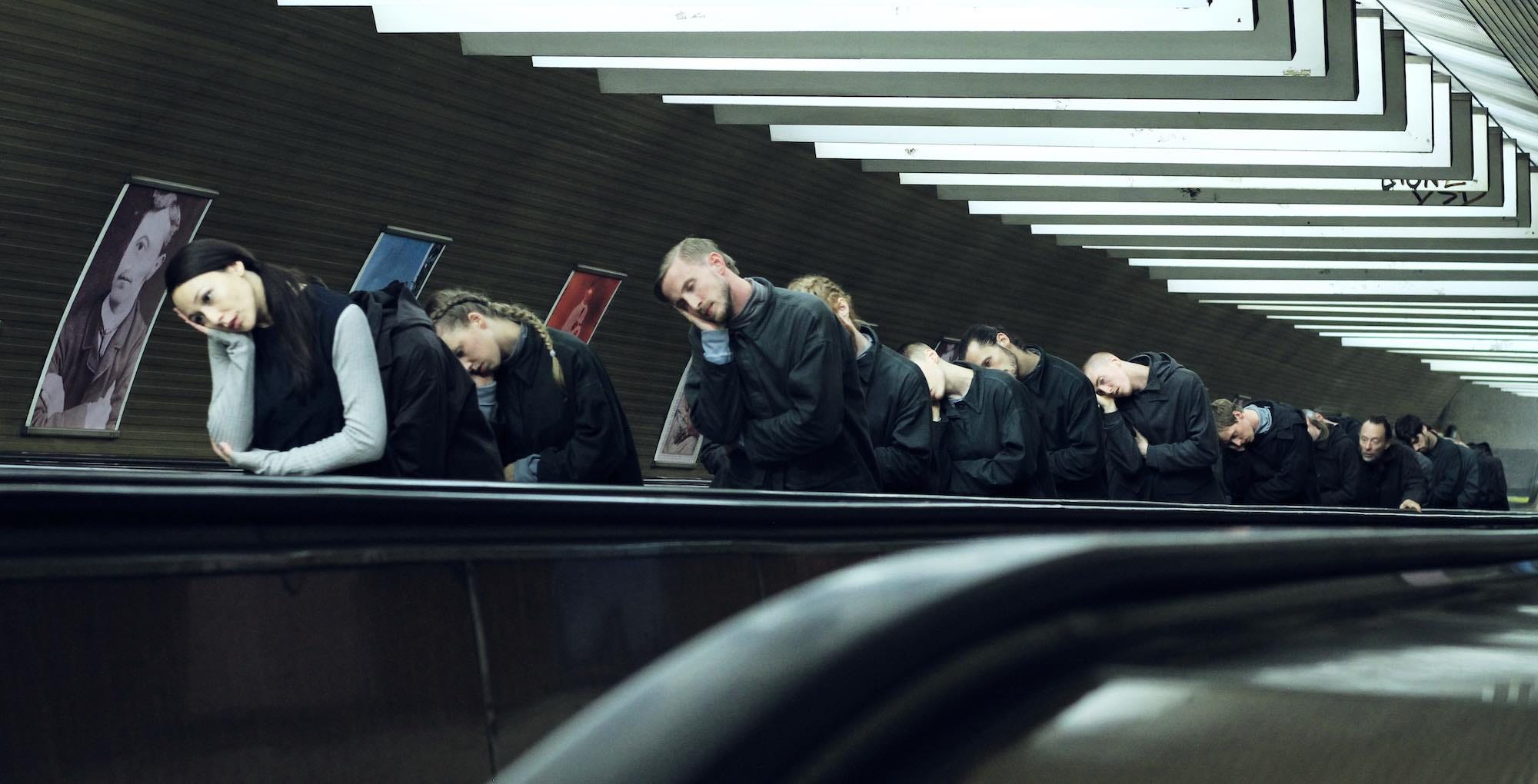
You can also see Skid in the film Anima (2019) that I did with Paul Thomas Anderson and Thom Yorke. I always feel there’s an interesting connection between gravity and sleep. When you fall asleep, you surrender to gravity, which inspired the film’s subway scene.
It was filmed with a camera tilted at a sloped angle, creating a surreal illusion of everyone living in a tilted world — something I also used to teach dancers to surrender to gravity, playing with it more than constantly trying to resist it.
What about Chiroptera (2023)?
[French artist] JR reached out to say he’d received an offer from Paris Opera to stage something during the two months while the opera was under renovation. He came up with this idea of a cave, and he wanted me to create a performance connected to it.
I’ve always dreamt of creating a vertical dance piece, so I decided to use the opera’s scaffolding. Each square held a dancer, and they would wear both a reflective costume and cape that absorbed the surrounding light. This game of appearing and disappearing was really interesting because the audience had to bring a headlamp that made the dancers look holographic because of the reflective material. It’s also what you wear when you go into a real cave.
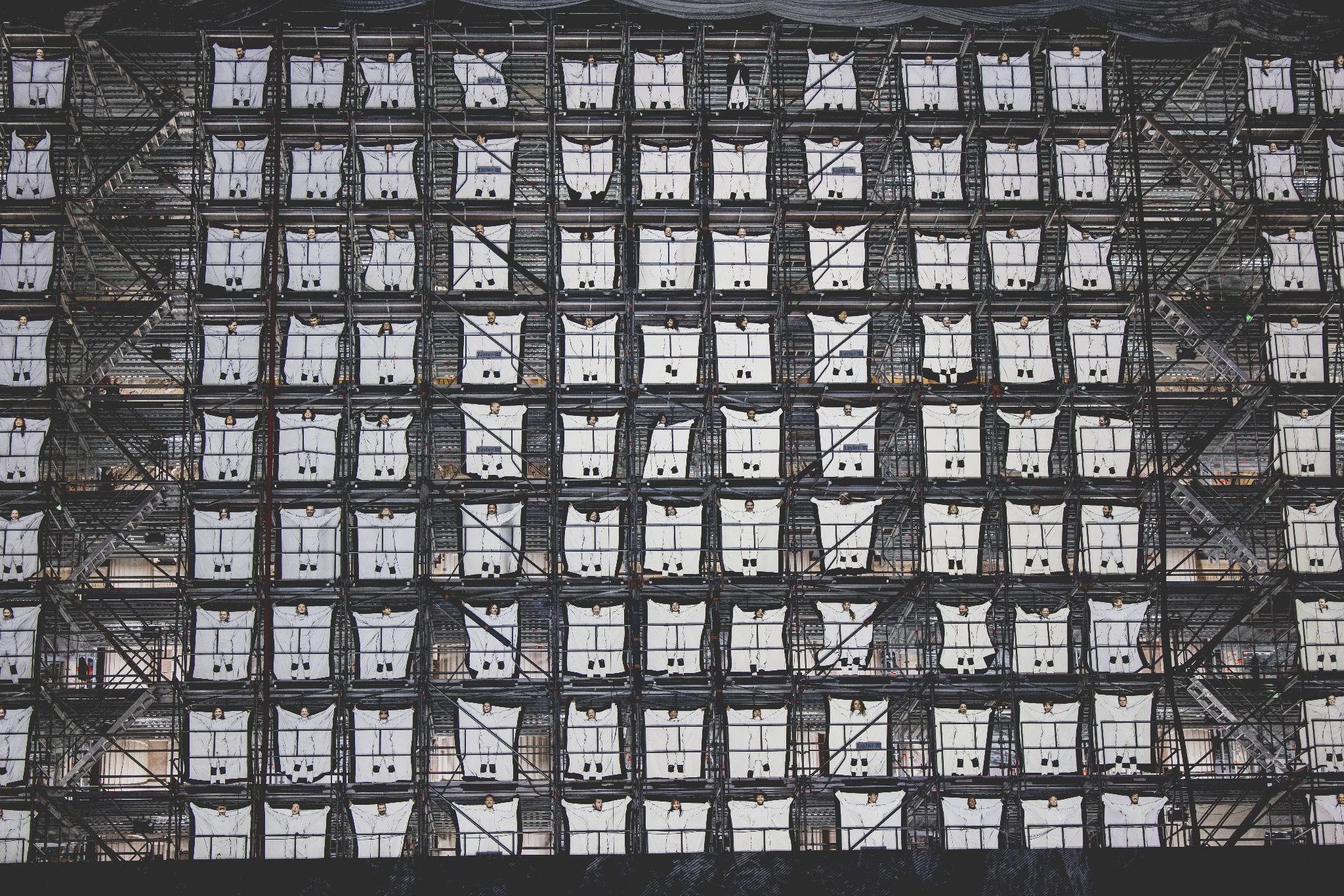
[The scaffolding] made the dancers look like bats, so we called the project Chiroptera1. It’s also a philosophical reference to Plato’s Cave: we, as people, are all stuck inside a cave, and what we see is just a reflection of reality. We had to develop a whole new technique to manage how to choreograph dancers that would not see each other on nine different levels.
The message of the piece is that darkness holds the grace of the light, something that only appears in the night, like a kind of secret. It’s a very important piece for me on a personal level, as I’ve been a direct witness of the Paris attack that happened on November 13th in 2015, [the eighth anniversary of] which was just the day after the premiere. It’s probably something the City of Light taught me: that darkness is the best way to see the light.
Tell me about Vessel (2015).
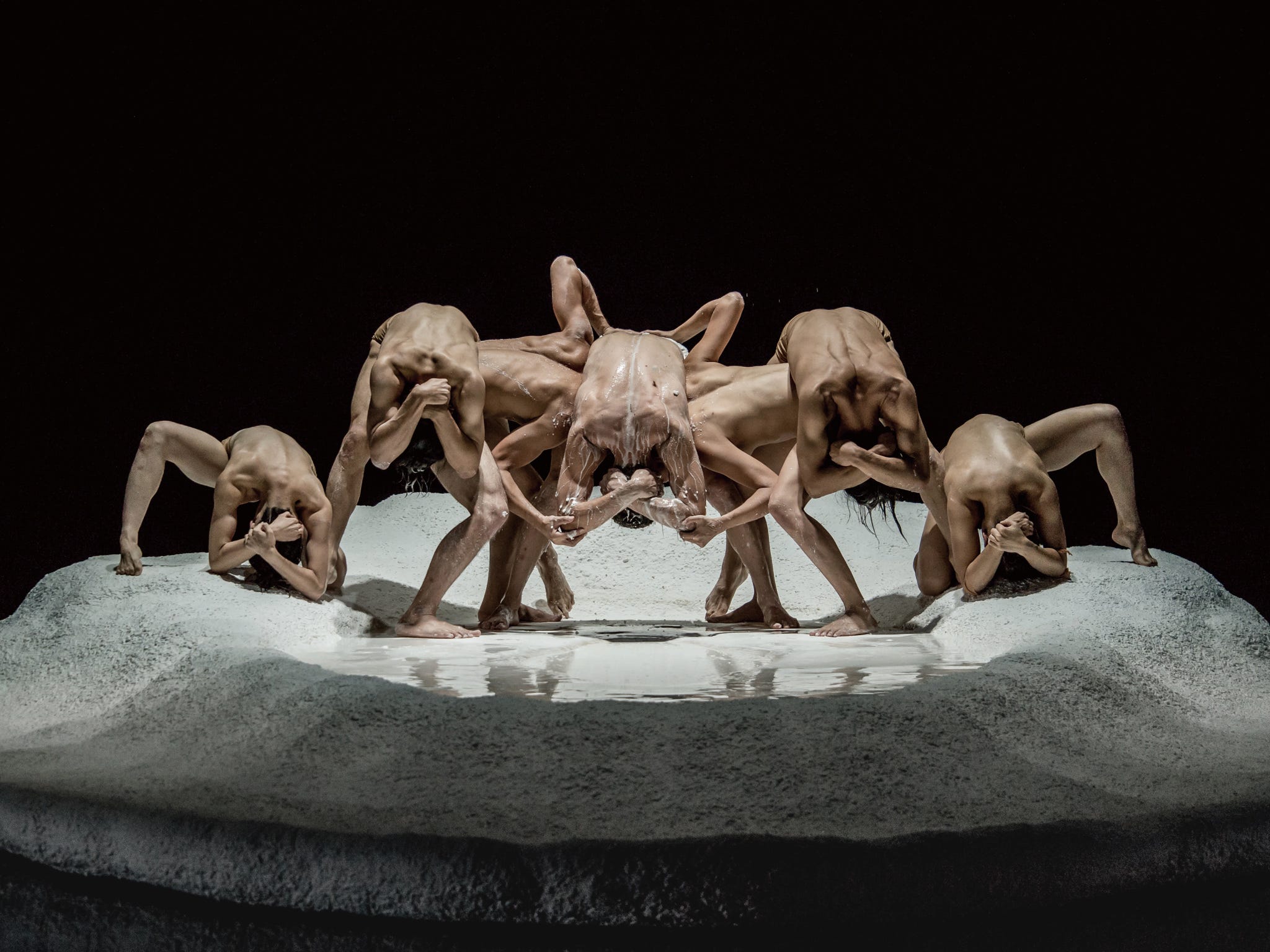
I think, like any artist, I’m investigating what the human experience is about, and with a point of view that isn’t necessarily anthropocentric, in the sense that I love to show what connects us to the non-human. I love to work on the animalistic nature of our being. In a piece like Vessel (2015), the dancers never show their faces and are slightly naked in a completely flooded environment. In the center of the stage is an island that reminds you of something between a grave and female genitalia, in an abstract sense.
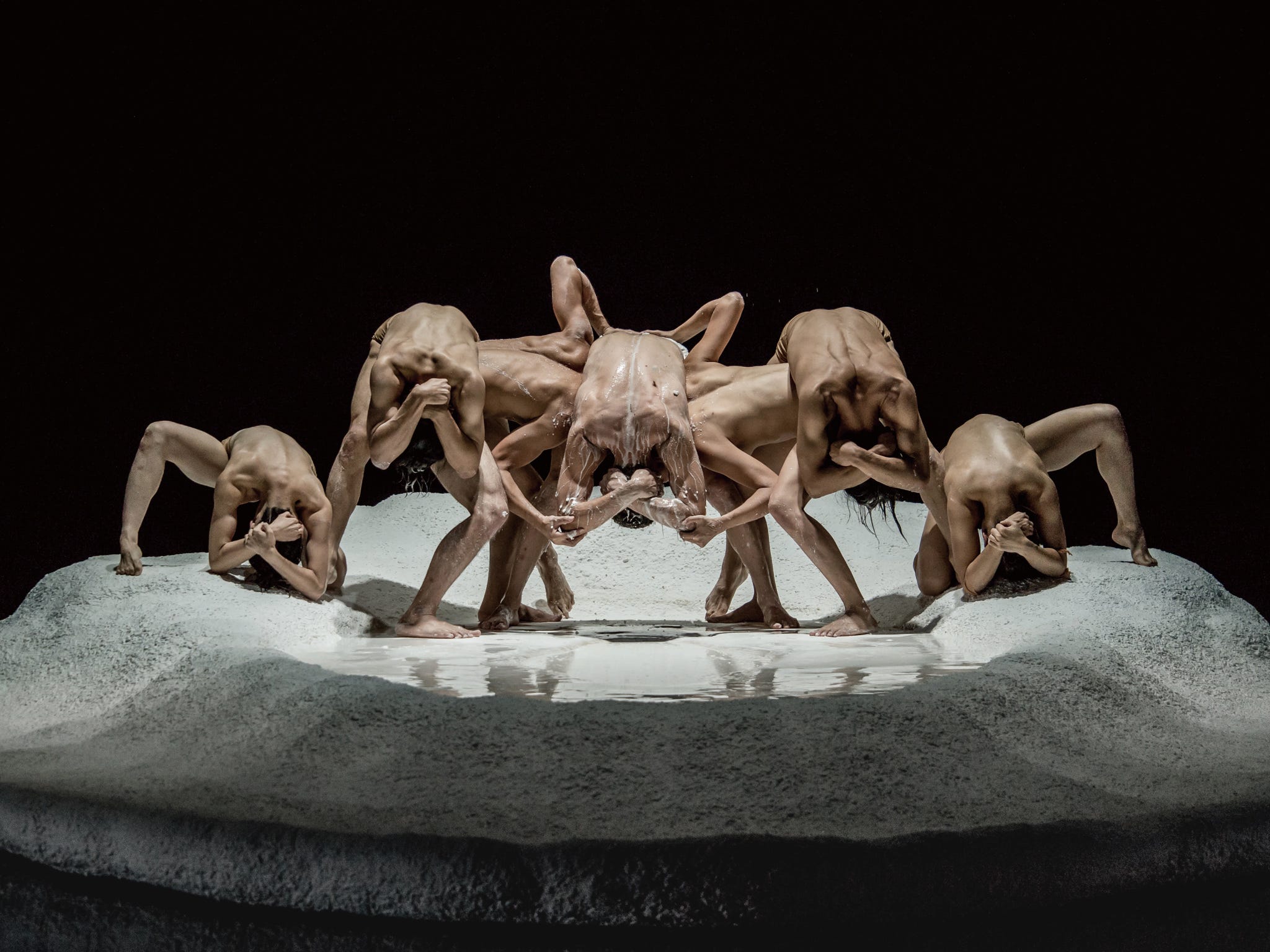
Vessel is a very radical piece because the performers never see the audience. Their heads are concealed within their bodies, and they create forms that leave very few traces of the human left. It’s interesting how hiding a dancer’s face makes their identity disappear. The audience projects different things as well; the human body has real sculptural potential, but it can also evoke different species. It was unsettling for a lot of people, but it also toured widely, and it’s definitely a signature piece for me.
Vessel inspired another piece. Tell me about Planet (2021).
After Vessel, [Nawa Kohei and I] created Planet, a piece developed through the complex relationship between humanity and its surroundings. The word planet comes from the Greek word planámai, meaning to wander. I wanted to portray humanity’s fundamental characteristic of constant wandering. We are nomads at heart, and we have that urge to expand. The music is by Tim Hacker and combines gagaku, an extremely ancient form of imperial court music in Japan. It connects you to electroacoustic waves, creating something both ancient and futuristic.
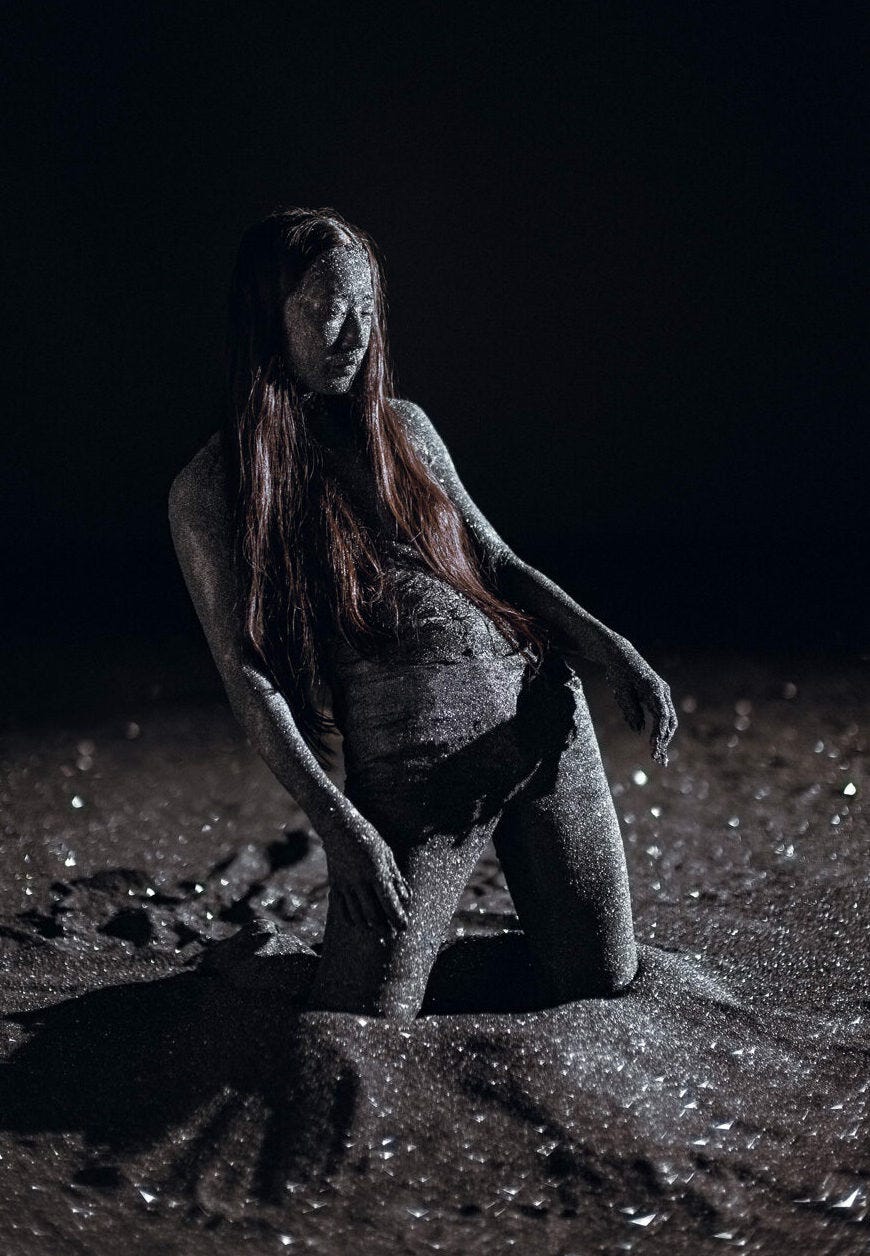
[In Planet] eight dancers, like the eight planets, are coming from very different places; the metaphor of a wandering nature; and how we emerge from a long evolution. We are still transiting, and have not yet found our final form as humans.
Many people will have seen your work in the film Suspiria, even if they don’t know it. Tell me the story behind that piece.
I started gaining a larger audience after Suspiria, when I choreographed for Luca Guadagnino. Luca saw [Les Médusés (2013)], which was quite niche despite being performed at the Louvre Museum, but it was dark and strange, and he probably invited me because it fit his film’s narrative.
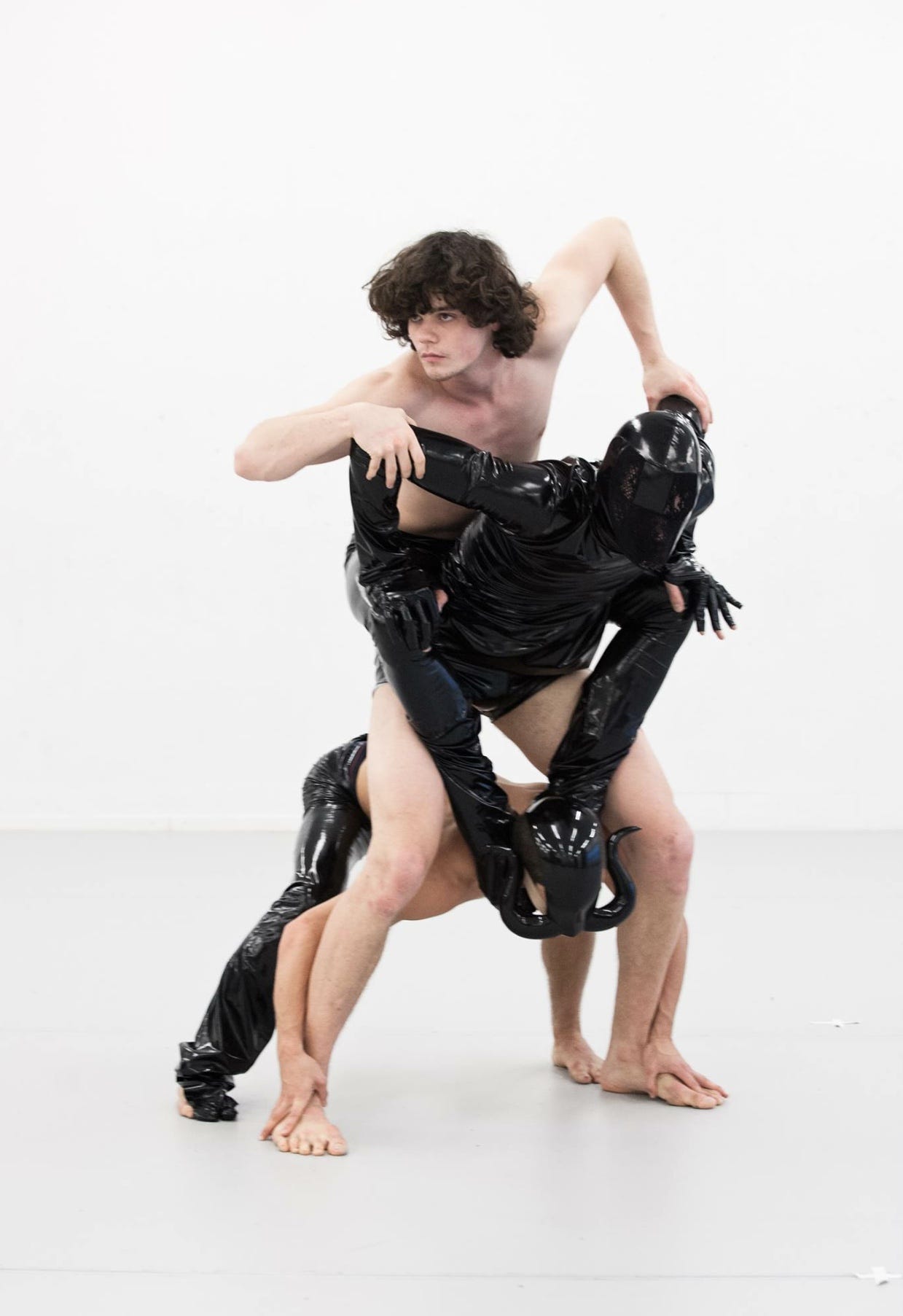
I think he called me in July, and we started shooting around November 1, 2016. Happy 10th anniversary! The film took two years to edit, and when it was released, I understood that Luca wanted something more balletic and softer-edged, or more mainstream in its aesthetic. In the film, however, dance was the killer. Through the choreography, you kill. So dancing was also connected to the film’s most violent scene.
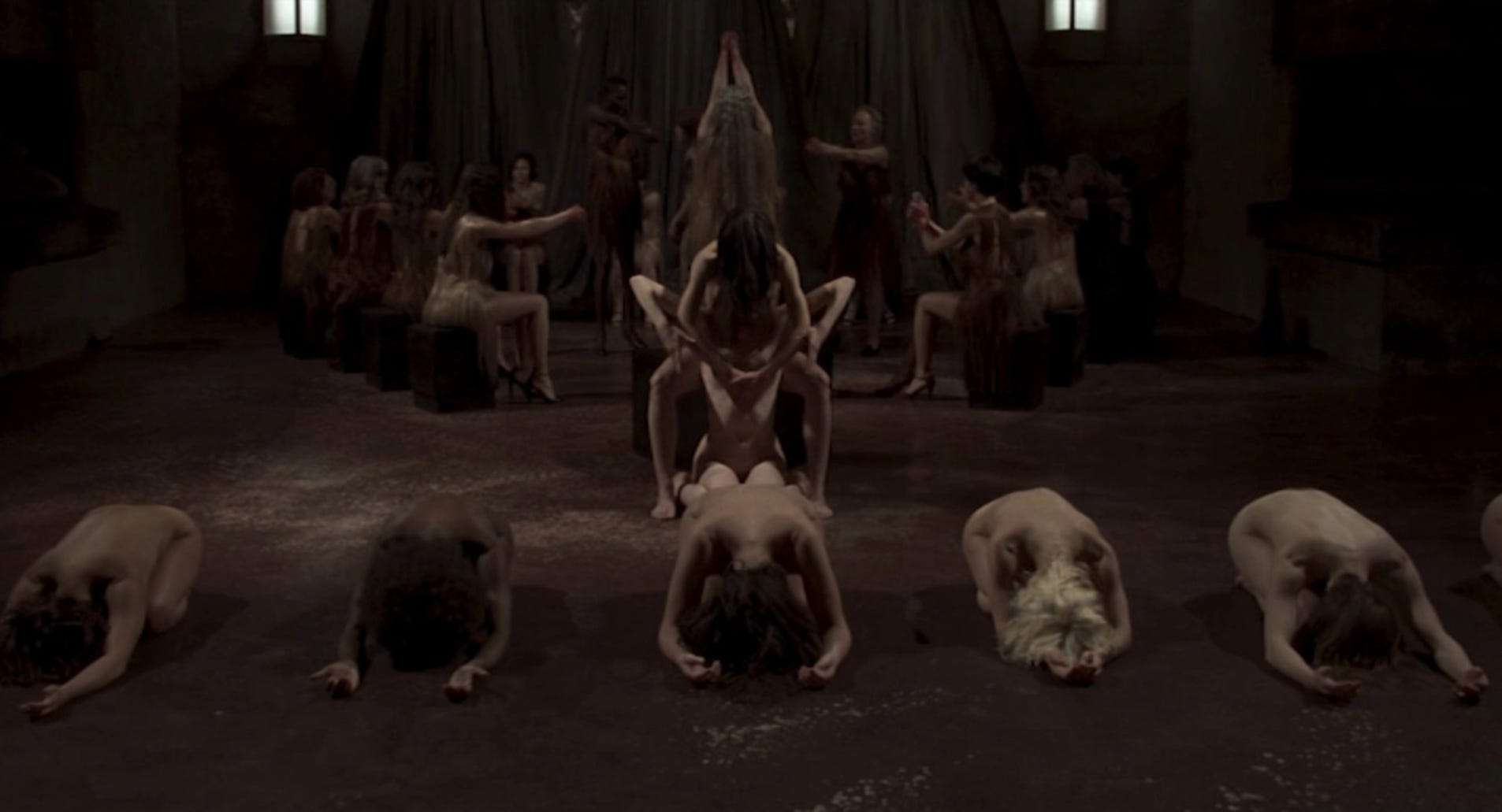
I’ve always loved questioning what we perceive as beautiful, and finding beauty in things that might not appear so at first sight. Actually, this question of beauty in dance has always irritated me because I think dance has often been connected to something so academic, so bourgeois, so ethereal, which is niche in itself, but it’s incredibly reductive.
So for me, I love the fact that Luca was really up to bring this kind of modern dance into this film and to give it so much space. That was one of the elements that people really appreciated in the film. Suddenly, I reached an audience I would never have connected with. Then Madonna saw the film and wanted me to work with her.
What was the experience of working with Madonna like?
I started dancing because of Madonna in the 90s when I was about 11 or 12 years old. She’s the one who definitely connected me to my body. I was happy to have this kind of full-circle moment. She’s always been a bridge between high art and mainstream, and I like this iconoclastic idea of breaking walls, creating bridges, or confronting points of view. I’m very happy to help break [norms] and bring something very specific, done with a lot of rigor. It took me 20 years to develop this kind of compositional complexity.
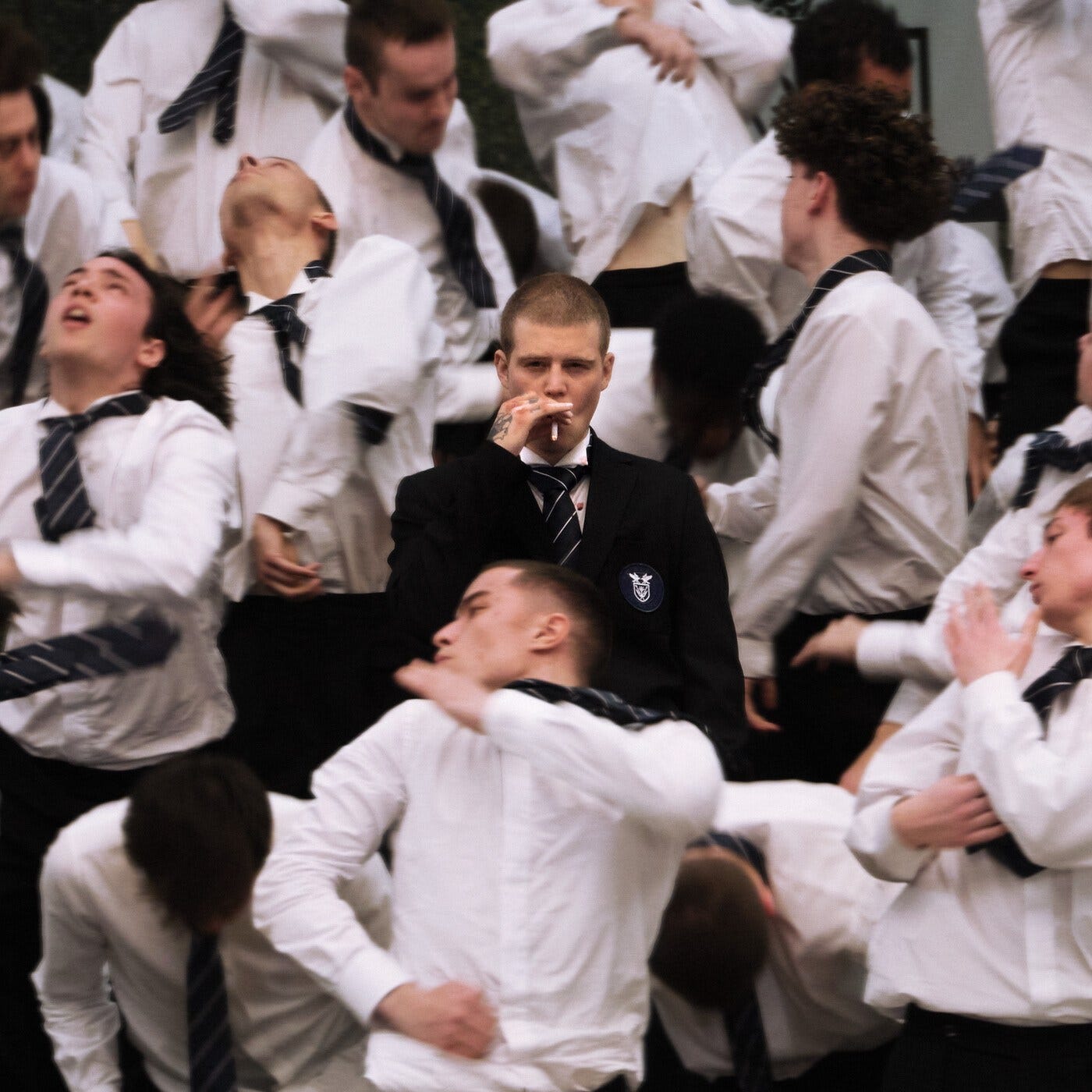
I’m now thinking about the mega-viral Yung Lean STORM performances. Do you ever think about virality when you’re choreographing, and how these bodies will show up on social media?
I’ve always considered myself a niche choreographer, where the things I initially did would be visible only to a small number of people.
I think it’s fascinating that I end up reaching millions of people just by sticking to developing my craft, because I’ve always done things a certain way. I’ve never really been able to adjust my work to fit a more mainstream context, and maybe that’s why the STORM (2026) video is so successful, because it’s itself quite a radical object. The internet lets those things be shared massively now. It would have been impossible 20 years ago for this kind of performance to be so widely seen.
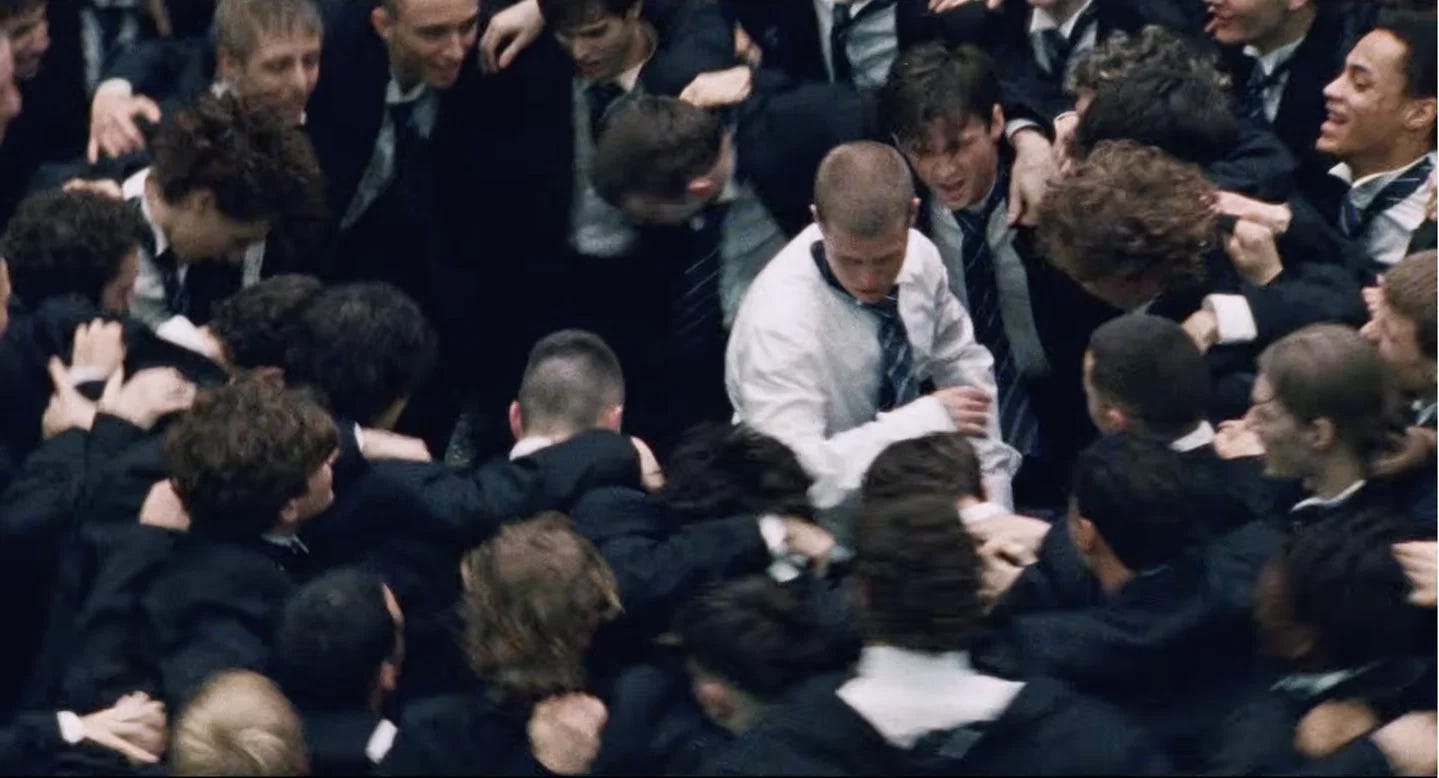
STORM is quite radical, in the sense that [today] everything is over-edited, and people’s short attention spans don’t last more than three seconds before they scroll off. Deciding to do a three-minute dance with no cuts or editing as one movement is pretty daring. Nowadays, very few people do that.
Whenever I work in mainstream media, I take good care of my contract on the condition that I get complete carte blanche: it’s French to do whatever I feel. I just did an event in Seoul with Gentle Monster and Martin Margiela; it didn’t look like an advertisement for glasses. It was actually a sensorial, semi-dark kind of experience that I think surprised its audience.
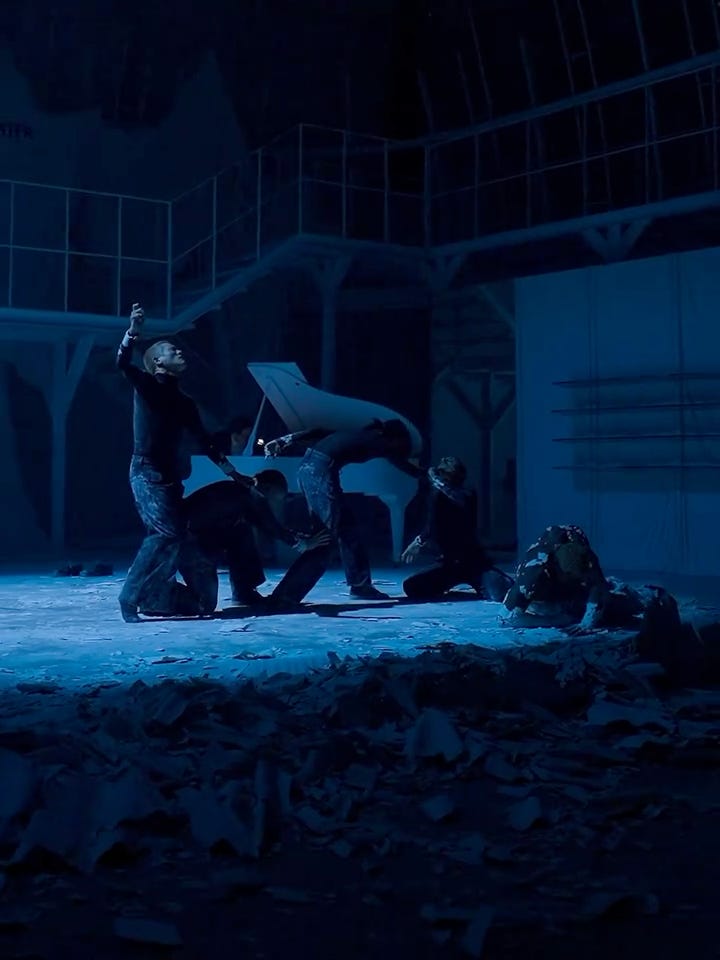
Still, I am not obsessed with viral success, and that’s important. I need to trust my instincts and feel a gut connection to the project. It has to challenge me intellectually, artistically, spiritually, and in every single way. That’s basically what keeps my energy going.
There’s some controversy around people’s use of AI generated visuals based on the STORM music video. What was all that about?
I’m going to be very damning. I hated it.
I liked the first two or three videos. What I really didn’t like was that it felt like people [were entitled to steal the dance]. Even with the viral success of STORM’s original video, there was a good side to it: you think, “Oh, people are so excited by it that they want to become it literally.” Still, I think stealing this dance by just pressing three buttons, using a technology that is, first of all, incredibly demanding in terms of natural resources—from water to electricity—and without crediting the artist, taking the thing, just putting yourself, your ego, on it, and sharing it with no kind of consideration.
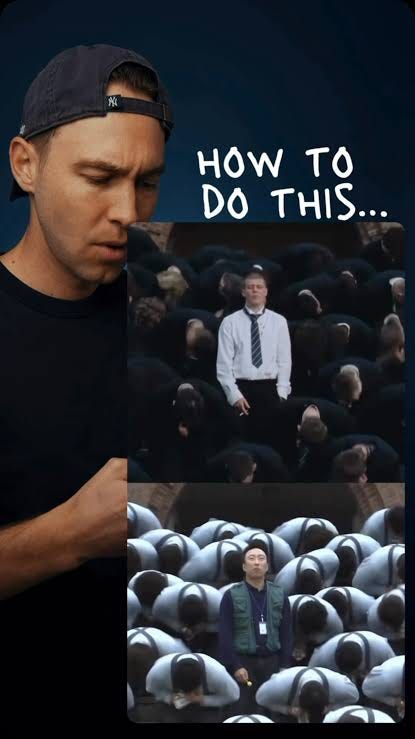
It’s like someone takes your soul and basically puts whatever they want on it, changes the color, adds a bit of this and that, and usually has incredibly bad taste. I love it when people get inspired, but I don’t think AI can capture the STORM dance. It always looks weird. From a choreographer’s perspective, what I’m interested in is the differences between each performance. I need to feel the very small distortion, the differences that make you really feel the emotion it comes from, and it’s why none of these videos are actually moving.
I think that my problem with AI is that I think art is the expression of the soul, and I think AI doesn’t have one, at least not yet. I might sound like a boomer and completely conservative about this, but I’m really quite affirmative about it. When it comes to art, I think it’s all about subjectivity.
Why do you think audiences are so captivated by real bodily movement?
Because we all have one, the body is the condition of our existence. Without a body, you’re not there. And people often think that, in a capitalist society, the body has to be very useful; you have to be able to do things with it or need to have a utility, which I think dance re-questions. That’s probably why dance has so much to say in the time of AI, because AI [re-examines] the utility of humanity, of the human body. And in art, maybe the body is also what connects us to nature. I think when you work as a dancer and a choreographer, you understand that the body has a lot to teach you.
It’s very hard to lie with the body, and in a time where everything is artificial and processed and transformed, I think the body has a certain sense of authenticity that we’re all starving for.
The scientific order name for bats.