


If you’ve spent much time looking at art on Instagram, you might be aware that there is a new artistic movement emerging. It’s been percolating for years, and has reached fever pitch in the last 12 months.
The movement is defined primarily by one fact: the art looks like it was made by a child.
This is not derogatory. The art is childlike in the sense that it is colorful, raw, and anti-technique, but it still displays a compositional awareness and attention to detail and color balance that has produced some of our favorite pieces over the last year.
Many of its practitioners are excellent artists on a technical level, who are intentionally turning in this more whimsical direction. (The reasons for this are numerous, and we’ll get into them.)
Artists working in this style are multiplying rapidly, and the aesthetic has broken into several adjacent cultural spaces, such as underground rap, and major commercial campaigns.
Internally, we’ve been calling it the Elementary School Figurative style. In this piece, we’ll be defining the style, identifying our favorite practitioners, and examining the motivating forces behind its emergence.
[def] Elementary School Figurative: a widespread contemporary artistic movement that incorporates materials, colors, subject matter, and stylistic motifs reminiscent of an elementary school arts and crafts session.
Defined by:
colorful palette
colored pencil or pens/markers as the primary material (or the digital mimicking of these)
paper as the primary surface
hand-drawn figurative daydreamy subject matter that ranges from idyllic innocence to the twisted and sinister
raw anti-technique style
There are countless contemporary artists working in this realm, but a non-exhaustive list of practitioners to give you a sense of what we’re talking about:
Lucy Levine
Loose Sleep
Fox111nko
Virus of Minora
Niptong
Lugas Elias
With important forebearers like Aya Takano, Teng Yung Han, and Aurel Schmidt.
Aya Takano
Teng Yung Han
Aurel Schmidt
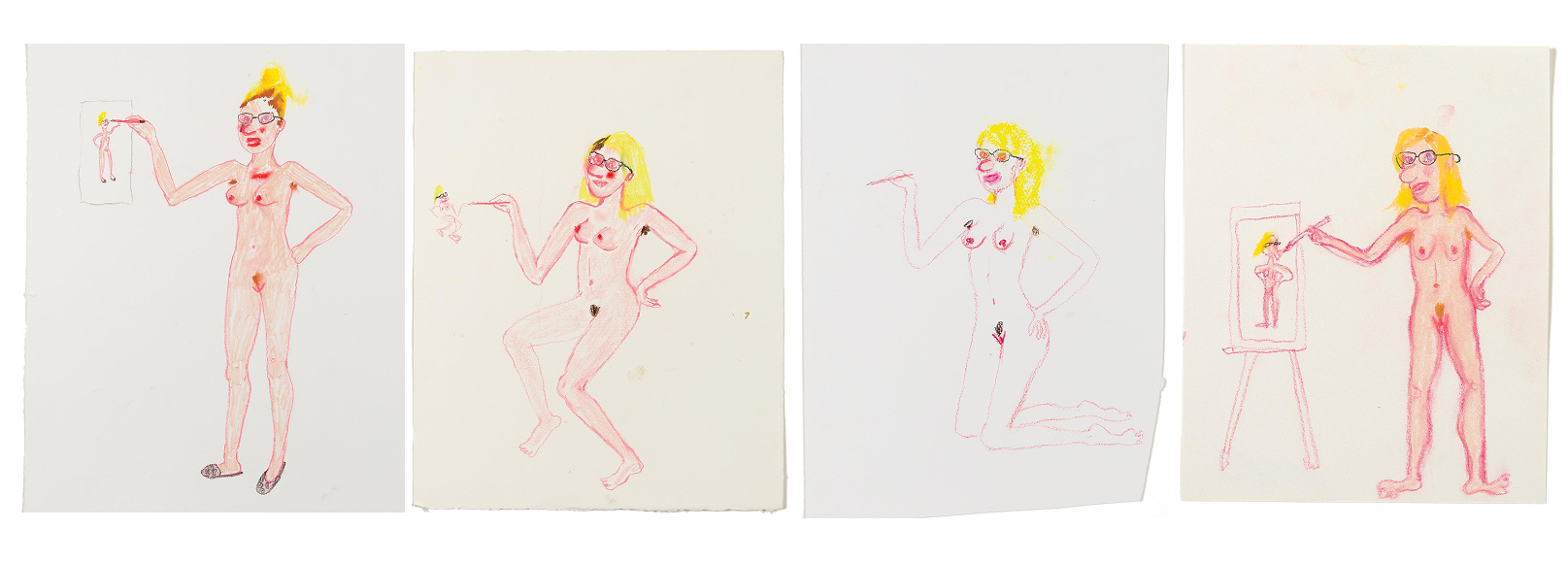
Obviously, the work of the above artists is incredibly diverse. These artists have different backgrounds and practices, and many will not like being grouped together.
But it is undeniable that there is a throughline in materials, color, rawness, and straightforward affective perspective. Elementary School Figurative is not a coherent movement with a single philosophy, but a general aesthetic shift that emerges differently in different artists’ practices.
One of the reasons we’ve gravitated toward the term Elementary School Figurative is because this simultaneous breadth and unity is exactly what you might mind in an elementary school classroom.
Just as every class has a few artistic talents who can draw things that look kind of real, there are the Elementary School Figurative Realists.
Fox111nko
Sayo
Not realists in the conventional sense, these artists do at least devote some attention to figurative and objective accuracy, and often complete their compositions with backgrounds.
Then there are the kids who gravitate towards sketching cartoon characters, or figures of their own imagination; in ESF, these are the Illustrators.
Matthew Bonneau
Motka Ambu
Uou Cute
Their work is more simplistic and raw, sometimes feeling almost incomplete. Their forms are often caricaturistic, or abstracted from the real thing. Closer to a doodle, but of course with much greater sense of line and compositional awareness.
Then you’ve got the edgy misbehaviors and abstract thinkers, who draw chaotic scenes and scribbled compositions. This less figurative bunch are the ESF Expressionists.
Kinki Texas
Juanita Nieto
The artists in this approach abstraction, but don’t quite get there. Their compositions are more like hieroglyphs, arranged with a collage sensibility. Their forms vary widely, but they are united by the shared techniques of juxtaposition and layering.
These categories are a bit simplistic, but do stake out three distinct camps within Elementary School Figurative. They all, however, share an undeniable linkage in terms of materials, colors, subject matter, and stylistic sensibility.
The reference set of Elementary School Figurative includes other contemporary hand-drawn artistic modes (several of which ESF bleeds into), and historical predecessors in the world of fine art.
On the contemporary side, ESR is closely associated with illustration, graffiti, and tattoo artistic modes, both aesthetically and structurally.
Many ESF artists began as (or still are) commercial illustrators. Lucy Levine and Dagou are examples. Even those who are not are deeply informed by the artistic tradition in the world of illustration, including that of manga and other comics, oftentimes more than any fine art practice.
The tattoo connection is also very intense, as many of the artists on the forefront of this style are tattoo artists, and tattoos have been a key medium for its distribution.
A subset of ESF artists have emerged from, are actively involved in, or are inspired by graf scenes as well, including (a favorite of ours) Leif Jones.
But there are also echoes of fine art traditions among ESF practitioners. In particular: classical masters of engraving like Dürer and Rembrandt, certain neo-expressionists like Basquiat and Condo, superflat / superflat adjacent artists like Murakami and Yoshitomo Nara, and contemporary painters like Robert Nava.
There are some miscellaneous references that bear commenting on. Toys like Blythe Dolls are undeniably a reference for some of the figures of ESF, as are certain comic book characters.
And any understanding of ESF would also be incomplete without acknowledging the extent to which DeviantArt has served as both incubator and reference bank for this growing form
Temporalizing this style is difficult, because it is hard to distinguish from the notebook-posting ongoing since Instagram’s debut, the forever-cutesy artists who have been drawing like this for a long time, and the fine art world covid-era increase in color pencil art (which was enough to make it one of the trends to watch in 2021). Not to mention the commercial lane, where there are illustrators who have made their careers on colored pencil work. (Nike employed it recently.)
All of the forgoing is acknowledged, and none of it is exactly what we’re talking about here. We’re focused on a class of mostly small-following digital-native artists and aspirants who have adopted this style (or innovated on it) more recently, and the new aesthetic gravity that their creations have in the algorithm.
In this specific area, there has been a marked increase in ESF, first visible in hindsight in early 2023, but really picking up steam last year. Many of the artists most closely associated with it now made the stylistic transition between ‘23 and ‘25.
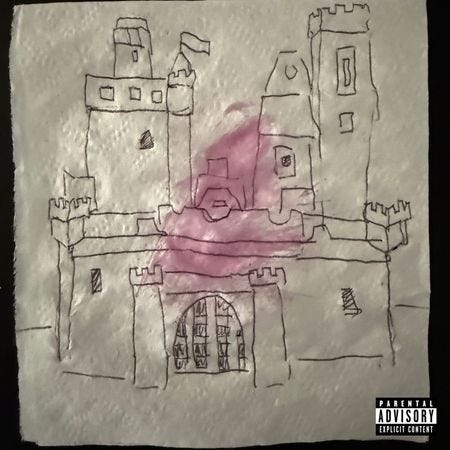
This distinction’s validity is supported by the fact that ESF has recently permeated other pop culture spaces (see Jaeychino’s June album cover, or hunnigarden’s recent prominence in the underground rap space), and the resurgence of a similar sensibility of colorful innocence in other mediums, such as twee in music, and a generally cutesy turn in street style.
The final question to ask about something like this is why it emerges. We posted the question to Aurel Schmidt. Here was her answer:
“I feel like the exciting answer you probably want is it’s symbolic of some kind of societal repression and escape. People are retreating to calming childlike things as a way to escape the complexities of the modern world....
But all the examples are the kind of thing you doodle on your notebook in high school, the drawings you’d make privately, maybe in a journal in your room.
These are not stereotypically masculine techniques and they certainly aren’t art market driven techniques. Could it be possible that the freedom of social media has allowed different people (a.k.a. women working in their bedrooms like myself) to become popular?
Reminds me of what the Internet did for music, some loner making songs in their bedroom can get more popular than some douche bag in a giant studio. I would call this progress, one swirly pink doodle at a time.”
It’s certainly the case that social media is central to the prominence of ESF. The stuff just photographs well; it has a pleasing first impression, its color pops on the feed, and its subject matter doesn’t lose as much as other styles to 2-D interactions.
But social media has been around for too long for it to be the only variable behind the present growth of ESF. The concurrent trends in other mediums (music, fashion, etc) also suggest a deeper drive.
In general, it is clear that the pendulum is swinging away from the cold monochrome of first the opium and then the indie sleaze cultural movements. Not just on an aesthetic level, but that of attitude as well. Culture has started to feel lighter. Many of our leading artists seem to be comfortable with a more childlike approach to their craft. Could it be that a self-serious age of irony driven by pessimism (beginning in or around 2016) is wilting? And that we’re going back to the meadow?
Of course, there is also the AI aspect. ESF is a style that foregrounds the human touch, something there is a particular drive for in today’s climate.
And then you would also be remiss not to mention the generational trend of prolonged adolescence, and a falling birth rate that means people are less likely to be re-exposed to the childish in their own immediate lives.
And an economy that might be making the purchase of expensive oils and canvas less accessible than a 12-set of Crayola and a notebook.
Etc.
What do you think?
I feel like this has been happening for nearly 10
Years now. there are the bladee covers and the yung lean video for boylife in EU, that come from the same world of naivety and childlike wonder. Also tattoo artists like will Sheldon and the omnipresence of swirls in art schools from 2020 on. Online platforms like apoc or apocene have been selling products from that world since 2020.
xx love your magazine
I have been drawing like this for a few years now but i never posted it, buts it mostly vent art and very simplistic.
it could be a counter culture to ai itself where it strives for the soulless singularity of perfection . To be human is to be imperfect, its messy, simple, charming, its textured, an automous self expression and individualism in a sea of ai generated content. I think this movement is essentially a permission to not be good or perfect. a return to the creative expression of childhood or inner child.