


Written by Nicolò Michielin, Ph.D.
The day before the riots, as I had been every day since moving to Pigalle, I was having a coffee at Le Mansart to take a break from work, when Grace called me.
“Tomorrow the city will be completely blocked, there are demonstrations planned pretty much everywhere. Juan will be going around in the campaign bus, following the protesters,” she said.
Juan Branco was an old friend of Grace’s, and in France he was known above all for his opposition to Emmanuel Macron and his support for the gilets jaunes.1 He had also worked as a legal adviser in France for WikiLeaks and Julian Assange, and a few years earlier had written Crépuscule, a book that condemned him to bear the label of a troublesome figure, not only politically but in every aspect of French social life.
Despite his far from humble origins (Juan was the son of an important film producer), Juan had become a hombre del pueblo,2 a sort of religious and holy figure for the lower classes of the French population, who saw him as a kind of saviour who had taken it upon himself to carry their cross. Now he was running for president.
“Tell him I would like to go with him,” I told Grace. “It would be a nice way to spend my birthday.”
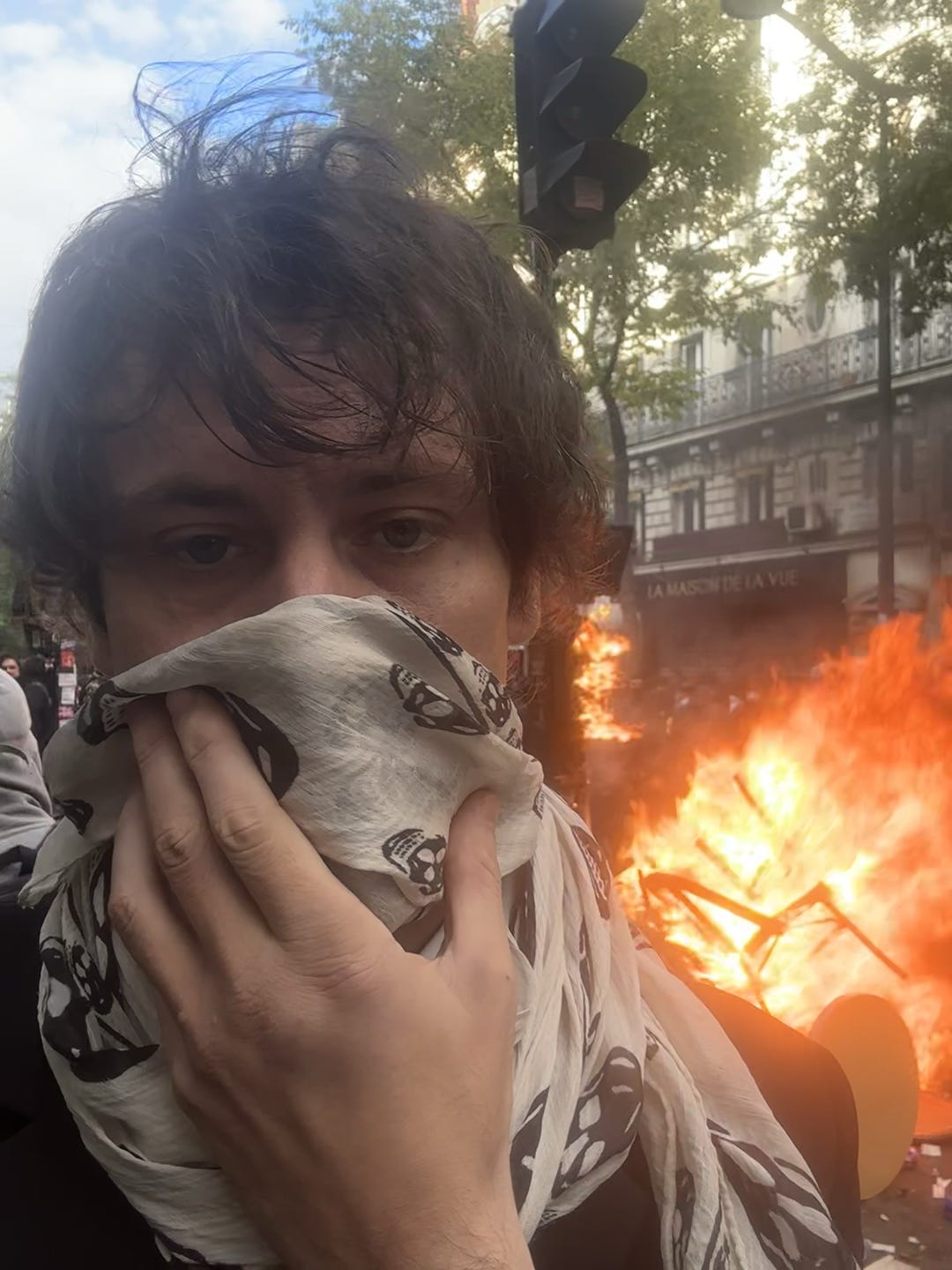
17 October is a date historically associated with protests of various kinds, not just in Paris but in Algeria, Lebanon, and Buenos Aires, where, on that day, Peronism (or Justicialism, if you prefer) was born. For me, 17 October has always simply been my birthday, a day I have never particularly loved, because, quite apart from the fuga temporum, ever since I was a child it has made me deeply uncomfortable to find myself the centre of attention for the simple fact of having been born. Not that I don’t like being the centre of attention. I’m an egocentric person, and I don’t always manage to hide it, but I’m simply embarrassed to be the centre of attention without having done anything of significance to deserve it.
This, however, would be a birthday I would not forget easily.
I was supposed to meet Juan in Place de la République at 2.30 p.m., and I spent the morning working on a paper for the theoretical philosophy journal of the University of Naples Federico II, which had recently accepted my abstract, titled The Delegated Intellect. Computation and Cognitive Proletarianisation. I had a chicken salad sandwich for lunch and left the house just after one.
I walked all the way down Rue de Bellfond to where, past the junction with Rue La Fayette, it became Rue de Chabrol. There were already roadblocks here, with officers in riot gear, but the situation was calm. Rue de Chabrol led straight onto Boulevard de Magenta, and once I got there I found myself facing a river of people marching slowly with chants and banners, entirely peaceful. They were almost all young, like students, and had their faces uncovered.
Of course there were plenty of keffiyehs, just as there were plenty of placards calling for a free Palestine. There were numerous banners saying, in Italian, «Siamo tutti antifascisti»3, and the anti-fascist chants were in Italian too.
Otherwise, most of what you could read were slogans like the now infamous «Bismillah, c’est les ténèbres»4, or «ACAB»; or «Only one solution: revolution»; «Who’s robbing us? The billionaires»; «We are France»; «Fuck You Macron»; «Power to the people»; «Sacrifices must be made. Starting with Bernard Arnault»; «Wake up, Gen Z», and many others concerned exclusively with the future of education. In short, it was mostly a combination of criticism of billionaires, hostility towards the government in office, and a demand for popular power, all accompanied by many flags: French, Palestinian, Algerian and Soviet flags; trade union and party flags, such as those of the PCR, the Revolutionary Communist Party; peace flags and One Piece flags, with the skull in the straw hat.
The stickers being handed out read «Le capitalisme c’est la guerre. Si tu veux la paix, prépare la révolution!»5 and the kids were sticking them on the walls and their windbreakers. There were people climbing everywhere, onto bus stops, traffic lights. The scaffolding on the façades of the buildings overlooking the boulevard had filled with protesters.
The atmosphere was completely relaxed and peaceful, but who was going to listen to these people? Only a State that stood on the side of the people, that served the people, which in the age of neoliberalism is not something you can take for granted.
I walked with the march for about twenty minutes before realising it was heading in the opposite direction to the one I needed to go in. Then I turned around and walked upstream through the river of protesters until I reached its end, where for about two hundred meters the street was completely deserted, a sort of no man’s land leading to the north-western corner of Place de la République.
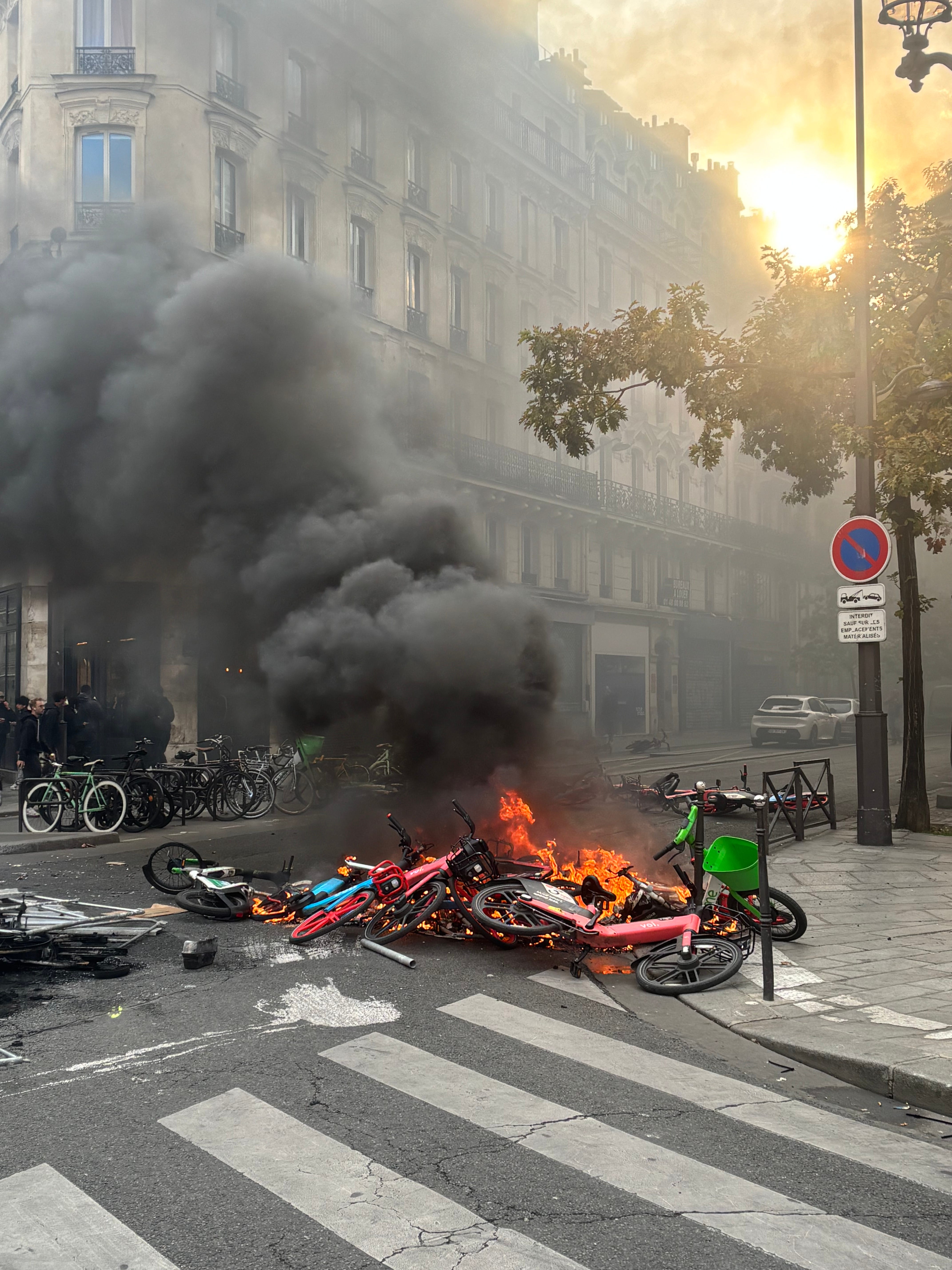
When I arrived, the clashes with the police had already started. It wasn’t just the atmosphere that was different. The protesters were too; they were all dressed in black with their faces covered, and most wore sneakers like Nikes, tracksuit bottoms and a hoodie. Many covered their faces with ski goggles, anti-pollution masks, scarves or bandanas to protect themselves from the tear gas and the smoke rising from the heaps of Lime bikes burning alongside café chairs in the middle of the street. I covered my face with the Alexander McQueen scarf I had nicked off my friend.
I had expected to find Juan Branco and his team handing out T-shirts from a gazebo, and instead I found myself in the middle of a civil war. Part of the square was ghostly, like a liminal space between two trenches, covered in a blanket of smoke ranging from the white of the tear gas to the black of burning lithium batteries and plastic, all of it mixing with the smoke coming from a car on fire in the middle of the square.
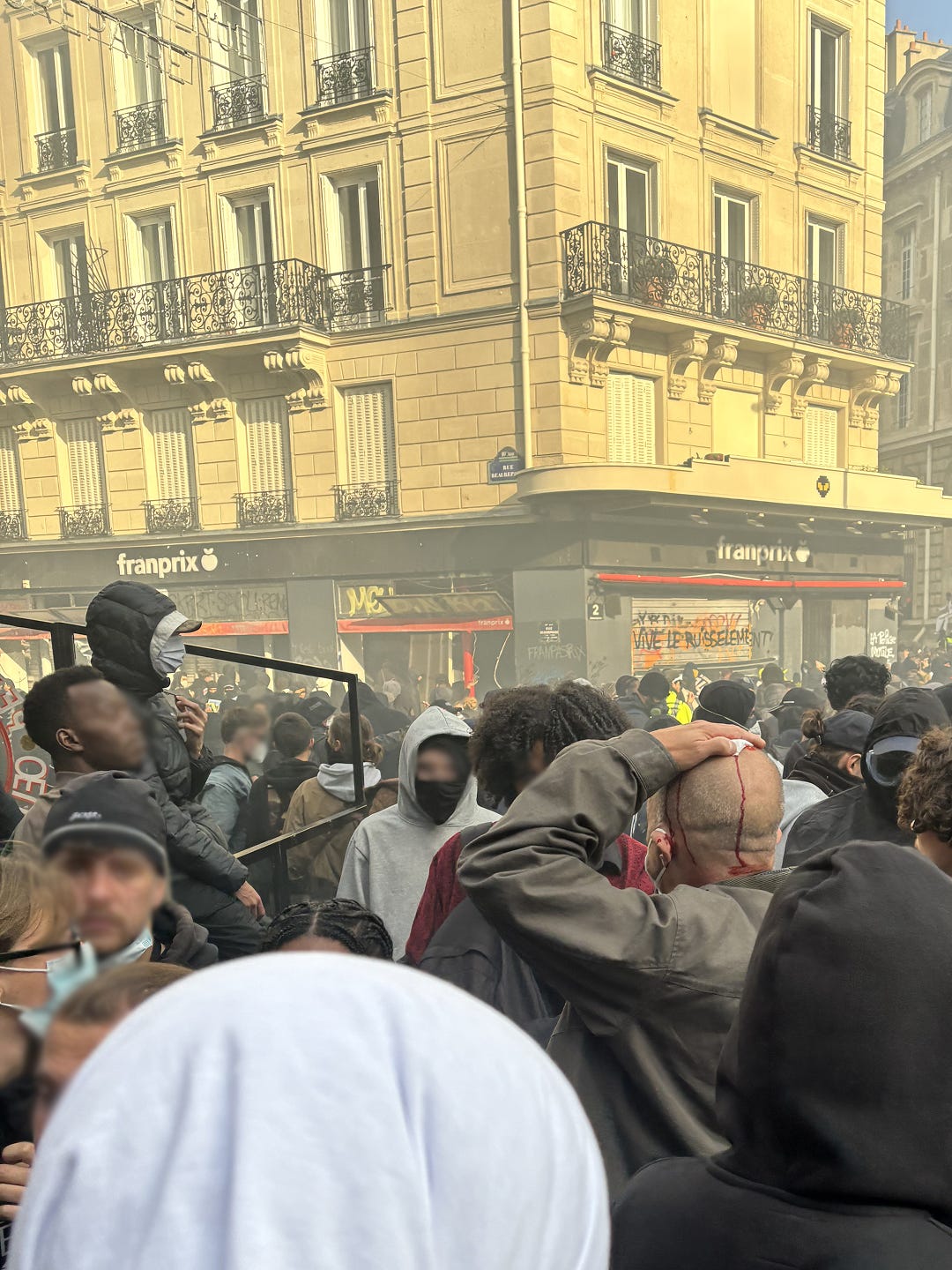
Paramedics were carrying the injured on field stretchers towards Rue du Temple and the south-western corner of the square. More than one person was dripping blood from the baton blows they had received during the police charges, which came at regular intervals. Other unofficial paramedics, with red crosses drawn on sheets of paper and taped to skateboard helmets, were treating injured protesters on the spot, disinfecting wounds beside the fires. Some of them were distributing saline eye drops. There were heads, legs, and hands wrapped in conspicuous white bandages soaked red with blood. About every twenty seconds a stun grenade went off. The protesters, for their part, threw stones torn from the paving. Someone had brought a suitcase full of stones from which the rioters were replenishing their supplies beside the barricades. Fireworks, generally used in the city to announce the arrival of drug shipments in the neighbourhoods, became improvised weapons in the protesters’ hands.
To my eyes, the effect was tragically beautiful, surreal. In front of me a boy wearing a large rabbit mask was holding a traffic light torn from the street, which was then thrown at the police as well. I knew that violence carried an inherent suffering within it, but I felt the force it unleashed as something positive, something I was drawn towards like a moth to the light of a fire. Tucked away in a doorway, a few people were racking up lines from their phones. I don’t know if it was cocaine, 3, or ketamine.
It was around 4.10 p.m. when the looting began where I was. I remember the time because I tried to call Juan for the umpteenth time, but the phones weren’t working anywhere in the area.
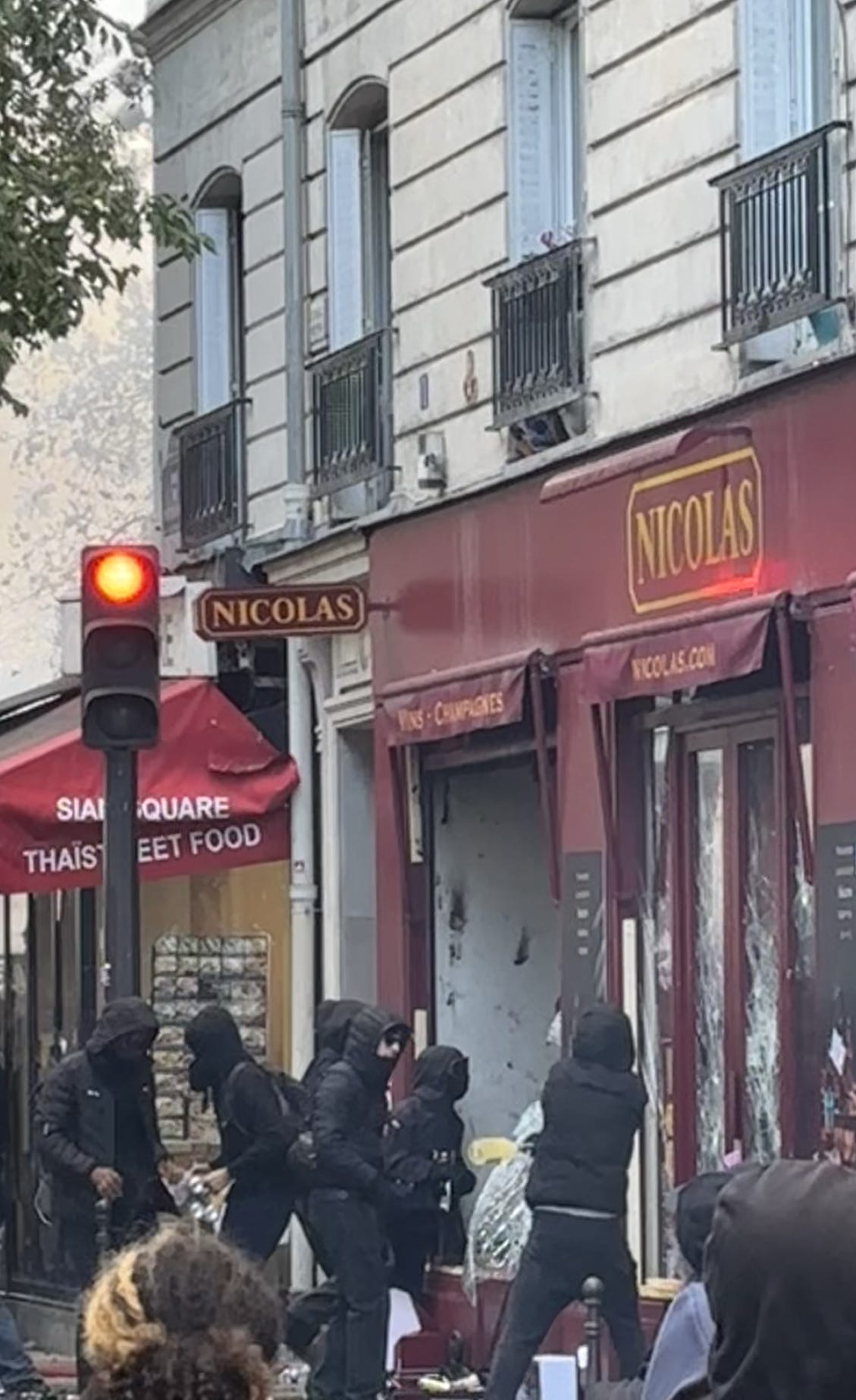
The first shop to be attacked was Nicolas, a chain selling alcohol a few dozen metres from where the clashes were raging. They smashed the shop windows with a hammer. Some were stealing bottles for themselves, others were smashing them on the ground. Others still were throwing bottles at the windows of the first-floor flats in the building. A red trickle of wine ran down Rue du Château d’Eau under the feet of friends carrying the injured to safety on their shoulders.
At first I thought it was an isolated incident, and to tell you the truth, since it was a large chain, I thought that, on a balance of interests, it would be more useful to the cause as a symbol, amplifying the protests through the media, than it would be harmful to any actual person. I thought the same when a guy destroyed a cash machine on the northern side of the square by hitting it repeatedly with the trucks of his skateboard. Meanwhile the grenade explosions and the charges continued, and the protesters moved like a swarm; when one started to run, many followed, shouting. Everyone was in the grip of something like an ancestral frenzy.
Perhaps it was precisely this uncontrollable feeling that caused the individual to sublimate into the crowd, that crowd Elias Canetti, winner of the Nobel Prize in Literature in 1981, writes about in Crowds and Power. I thought of that good man, who had been my professor of Political Language Analysis at university, lecturing on the topic as the crowd began destroying bars, restaurants, tobacconists, and shops around us, looting them and setting fire to what remained, businesses belonging to ordinary people who could have been my parents, or the parents of the very kids who were protesting. These were not symbols of luxury, they were not Chanel or Dior, whose looting verged on a romantic symbolism. Here were people’s lives, years of their sacrifice, being dismantled. Was it right? No. But there was certainly a reason for it, which made it understandable, and a starting point for thinking about how to heal our society, something that, given its sociological implications, could not simply have been dismissed as a criminal act.
Understanding a looting requires reconstructing what brought a person to the shop window, and then to the other side of it. Justifying a looting requires explaining why the need of that person should prevail over the harm suffered by the person being looted.
These are two different questions, and anger, however well-founded, does not automatically answer them both. We are certainly not dealing with Saint Thomas Aquinas’s justification of theft, which only considers theft of necessity. The shopkeeper who finds his life’s work destroyed does not become any less innocent because he lives within an unjust system, but equally his innocence does not make that system just. Both things can be acknowledged, you can demand accountability for the harm and continue to question the conditions that helped produce it.
In my view, the State should take responsibility for its own children, fully compensating those members of society who have suffered damage from the riots. But the question remains: why had these kids come to do this?
In his speech The Other America, delivered at Stanford on 14 April 1967, Martin Luther King described a riot as the language of the unheard. This is absolutely true, but I don’t think very revealing in this case.
There is no doubt that the fundamental element of the protests is the hardship which is the outcome of inequalities caused by neoliberalism, and insufficiently curbed by the State. Economic equality is a factor that does not serve capitalism itself, whose prius logicum is inequality itself.
The days before 17 October proved how easily a government can ignore a march. Under these conditions, the conviction can develop that power only responds to what disrupts its functioning, such as a violent protest. Violence may then appear to some protesters as one of the few remaining ways of making indifference impossible. In Reflections on Violence, Hannah Arendt quoted a sentence by Conor Cruise O’Brien: “Violence is sometimes needed for the voice of moderation to be heard.”
But I believe there are other reasons informing the extent of the protests, although they do still arise from the fundamental element of inequality.
I believe a person seeks in confrontation the feeling that they matter, especially when in everyday life they are treated as irrelevant. Moreover, collective participation can become a desirable experience in itself, capable of changing what a person feels able to do. Normally we preserve our distance from strangers; in the crowd, however, that contact can become reassuring. The closeness of others gives you the feeling of belonging to a larger body, with a will of its own, distinct from those of the individuals within it. I myself couldn’t get out of that intersection of streets in revolt, because I didn’t want to, even though at times I was genuinely afraid. This wasn’t only because I wanted to see with my own eyes something that would go down in history; it was something deeper, something connected to my humanity. Everyone had shed social distances and become equal. The political objective was still there, of course, but the experience of acting together was beginning to matter just as much.
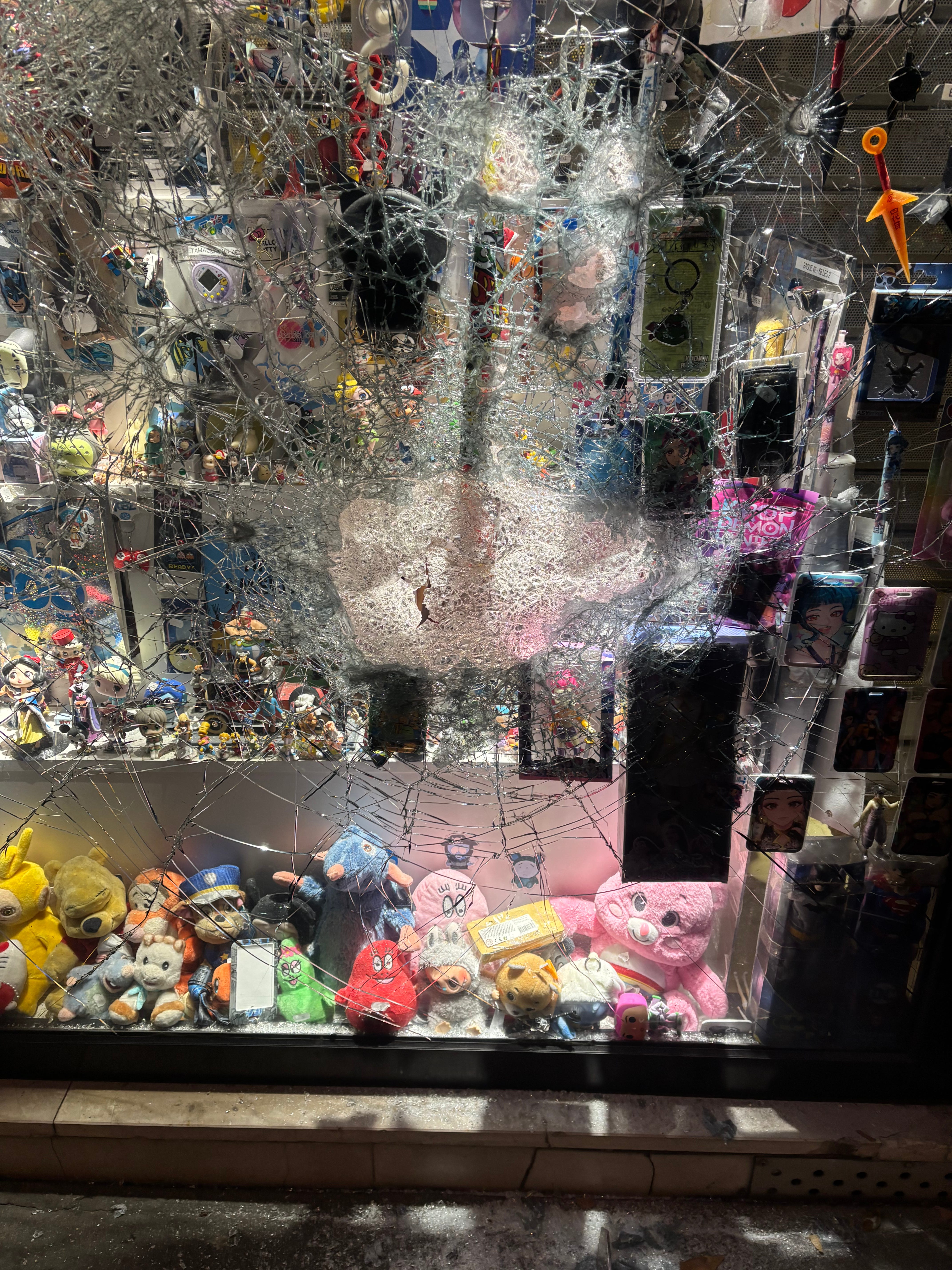
A broken shop window does not necessarily change the power relationship being protested against, but it can make the person breaking it feel they have escaped their own powerlessness, if only for a few seconds. Understanding this gratification helps explain why the gesture can be repeated even when it harms the stated cause.
“To the naked crowd everything seems a Bastille,” as Canetti himself said, and something that would have caused fear or shame if done alone can be experienced as proof of belonging. Destruction and looting can take place in the same street, even be carried out by the same person, without expressing any coherent intention, this is where the difference lies between feeling liberated and changing the conditions that make that liberation necessary. A person can experience destruction as genuine emancipation on an emotional level while the social relationship against which it is directed remains almost intact.
For others still, the act of destruction or looting can serve as a presentation of themselves to others, in which their identity is sustained through behaviours that a particular environment recognises as meaningful. Specifically, if exposing yourself in a confrontation confers prestige within a group, doing so can become a way of winning admiration.
Another element to consider is that being part of a crowd can make your own contribution to what happens seem less identifiable, and a person may feel less directly responsible for the harm. But that is without considering that, at least under Italian law (I don’t know how it works in the French legal system), they were committing offences carrying sentences of 8 to 15 years’ imprisonment for devastation and looting; and up to 20 years for aggravated robbery when committed by several people acting together. Not to mention the possibility of being charged with association for terrorist or subversive purposes, should the investigations reveal an organisation behind what had happened.
The political cause, in other words, can give a collective form to very personal desires, some conscious, others difficult to acknowledge even to yourself. You can appear to shatter the social order while continuing to desire exactly what that order teaches us to desire.
There is also the question of what difference any of this would make. Perhaps all this violence would end up shifting the debate towards public order and politically benefiting those who promised repression, such as Marine Le Pen’s right, in the most classical expression of Wilhelm Wundt’s heterogony of ends. This is what had happened in ’68, when mobilisation and strikes were initially followed by wage gains, but in the June elections the Gaullist UDR won 293 seats out of 487.
On the other hand, and I would perceive this clearly, like an epiphany, the following day as I sat once again at the counter of Le Mansart, looking out through the window on which the name of a seven-euro cocktail was written (“Frozen Pornstar”), the riots had given people back a sense of their own ability to act, of the fact that the people still had power, that every slogan about revolutions they had heard from their fathers and on television wasn’t bullshit, that change was possible and everything was possible, you just had to want it. This feeling gave me a sense of joy that I have rarely experienced in those terms. I don’t even know if joy was the right word to describe it. It was a sense of openness, of newness, of possibility, of something universal, enveloping me as two tousle-haired Parisian women at the next table unwrapped sugar cubes to put in their coffee.
I was at that intersection of streets and lives for another few hours before moving on to the Marais. The only people who seemed unmoved by the events were the homeless, who, like saints or ascetics, carried on drinking their cans of beer and cartons of wine, crouched on the ground, and watched the scene impassively. Victim of the world, Saint of the streets, what prayers do you offer your God in those heroin dreams of yours? For what sins do you ask indulgence? What is it you want to forget? How much crack will burn between your lips in the French autumn? In this country where Red Brigadists and Spanish poets have found refuge, where Carla Bruni sings sweetly, and where, my love, Arthur Rimbaud’s star shines brightly in the sky; it shines, synthetic, in the tragedies of punks, it glitters in palaces and on the outskirts, in the eyes of the downtrodden and in the paranoia of morning, it glitters in Stalincrack and Pigalle, in nightclubs and courtrooms. And it shines holier than ever this October Saturday, in the fires and the bombs. Forgive the children of man, embrace the mercy of our Lord in the world of the Internet, of floods and trials, of markets and rockstars, sweat and tears, wait for us at the end of history with the wisdom of those who have suffered. Who knows how you ended up like this. Who knows if, as a child, you dreamt of playing football or if you grew up quickly, without the time to think about the world and its misfortunes, without the swagger of revolutionary poets spitting words from the drawing rooms of Europe; because anyone can play the thinker with a full stomach, have ideals without getting their hands dirty. But we are nothing, just smoke in the eyes, Pernod and petitions, whores and haute couture, poor bastards at café tables. Look around you, Christ among men, Paris is burning for you too.
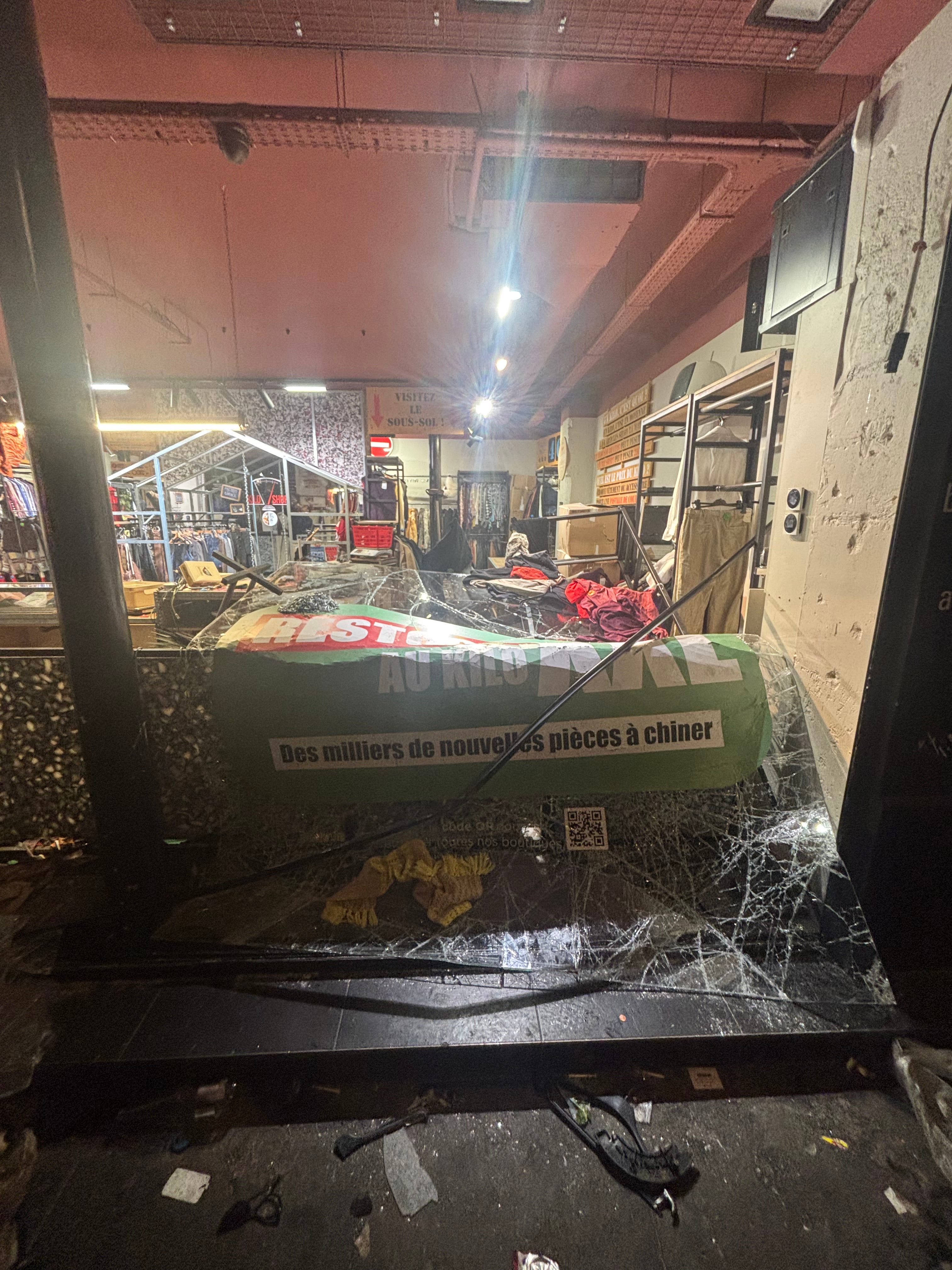
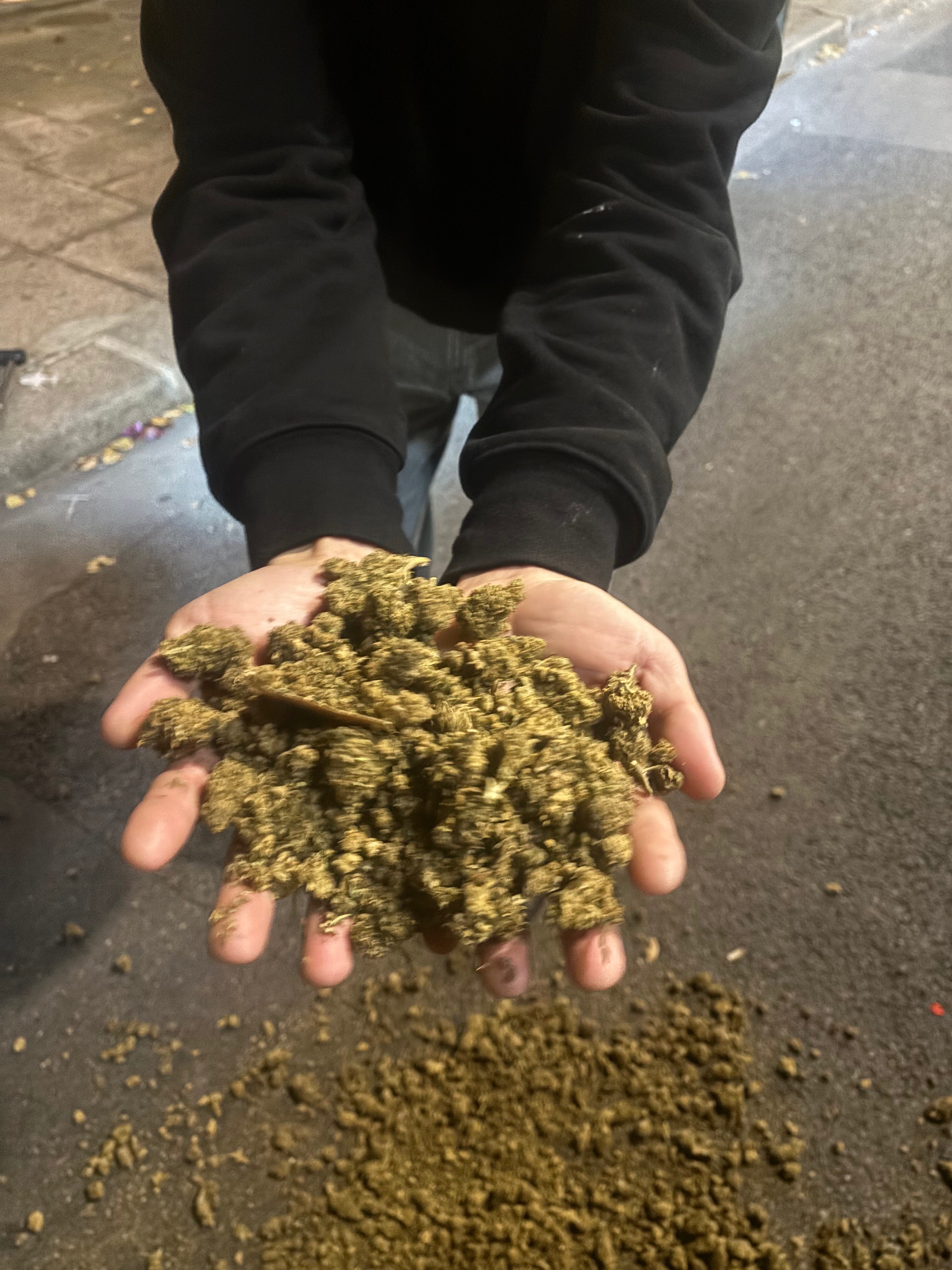
Along the way I saw more shops being looted and more burning barricades. Police trucks were dousing the protesters with freezing water from their hoses and the sirens of ambulances and fire trucks provided the backdrop to more explosions. In a little side street I came across a bag full of weed whose smell made the air less acrid for a few moments. Some rioters sped past me without helmets, riding two scooters they had just stolen and whose number plates they had promptly ripped off.
I took nothing from the shops. I have always stolen only when I was certain nobody would suffer for it, but at that moment I had a bandaged hand to remind me that God’s eyes were on me and that I had to atone for my sins.
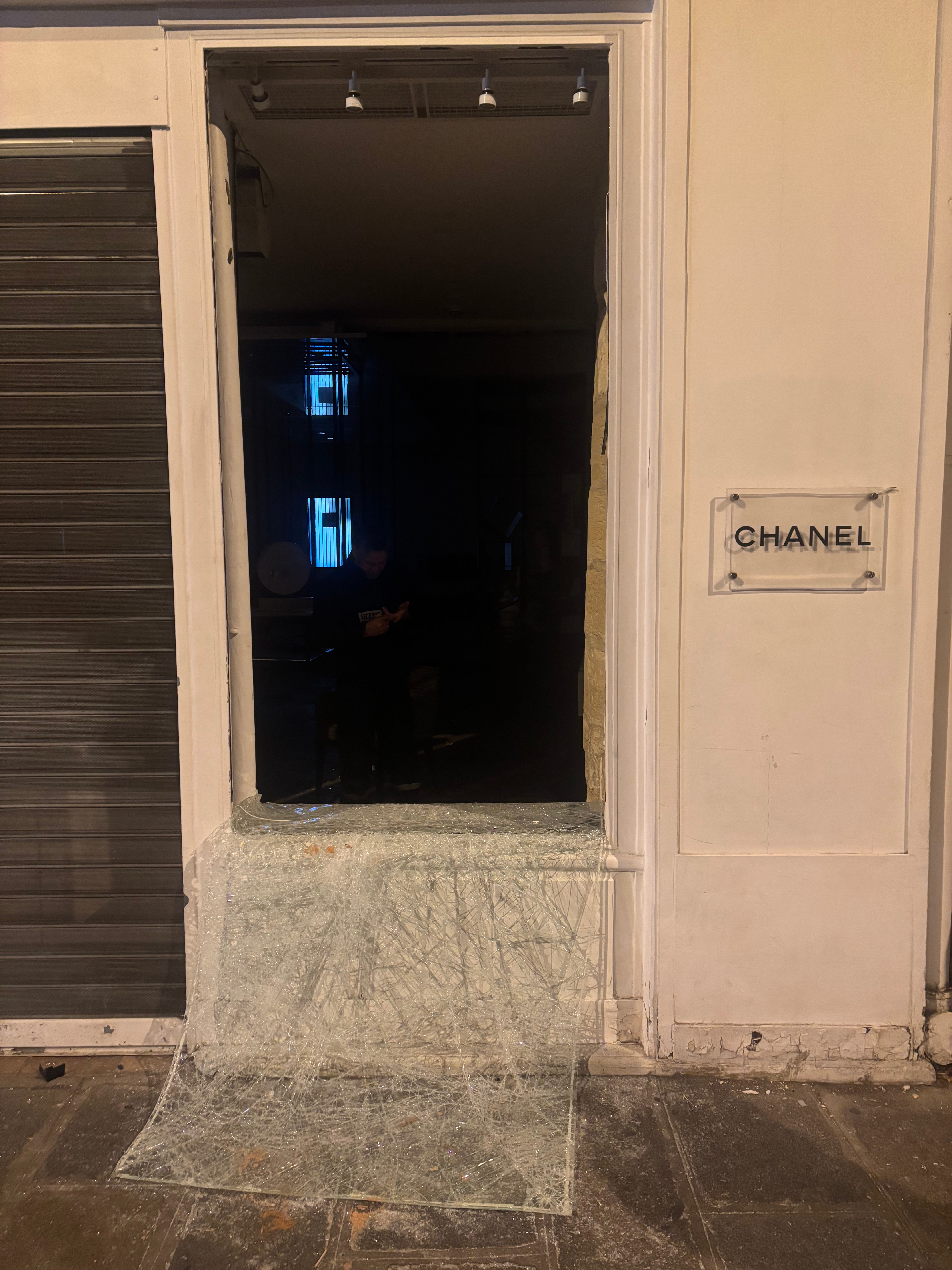
On Rue Saint-Honoré, all the luxury boutiques had been looted and the last scavengers were going in to see if they could scrape together anything; Burberry, Dior, Armani, Maison Goyard, Chanel, Louis Vuitton, Versace, they had all been destroyed, and on the few shop windows that had remained intact you could read things like «Eat the rich», «Acab» or «Revolution». The Kooples store had also been burned down, along with the posters from the campaign that my friend Harley and I had done together. It all made sense.
By then it was the middle of the night and I was exhausted, my eyes were burning and my throat hurt from the tear gas. I walked home. I turned onto Avenue de l’Opéra while people were still looting a cosmetics shop, and with my earphones in I began replying to the birthday messages that had arrived during the day. Further up I saw a boy standing motionless outside a Chinese restaurant that had been set on fire, with tears in his eyes, so I stopped to ask if everything was okay. “It was my parents’ restaurant,” he said, staring at the blackened façade and the burnt curtains. It looked as though a bomb had gone off in there. It made me cry. What fault did these people have? They had become, as often happens, victims of other victims.
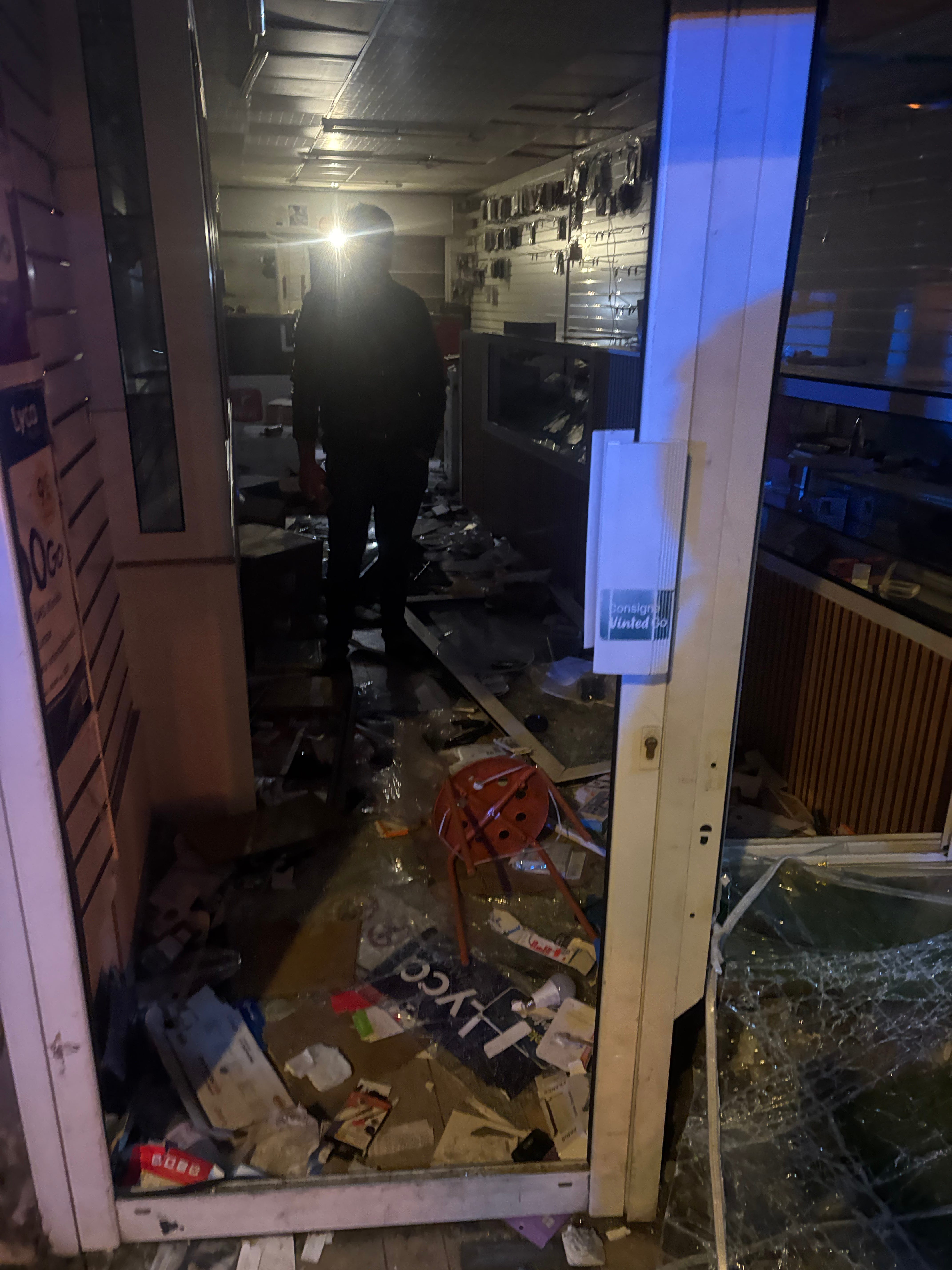
I had cried three other times that day, because of the police tear gas, because of the messages and calls from my friends that had warmed my heart, and because Venezia FC had won their first league match, the first three points of the season against Napoli, but this was obviously a completely different story, my God.
I no longer understood what I felt about what had happened that day, but one thing was certain, something important had happened and, whatever anyone’s judgement, those who govern us had to acknowledge it. I didn’t think it was the time to judge, it was the time to understand that the status quo was not good enough, that those on the outskirts of cities and of life must have the right to dream, that if neoliberalism does not rest on a socialist institutional foundation, it is unsustainable for human beings. At that moment it had become easy for everyone to point fingers and pass judgement, on both sides. The truth is that we are all lost in this vast cruel world, and that a little humanity and love for our neighbour would be enough to save us all, but this too is much easier said than put into practice, because it is easy to fill your mouth with beautiful words when you are not in the situations you are judging, and I had experienced this first-hand. But what future can a society ask of those who can’t even live in the present?
Suddenly I realised that the weather too had changed along with the sky over Europe, it was properly cold. So I started walking again and looked on my phone at the photo Lucio and Brando had sent me from the stadium, and I thought of them. God, how much I loved them. I thought of my impossible love and her sweet smile. Where were you, my love? Who were you giving your dark eyes to in a bathroom in Milan? Who knows if we’ll see each other another time, if you’ll read me your poems from your iPhone again, who knows if we’ll hold hands like that summer. Who knows if we’ll still tell each other we’re in love in deserted squares when winter comes. And immediately afterwards I thought of Harley, of when we walked through Paris together on April evenings. I thought about the Thai restaurant in Pigalle where we were talking about our wedding, I thought of all our love, and I thought of how easy it is to fall in love again, but how difficult it is for that to happen with someone you feel at peace with, truly happy. I thought of my parents in Venice, of Lorenzo in Los Angeles with Brad, at the Chateau Marmont and on the beach in Santa Monica. I thought of Grace asleep with her beautiful baby on the other side of the Seine, I thought of Francis, wrapped tightly in his leather jacket on a coach bound for Berlin. I thought of the girl I liked and wanted to send a message to, I thought of a song by Sky Ferreira, of Franco and Maria Elena at The Strokes concert in Bologna. I thought of Pete and his love songs, I thought of the night and its lies; I thought of the revolutions of Our Lord Jesus Christ, I thought of the police, of the good men from the proletariat behind their uniforms, pelted with stones in the name of a state they had not chosen, and I thought of the words of Pier Paolo Pasolini. I thought about my grandparents’ one-room apartment in the public housing of Marghera, and of the gentle Moroccan family that lives there now. I thought of Angel, the purest of us all, who in mephedrone dreams listened to songs by Suicide while sleeping on the floor, talking to God about cruelty and romanticism. I thought of the Versace coats now keeping the banlieues warm and I thought that, in the end, all it takes is just a little love to feel happy, and I went home looking at the sky on 17 October 2026.
-
Yellow vests
Man of the people
We are all antifascists
In the name of God, it's the darkness
Capitalism is war. If you want peace, prepare the revolution!